Vertex Learning Solutions


In March 2026, the UK accountancy sector reached record monthly revenues of £4.3 billion, yet many practitioners still worry that AI agents might render their technical expertise obsolete. You're likely feeling the weight of the April 2026 Making Tax Digital for ITSA rollout and the complexity of new UK GAAP standards that align more closely with IFRS. It's natural to wonder if the future of accounting profession UK still has room for the human element when algorithms can process data with such clinical speed.
We recognize that the pressure to transition from technical reporting to strategic advisory is immense, especially when regulatory changes like the new IFRS 18 comparatives demand your immediate attention. This article provides a clear strategic outlook for 2026, offering you a roadmap to future-proof your career through advanced qualifications like ACCA or CIMA. You'll discover how to leverage technology to enhance your professional judgment, ensuring you remain a secure and trusted partner in an increasingly automated world.
Key Takeaways
- Understand how AI agents are evolving into virtual employees that manage routine bookkeeping and HMRC compliance, shifting your focus toward high-level oversight.
- Master the transition from technical reporting to strategic advisory by developing core competencies in data storytelling and ESG reporting.
- Identify how the future of accounting profession UK is being reshaped by blockchain technology and real-time audit verification through triple-entry accounting.
- Discover why professional qualifications like ACCA and CIMA remain the gold standard for trust and regulatory security in a digital-first market.
- Obtain a structured roadmap for acquiring the digital and leadership skills necessary to thrive as a strategic navigator by 2026.
Table of Contents
- The Evolution of the UK Accounting Landscape in 2026
- The Rise of the Strategic Navigator: Core Skills for 2026
- Navigating the Digital Shift: AI, Blockchain, and Cyber-Resilience
- Future-Proofing Your Career: The Value of Professional Qualifications
The Evolution of the UK Accounting Landscape in 2026
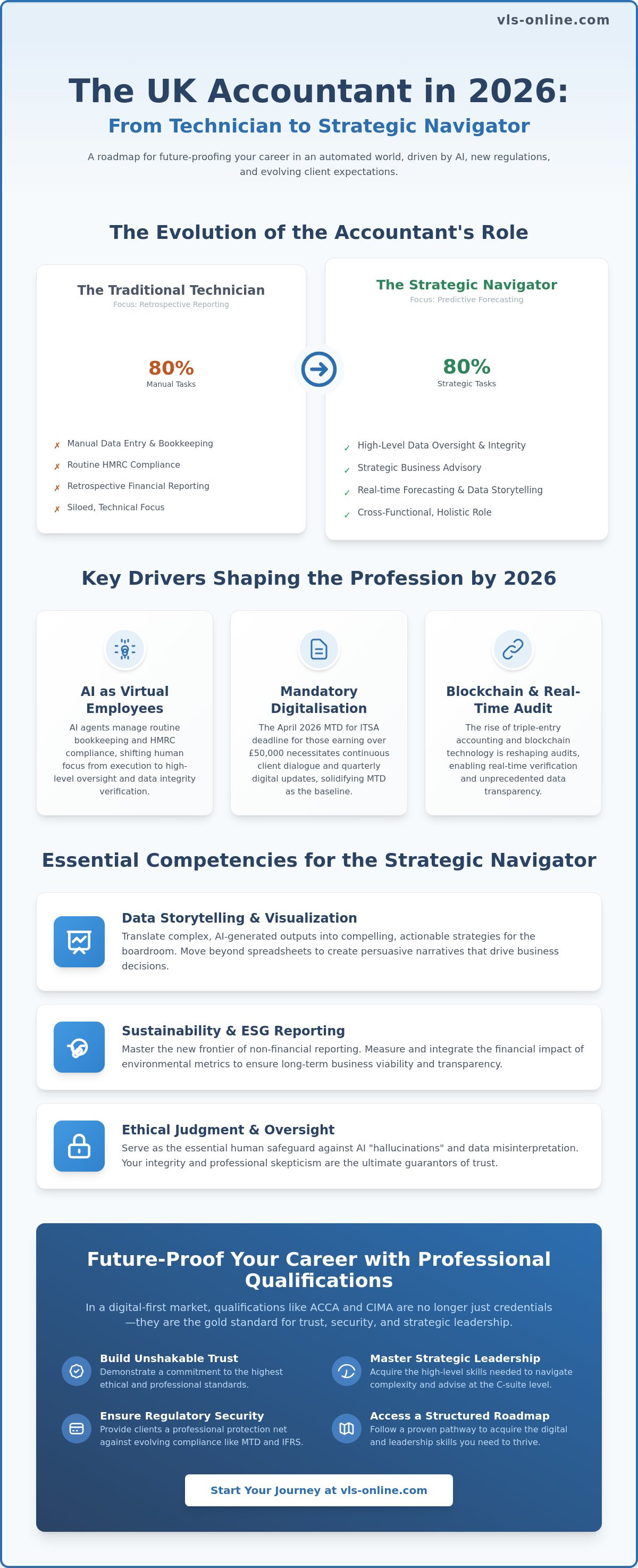
By May 2026, the UK accounting sector has moved beyond the era of digital transformation into a period of automated execution. AI agents now function as virtual employees, managing the heavy lifting of routine bookkeeping and HMRC compliance with clinical precision. This shift means the future of accounting profession UK centers less on manual data entry and more on high-level data integrity. Making Tax Digital (MTD) is no longer viewed as an innovative hurdle; it's the foundational baseline for every modern practitioner.
The profession has pivoted from retrospective reporting to real-time strategic forecasting. Instead of analyzing what happened last quarter, accountants use live data streams to predict what will happen in the next. The UK remains a global hub for this transition, blending technological adoption with a steadfast commitment to ethical leadership. It's a landscape where technical accuracy is assumed, leaving the professional's true value to be found in their judgment and foresight.
From Compliance to 'GP for Organisations'
Accountants have emerged as the "General Practitioners" of the business world. They don't just treat the symptoms found in an annual balance sheet; they diagnose the holistic health of an organization. The decline of the siloed accountant is complete. Today's successful professionals are cross-functional strategic partners who understand how financial health intersects with operational efficiency. This transition relies on the rigorous standards set by professional qualifications for UK accountants, ensuring that as roles evolve, the core of ethical oversight remains unshakable.
UK Regulatory Drivers: MTD and Beyond
The April 6, 2026 deadline for MTD for ITSA has fundamentally reshaped small business advisory. With self-employed individuals and landlords earning over £50,000 now mandated to provide quarterly updates, the relationship between accountant and client has become a continuous dialogue. Beyond domestic compliance, practitioners are essential in navigating post-Brexit complexities. They provide the professional protection net businesses need to manage international trade and customs regulations, turning regulatory pressure into a strategic advantage for their clients.
The Rise of the Strategic Navigator: Core Skills for 2026
The future of accounting profession UK relies on a shift from technical proficiency to strategic influence. While algorithms handle calculation, the human professional provides the ethical judgment and interpretive depth that machines lack. This evolution defines the "Strategic Navigator," a role where integrity acts as the ultimate safeguard against AI hallucinations and data misinterpretation. In a digital-first environment, building trust requires more than just accuracy; it demands strategic communication that bridges the gap between complex data and business objectives.
Data Storytelling and Visualization
In 2026, moving beyond spreadsheets is a professional necessity. Strategic Data Navigation is the intersection of finance and business intelligence, where the accountant translates AI-generated outputs into actionable boardroom strategies. By predicting market trends and identifying operational risks before they manifest, you provide a level of security that automated systems cannot replicate. Understanding how the ACCA Strategic Professional level prepares you for this shift is vital for those seeking to lead at the highest corporate tiers. Despite the technological shift, the future of the accountancy profession remains robust for those who can turn raw data into persuasive narratives.
Sustainability and ESG Reporting
ESG and carbon accounting represent the new frontier of non-financial reporting in the UK. With the government’s commitment to climate-related financial disclosures, practitioners must now measure and explain the financial impact of environmental metrics. Integrating sustainability into traditional statements requires a systems-thinking approach. You aren't just checking boxes; you're ensuring long-term viability in a market that demands transparency. Strategic communication becomes your primary tool for building trust in this digital-first environment. To begin mastering these complex frameworks, exploring a Strategic Business Reporting course can provide the structured guidance needed to navigate these new requirements with confidence.
Navigating the Digital Shift: AI, Blockchain, and Cyber-Resilience
The future of accounting profession UK is defined by a strategic partnership between human intuition and machine efficiency. By 2026, the role of the practitioner has evolved into that of a "Cyber-Sentinel." You're no longer just managing ledgers; you're protecting the absolute integrity of financial data against sophisticated digital threats and algorithmic bias. This digital fluency requires a shift in mindset where technology serves as a high-performance co-pilot for complex decision-making and risk assessment.
Working with AI, Not Against It
AI has moved from a novelty to a daily utility in UK practices. Large Language Models (LLMs) now streamline complex tax research and simulate audit scenarios, allowing for a level of depth previously impossible within standard timeframes. Practical applications include VAT automation, where AI agents flag anomalies in real-time, and advanced fraud detection that identifies patterns of irregularities before they escalate. Mastering these tools requires "Prompt Engineering," a skill that demands the same logical precision found in traditional accounting. To build the structured logic necessary for these advanced systems, we recommend refining your foundational skills through our Advanced Excel for Accountants course.
Blockchain and Distributed Ledgers
Blockchain is revolutionizing the UK's intricate supply chain accounting by providing an immutable, single source of truth. This technology facilitates a move toward triple-entry accounting, where transactions are verified in real-time on a distributed ledger rather than through periodic reconciliation. We are witnessing a fundamental shift from annual audits to continuous assurance, a move supported by several key trends shaping the future of accounting. While blockchain simplifies verification for international trade, technical mastery of Excel remains the bedrock of digital fluency. It's the environment where logic is validated; you must maintain this skill to audit the algorithms themselves. To ensure your technical skills meet these 2026 standards, consider enrolling in our comprehensive course package for total professional readiness.
Future-Proofing Your Career: The Value of Professional Qualifications
Professional bodies like ACCA and CIMA have methodically updated their syllabi to reflect the realities of a digitized market. By 2026, the future of accounting profession UK is anchored in the "Qualified" status, which serves as a vital protective net for clients and employers alike. While AI can process data, it lacks the ethical accountability and regulatory standing that a chartered professional provides. This creates a significant premium on those who possess the formal authority to sign off on complex financial narratives in a fragmented market.
Trust remains the core currency of our profession. As automated systems become more prevalent, the human professional's role in verifying the integrity of those systems becomes paramount. Continuous Professional Development (CPD) is now a non-negotiable commitment for the 2026 accountant. It's the mechanism that ensures your expertise doesn't just keep pace with change but anticipates it, providing the security and professional protection your clients expect.
ACCA and CIMA: The Strategic Advantage
The foundational logic developed through ACCA Applied Skills provides a cognitive framework that algorithms cannot replicate. These modules teach you to understand the "why" behind the numbers, ensuring you can detect anomalies that AI might overlook. Moving toward the Strategic Business Leader (SBL) module is essential for developing the "Navigator" mindset required in modern boardrooms. It moves beyond technical calculation into the realm of professional skepticism and strategic leadership. For those ready to commit to this path, our structured ACCA Courses offer a secure route to achieving this elite status.
Specialization and Niche Expertise
As the UK economy remains deeply globalized, the demand for specialists who can navigate complex international standards has reached new heights. IFRS expertise is no longer a niche requirement but a core necessity for firms operating across borders. Obtaining a Diploma in IFRS (DipIFR) allows you to bridge the gap between domestic practice and global mobility. This specialization positions you as a high-value asset, capable of interpreting the nuances of international financial reporting that automated tools often miss. By choosing a specialized path, you ensure your career remains resilient against technological displacement while expanding your reach into the global market.
Mastering the Strategic Transition to 2026
The future of accounting profession UK belongs to those who view technological disruption as a strategic opportunity rather than a threat. We've explored how the transition toward advisory roles and digital oversight requires a shift in mindset from technical execution to professional judgment. By mastering data storytelling and navigating the complexities of ESG reporting, you secure your position as an indispensable partner in the UK's evolving regulatory landscape.
Success in 2026 demands a structured approach to learning that balances rigorous technical standards with practical digital fluency. You don't have to navigate this transition alone. Our platform provides a professional protective net through expert tutor support via WhatsApp and exam-focused recorded lectures designed for real-world application. Whether you're attending our live sessions or reviewing complex modules at your own pace, you're building the resilience required for long-term career success.
Take the next step in your professional journey and secure your future in accounting with VLS's professional ACCA and CIMA courses today. Your expertise is the ultimate safeguard in an automated world.
Frequently Asked Questions
Will AI replace accountants in the UK by 2026?
AI won't replace accountants by 2026 but it'll fundamentally redefine their daily operations. Algorithms excel at processing high volumes of data and identifying patterns with clinical speed. However, they lack the professional skepticism and ethical judgment required for complex decision-making. The human professional remains essential for providing the strategic foresight that algorithms cannot replicate, ensuring that financial narratives remain grounded in reality and regulatory integrity.
What are the most important skills for an accountant in 2026?
The most critical skills for 2026 involve a blend of technological proficiency and strategic influence. You'll need to master data storytelling to translate automated outputs into actionable boardroom insights. Additionally, expertise in ESG reporting and sustainability metrics is becoming a core requirement as UK regulations tighten. Professionals must evolve into strategic navigators who understand how digital tools like blockchain impact the broader business health.
Is the ACCA qualification still relevant in the age of AI?
The ACCA qualification is more relevant than ever because it provides the rigorous ethical framework and foundational logic that AI lacks. Syllabi for the future of accounting profession UK have been updated to include digital leadership and strategic business reporting. These modules ensure that qualified professionals possess the professional skepticism needed to audit the algorithms themselves, maintaining a high standard of trust in a fragmented market.
How is the UK's 'Making Tax Digital' changing the profession?
Making Tax Digital (MTD) has transformed compliance from an annual event into a continuous, real-time dialogue between accountants and their clients. With the April 2026 rollout for ITSA, practitioners are moving away from retrospective reporting. This shift forces a closer relationship with small businesses and landlords, where the accountant acts as a proactive advisor who monitors financial health throughout the year rather than just at year-end.
Should I specialize in a specific area of accounting for the future?
Specialization is highly recommended as it adds a distinct premium to your professional status in a competitive environment. Niche expertise in areas like International Financial Reporting Standards or sustainability accounting allows you to handle complexities that generic AI tools struggle to interpret. Pursuing a Diploma in IFRS (DipIFR) can enhance your global mobility and ensure you remain a high-value asset within the future of accounting profession UK.