Vertex Learning Solutions


Choosing between a career in professional audit and a seat at the boardroom table as a strategic director shouldn't feel like a gamble with your future. You're likely feeling the weight of the ACCA vs CIMA decision, perhaps fearing that the wrong choice will pigeonhole your career or that the intense exam commitment won't yield the specific return you expect. It's understandable to feel overwhelmed by the 13-paper structure of the ACCA or the annual syllabus updates of CIMA, especially when your long-term earning potential is at stake.
This guide provides the professional clarity required to evaluate these paths through the lens of the 2026 landscape. You'll gain a precise understanding of the career doors each qualification opens, from the practice-heavy focus of the ACCA to the commercial strategy of CIMA. We'll examine the study burden, current pass rates, and salary benchmarks to give you total confidence in choosing the path that matches your personality. We'll break down the structural differences so you can move forward with a secure plan for your professional development.
Key Takeaways
- Determine if your ambitions align with the technical rigour of professional practice or the strategic demands of corporate management.
- Analyze the structural commitment required, comparing ACCA’s 13-paper modular system with CIMA’s objective tests and integrated case study requirements.
- Resolve the ACCA vs CIMA dilemma by identifying which qualification serves as the optimal "global passport" for your specific geographic and sector goals.
- Secure your long-term career trajectory with the knowledge that both paths lead to salary parity at senior leadership levels like CFO and Finance Director.
- Apply a strategic decision framework to match your personality with the day-to-day realities of either audit and tax or commercial finance.
Table of Contents
- ACCA vs CIMA: The Professional Landscape in 2026
- Structural Comparison: Exams, Syllabus, and Study Burden
- Career Trajectories: Industry, Practice, and Salary Outlook
- Making the Choice: A Strategic Decision Framework
ACCA vs CIMA: The Professional Landscape in 2026
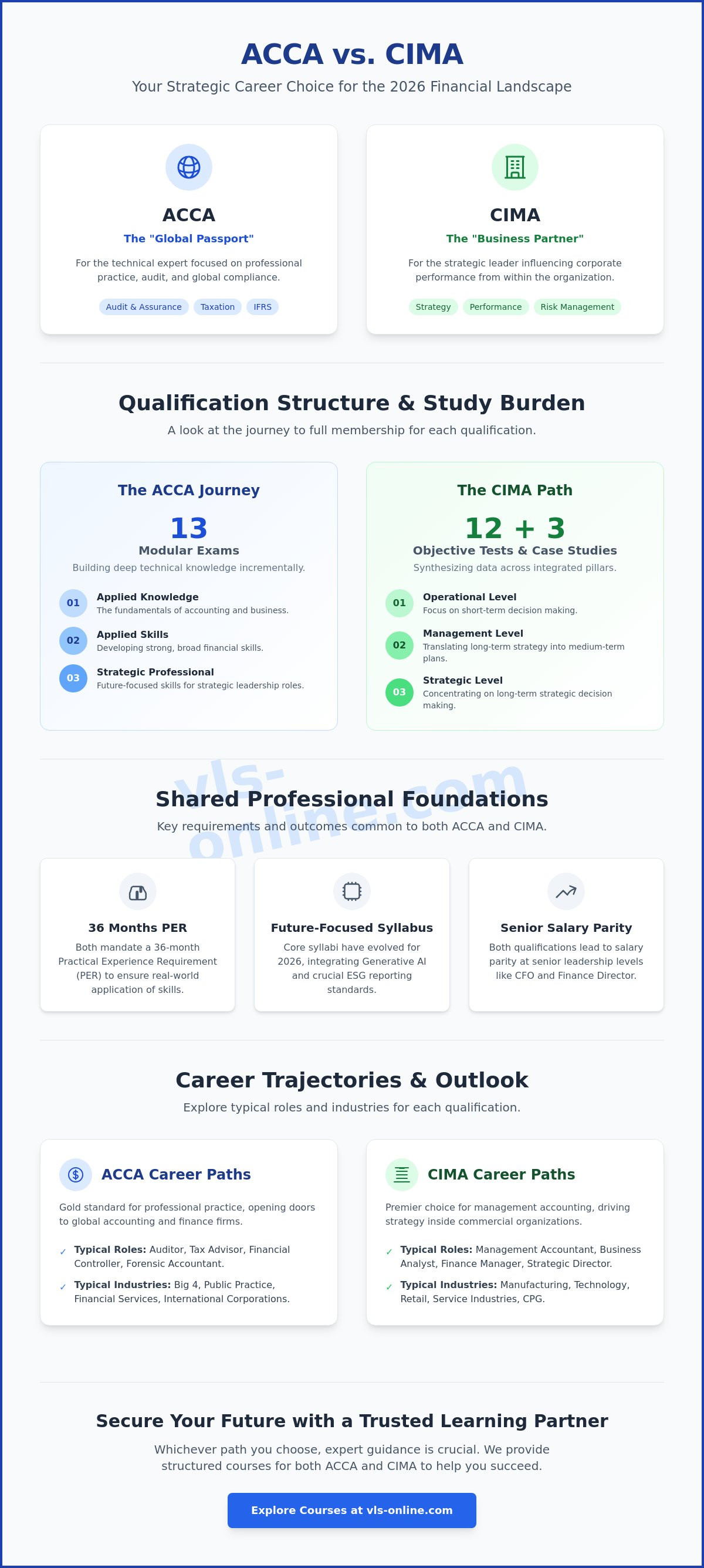
The global financial environment of 2026 demands more than just arithmetic precision; it requires a sophisticated blend of regulatory compliance and proactive business steering. Professionals often view the Association of Chartered Certified Accountants (ACCA) as a 'Global Passport' that validates expertise across accounting, audit, and taxation in over 180 countries. Conversely, the Chartered Institute of Management Accountants (CIMA) serves as the 'Business Partner' qualification, specifically designed for those who intend to influence internal corporate strategy from within the organization. Both bodies have adapted to the 2026 reality by integrating Generative AI and ESG reporting into their core syllabi. This evolution ensures that the ACCA vs CIMA debate is no longer about technical versus commercial, but rather about which specific leadership lens you wish to apply to your career. In 2026, ACCA remains the gold standard for professional practice and audit, while CIMA is the premier choice for management accounting and corporate strategy.
The ACCA Focus: Technical Mastery and Global Standards
The ACCA qualification prioritizes a deep understanding of international financial reporting standards (IFRS) and complex tax laws. It's the preferred credential for the Big 4 and international accounting firms because it equips professionals with the rigour needed for independent audit requirements. For those seeking this technical breadth, structured ACCA courses provide the necessary foundation to manage risk in a highly regulated global market. Its comprehensive 13-paper structure ensures that graduates can navigate the nuances of IFRS 18 and advanced sustainability disclosures with absolute precision.
The CIMA Focus: Driving Performance and Risk Management
CIMA centers on management accounting, cost control, and long-term financial strategy. By obtaining the CGMA designation, professionals signal their ability to drive corporate growth and optimize operational efficiency. It's tailored for those who see themselves in manufacturing, tech, or service industries rather than external audit. The curriculum emphasizes how to leverage data for decision-making, ensuring that finance leaders don't just report on the past but actively shape the future of their organizations through disciplined risk management and strategic resource allocation.
Structural Comparison: Exams, Syllabus, and Study Burden
The structural divergence of ACCA vs CIMA defines your daily study routine and long-term commitment. ACCA utilizes a 13-exam modular structure that builds deep technical knowledge incrementally, allowing students to focus on one specialized area at a time. In contrast, CIMA employs a 12-objective test system punctuated by three comprehensive case studies. These case studies serve as critical milestones, testing your ability to synthesize financial, performance, and enterprise data under pressure. While both qualifications offer on-demand flexibility for lower-level objective tests, the higher-level strategic components typically align with quarterly sittings. This hybrid model requires you to balance the convenience of immediate testing with the disciplined preparation needed for fixed exam windows.
Beyond the exam hall, both bodies mandate a Practical Experience Requirement (PER) of 36 months. This isn't merely a box-ticking exercise; it's a professional safeguard that ensures you've applied theoretical concepts in a live business environment. You'll need to document specific performance objectives and have them verified by a qualified mentor to achieve full membership status. Understanding this ACCA vs CIMA requirement is vital, as your current role must provide the necessary exposure to meet these professional standards.
The ACCA Journey: From Knowledge to Strategic Leadership
The progression through the ACCA qualification begins with Applied Knowledge before moving into the more rigorous ACCA Applied Skills level. The journey culminates in the Strategic Professional stage, where modules like ACCA Strategic Business Reporting challenge you to interpret complex financial data for diverse stakeholders. Success here requires a shift from technical execution to high-level advisory. For a detailed roadmap, consider our guide on Mastering the ACCA Strategic Professional Level.
The CIMA Path: Objective Tests and Integrated Case Studies
The CIMA pathway is divided into Operational, Management, and Strategic levels. Each tier integrates financial, performance, and enterprise pillars, ensuring a holistic view of the organization. This creates a solid strategic decision framework for accountants seeking leadership roles. To understand how these levels lead to the CGMA designation, view our overview of the CIMA Professional Qualification. If you want to accelerate your progress, choosing full access study support can provide the structured environment you need to succeed.
Career Trajectories: Industry, Practice, and Salary Outlook
Visualizing your professional standing a decade from now is the most effective way to resolve the ACCA vs CIMA dilemma. This choice isn't merely about passing exams; it's about selecting the environment where you'll spend your most productive years. If you envision yourself as a partner in a global professional services firm or a high-level consultant navigating complex tax jurisdictions, the technical depth of the ACCA is your primary tool. Conversely, if your ambitions lie in steering a multinational tech company through a period of rapid growth, the commercial focus of CIMA provides the strategic framework you'll need at the boardroom table.
Financial rewards remain consistently high across both designations, provided you reach the senior levels of leadership. By 2026, the salary gap between ACCA and CIMA has largely vanished, with senior roles in FP&A and Treasury valuing the strategic mindset over the specific letters. Research from early 2026 shows that while newly qualified professionals typically earn between £40,000 and £55,000, those with five or more years of experience frequently command salaries up to £85,000. For Finance Directors and CFOs, compensation packages often exceed £160,000, regardless of the initial qualification chosen. ACCA’s footprint in over 180 countries remains a significant advantage for those seeking global mobility, offering a professional protective net that spans from the UK to emerging markets in Asia and the Middle East.
Roles for the ACCA Qualified: Beyond the Audit
While audit remains a cornerstone, ACCA members are increasingly sought after for roles in Forensic Accounting, Tax Consultancy, and Corporate Finance. Their ability to handle complex regulatory environments makes them indispensable in sectors facing heavy oversight. To understand how to leverage these specialized paths, explore our Specialist Accounting Qualifications guide for 2026. This technical versatility ensures you aren't just an accountant, but a specialist in financial integrity.
Roles for the CIMA Qualified: The Corporate Boardroom
CIMA professionals thrive in Financial Planning & Analysis (FP&A) and Management Consultancy. The qualification is specifically designed to bridge the gap between finance and operations, preparing you for commercial decision-making at the highest levels. Many CIMA holders successfully transition into CEO or COO roles because they understand how cost control and financial strategy drive overall business performance. You can secure your future in corporate leadership by beginning your journey with our structured study resources today.
Making the Choice: A Strategic Decision Framework
Selecting your professional path requires a cold, analytical look at your ten-year objective. If your goal is to secure a position within a Big 4 firm or eventually establish your own professional practice, the ACCA vs CIMA decision leans heavily toward the former. ACCA provides the statutory authority and technical depth required for independent audit and tax representation. Conversely, if you're drawn to the operational heart of a manufacturing or tech giant, CIMA’s focus on performance management makes it the superior strategic fit. For those who remain undecided, ACCA offers the broadest technical foundation, ensuring you aren't prematurely limited to a specific sector. Regardless of the path, achieving a first-time pass rate depends on the quality of your preparation. Partnering with Vertex Learning Solutions provides the structured environment and expert guidance necessary to navigate these rigorous syllabi without compromising your current professional commitments.
Why Online Tuition is the Secret to Professional Success
Success in 2026 isn't just about hard work; it's about efficient resource allocation. High-quality ACCA online tuition offers a level of flexibility that traditional classrooms cannot match. We've seen that instant WhatsApp tutor support often makes the difference between a failed attempt and a pass. Being able to clarify a complex reporting standard or a variance analysis calculation in real-time prevents study momentum from stalling. Recorded lectures allow you to consume content during your peak cognitive hours, ensuring that your learning fits around the demands of a high-pressure finance role rather than competing with it.
Final Verdict: Future-Proofing Your Career in 2026
Both qualifications are elite credentials that command respect in the global marketplace. The 'best' qualification is ultimately the one you have the discipline to finish. If you're just entering the field and feel overwhelmed by the choice, starting with ACCA Applied Knowledge is a low-risk way to build a solid professional base. This level introduces the fundamental concepts of business and technology that serve as a prerequisite for any senior finance role. In the ACCA vs CIMA debate, the winner is the professional who begins their journey with a clear strategy and the right support system.
Securing Your Professional Legacy in 2026
The decision between these two elite qualifications represents more than a choice of study; it's a strategic commitment to your future identity as a finance leader. Whether you pursue the global technical authority of the ACCA or the commercial strategic depth of CIMA, the outcome remains the same: a seat at the table where critical business decisions are made. By 2026, the perceived boundaries between these paths have softened, leaving the ACCA vs CIMA choice to be determined by your personal career ambitions and the specific sector you wish to influence.
Success in either path requires a protective network of expert guidance to ensure your time investment yields the highest return. We provide the professional stability you need to succeed through expert tutor support via WhatsApp, weekly live sessions, and exam-focused study notes specifically designed for the 2026 syllabus. You don't have to navigate these complex regulations alone. Explore our comprehensive ACCA and CIMA preparation courses to accelerate your career and gain the confidence that your professional affairs are in the most capable hands. Your journey toward senior leadership starts with a single, well-supported decision.
Frequently Asked Questions
Which is harder: ACCA or CIMA?
Difficulty is subjective and depends on whether your strengths lie in technical precision or strategic synthesis. ACCA is often perceived as more technically rigorous due to its deep focus on audit and financial reporting standards, with some advanced pass rates sitting around 38%. CIMA's challenge lies in its integrated case studies, which require you to apply financial data to complex business scenarios under significant time pressure.
Can I switch from ACCA to CIMA later in my career?
Yes, you can transition between these bodies as your professional focus evolves. Many accountants move from practice into industry and choose to add a management qualification to their portfolio. Both organizations offer exemption routes for qualified professionals, meaning you won't have to start from the beginning. This move is a strategic way to pivot toward commercial leadership if your initial foundation was in audit or tax.
Do employers prefer ACCA or CIMA in the UK?
UK employer preference is dictated by the specific sector and the nature of the role. Large professional services firms and tax practices almost exclusively seek ACCA members for their technical depth and statutory knowledge. Conversely, corporate entities in the tech and manufacturing sectors often prefer CIMA for internal finance roles. They value the qualification's emphasis on driving business performance and long term strategic planning.
How long does it take to complete ACCA vs CIMA?
Most dedicated professionals complete either qualification within three to four years. The ACCA vs CIMA timeline is primarily governed by the 36 month Practical Experience Requirement that both bodies mandate. While CIMA’s objective tests offer on demand flexibility, the fixed quarterly windows for case studies and ACCA’s strategic professional exams require a disciplined, multi year study plan to ensure consistent progress.
Which qualification has the highest salary potential in 2026?
Both designations lead to high earning potential, with senior roles showing significant salary parity. In 2026, newly qualified professionals can expect starting salaries between £40,000 and £55,000. For those with five years of post qualification experience, the range typically extends to £85,000. At the CFO or Finance Director level, your ability to manage risk and lead strategy becomes more influential on your compensation than the specific qualification you hold.