Vertex Learning Solutions


What if the difference between a mid-level management role and a seat at the executive table isn't just your years of experience, but the strategic sequence of your professional credentials? It's understandable to feel overwhelmed by thirteen rigorous exams and the constant pressure to balance a demanding career with high-stakes study. You're likely weighing the heavy commitment against the promised ROI while wondering which ACCA career path will actually serve your long-term goals. We recognize that in a global market with over 200,000 members, standing out requires more than just a certificate; it requires a precise strategy.
This guide provides the clarity you need to master the qualification, ensuring every exam you sit is a calculated step toward a CFO or strategic leadership position. We've structured this analysis to simplify the complexity of the 2026 syllabus, including the critical updates to technology and sustainability reporting. You'll discover how to navigate the current requirements while preparing for the 2027 qualification redesign. From choosing the right study support to understanding the specific ROI of each module, we offer the professional protection and insight necessary to secure your future in global finance.
Key Takeaways
- Understand why the ACCA qualification remains the global gold standard for finance professionals in 2026, offering unparalleled versatility across 180 countries.
- Learn how to map your ACCA career path by aligning specific exam stages with high-growth roles, from entry-level analyst positions to senior leadership.
- Discover the strategic importance of elective papers at the Strategic Professional level and how these choices define your future trajectory toward executive roles.
- Gain a clear roadmap of the professional journey, including the critical integration of the 36-month practical experience requirement with your exam schedule.
- Identify how expert-led study support and tutor interaction can maximize your return on investment by accelerating your transition from student to qualified member.
What is the ACCA Career Path? A Professional Overview
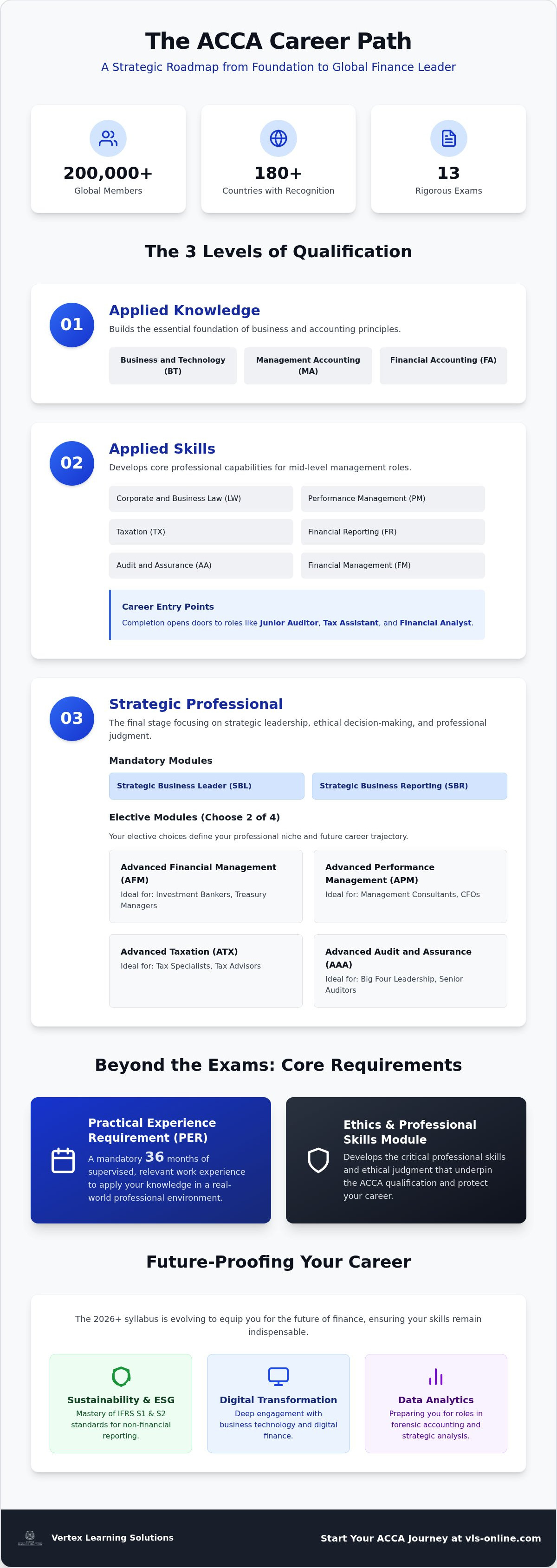
The Association of Chartered Certified Accountants (ACCA) provides a rigorous professional framework designed to cultivate strategic leaders. An ACCA career path represents more than a collection of certifications; it's a comprehensive journey consisting of 13 professional examinations, a specialized ethics module, and 36 months of supervised practical experience. By 2026, this qualification has solidified its status as the global gold standard for finance professionals due to its uncompromising focus on both technical precision and ethical integrity.
The modern landscape requires versatility. While traditional auditing remains a pillar, the 2026 syllabus reflects a significant shift toward digital transformation. Candidates now engage deeply with business technology and data analytics, preparing them for high-impact roles in forensic accounting, ESG reporting, and strategic consultancy. This systematic approach ensures that members don't just record financial data but actively shape corporate strategy within complex regulatory environments.
The Three Levels of Qualification
The path is structured into three distinct tiers to ensure logical progression and professional depth. Each level builds upon the last to create a protective net of expertise.
- Applied Knowledge: This stage builds the essential foundation through papers such as Business and Technology (BT), Management Accounting (MA), and Financial Accounting (FA).
- Applied Skills: Here, you develop core professional capabilities. This level covers Taxation (TX), Audit and Assurance (AA), and Financial Management (FM), providing the tools for mid-level management roles.
- Strategic Professional: The final stage focuses on leadership. It includes the mandatory Strategic Business Leader (SBL) and Strategic Business Reporting (SBR) modules, alongside specialized electives that define your professional niche.
The Global Mobility Advantage
One of the most compelling aspects of the ACCA career path is its international portability. With recognition in over 180 countries, the brand carries immense weight within multinational corporations. For those operating in complex international reporting environments, supplementing this journey with a Diploma in IFRS provides a distinct competitive edge. It ensures you possess the specialized knowledge required to navigate global standards, such as the concepts introduced by IFRS 18, which are already influencing the 2026 examination cycle. This global reach provides a level of professional security that few other credentials can match.
Mapping Your ACCA Exams to High-Growth Finance Roles
Success along the ACCA career path depends on your ability to translate theoretical syllabus requirements into market-ready professional capabilities. It's a strategic alignment. While the foundation is universal, the choices you make during your progression determine the specific doors that open within the 2026 global economy.
The Applied Skills stage serves as your first major professional milestone. Completing papers such as Audit and Assurance (AA) and Taxation (TX) provides the technical security required for roles as a Junior Auditor or Tax Assistant. For those targeting corporate finance, Financial Reporting (FR) offers the precision needed to excel as a Financial Analyst. The SBR module prepares you for the complexities of a Group Financial Controller role by refining your professional judgment in consolidated reporting and stakeholder communication.
In the current regulatory environment, the rise of the "Green Accountant" has shifted the focus toward ESG and sustainability reporting. ACCA's integration of IFRS S1 and S2 standards ensures you're equipped to lead non-financial disclosure initiatives. This foresight adds a layer of professional protection to your career, making you indispensable in an era of strict corporate accountability.
The Specialist Paths: Audit vs. Tax vs. Finance
Your choice of electives at the Strategic Professional level defines your long-term trajectory. Selecting Advanced Audit and Assurance (AAA) is the standard route for those seeking leadership positions within Big Four public practice. Conversely, the AFM route is tailored for aspiring Investment Bankers and Treasury Managers. Comprehensive AFM exam prep bridges the gap between abstract valuation theory and the real-world execution of corporate finance transactions. If you're looking to solidify your technical foundation, consider exploring our structured ACCA courses to ensure your progression remains on track.
The Management Path: Performance and Strategy
Strategic leadership requires a different analytical lens. Utilizing Advanced Performance Management (APM) prepares you for high-level Management Consultancy roles where optimizing organizational efficiency is paramount. Strategy dictates your trajectory. The Strategic Business Leader (SBL) module is specifically designed to cultivate a "C-suite" mindset, merging technical data with the soft skills required for executive decision-making.
The Professional Journey: From Student to ACCA Member
Entering the ACCA career path requires a disciplined approach to both academic and professional milestones. The initial phase involves securing the Applied Knowledge exams. These foundational papers provide the technical literacy needed for entry-level roles, allowing you to begin your career while you study. It's a dual-track progression where your office experience informs your exam performance.
As you progress to the Applied Skills level, the focus shifts toward professional application. This stage is where you must integrate the Ethics and Professional Skills Module (EPSM). Completing EPSM before attempting the Strategic Professional level significantly enhances your employability. It demonstrates to recruiters that you possess the commercial acumen and ethical judgment required in the 2026 business environment. Once you've mastered these core capabilities, full membership becomes a tangible reality rather than a distant goal.
The Practical Experience Requirement (PER)
Theoretical knowledge is only half of the equation. To achieve full membership, you must document 36 months of supervised experience. This involves meeting specific performance objectives that cover technical, professional, and ethical competencies. Working for an ACCA Approved Employer can streamline this process. These organizations have verified training systems that often simplify the reporting of your objectives, providing a professional safety net for your progression.
Balancing Work and Study in 2026
Maintaining professional momentum while managing a full-time role is the greatest challenge for candidates. Success requires structured support. Utilizing ACCA online tuition offers the flexibility to align your study schedule with demanding work deadlines. This systematic approach ensures you aren't just passing exams but are also internalizing the complex regulations that define modern finance. Strategic candidates often seek a competitive edge by integrating specialist certifications, such as the Diploma in IFRS, to bolster their expertise in international reporting standards.
To secure your professional progression and navigate these requirements with confidence, enrol in our structured ACCA courses today and benefit from expert-led guidance.
Maximizing Your Career ROI with Strategic Study Support
Attempting to navigate the ACCA career path through isolated self-study is a common trap that often results in stalled professional momentum. While the initial perceived savings are attractive, the hidden costs of exam resets and delayed career progression are significant. Expert guidance serves as a professional protective net, ensuring that every hour of study contributes directly to your advancement. This structured approach provides the stability needed to handle the rigorous demands of the 2026 global finance market with absolute confidence.
At the Strategic Professional level, technical knowledge is only one component of success. You must demonstrate professional judgment and commercial acumen that goes beyond the textbook. Direct WhatsApp access to experienced tutors and interactive live sessions are critical for this transition. These tools allow for the immediate clarification of complex regulations, preventing the accumulation of misunderstandings that lead to exam failure. Full Access packages provide the financial and educational stability needed for the long-term journey, allowing you to focus entirely on your professional development rather than administrative logistics. Vertex Learning Solutions acts as your strategic partner, providing the rigorous framework required for elite performance.
Beyond the Exams: Developing Soft Skills
The Strategic Business Leader (SBL) and Strategic Business Reporting (SBR) modules are designed to cultivate leadership qualities. These papers require you to exercise professional skepticism and communicate complex data to diverse stakeholders effectively. Active mentorship helps you transition from a technical accountant to a trusted strategic advisor. This evolution is essential for those targeting executive-level roles where decision-making under pressure is a daily requirement.
Future-Proofing with Technology
The 2026 examination environment is entirely digital, making technological proficiency a non-negotiable requirement. Integrating Advanced Excel and data visualization into your study routine ensures you're prepared for the Computer Based Exams (CBE) and the demands of modern corporate reporting. By mastering these digital tools early in your ACCA career path, you protect your trajectory against rapid shifts in business technology. This proactive approach secures your position as a forward-thinking finance leader who can translate data into actionable strategy.
Securing Your Future in Global Finance
The ACCA career path represents a disciplined commitment to professional excellence and strategic foresight. Success in the 2026 landscape requires more than technical knowledge. It demands a precise alignment of your exam choices with the evolving needs of the global market. By mastering the Strategic Professional level and documenting your practical experience, you build a protective net of expertise that secures your trajectory toward the C-suite. Moving from a technical role to a leadership position is a calculated journey that thrives on structured support and professional integrity.
Vertex Learning Solutions provides the London-based expertise and global community you need to excel. Our approach prioritizes your stability through dedicated tutor support via WhatsApp and weekly live sessions. You'll gain access to exam-focused study notes and interactive practice materials that simplify complex regulations without compromising depth. Start your strategic ACCA journey with expert-led courses at Vertex Learning Solutions and transform your professional potential into measurable success. Your advancement is the cornerstone of our partnership. We're ready to support your rise to the top of the finance profession.
Frequently Asked Questions
What is the average salary for an ACCA member in 2026?
Average salaries for ACCA members in 2026 vary significantly based on geographic location, industrial sector, and years of post-qualification experience. While specific global figures are subject to regional market fluctuations, qualified professionals consistently command a premium compared to their non-qualified peers. The global recognition of the qualification across 180 countries ensures that members can access high-paying roles in multinational corporations and strategic consultancy firms that value elite financial expertise.
Can I change my ACCA career path after choosing my elective papers?
Yes, you can certainly pivot your career focus even after selecting specific Strategic Professional electives. While choosing Advanced Audit and Assurance (AAA) or Advanced Taxation (ATX) provides an immediate specialism, the core qualification is designed for maximum versatility. Many members move between audit, corporate finance, and management roles throughout their professional lives. Your elective choices don't lock you into a single trajectory; they simply provide an initial competitive advantage in your chosen field.
How long does it typically take to complete the full ACCA career path?
Most candidates complete the ACCA career path in three to four years. This timeline accounts for passing the 13 required exams and fulfilling the mandatory 36-month Practical Experience Requirement (PER). Your personal progression may vary depending on any exemptions you hold from previous university degrees or professional certifications. Consistent study support and a disciplined exam schedule are the most effective ways to ensure you reach full membership within this standard timeframe.
Is the ACCA career path better than CIMA for a career in corporate finance?
The choice between ACCA and CIMA depends on your specific long-term objectives, though ACCA is often viewed as the more versatile "Gold Standard" for global finance. While CIMA focuses heavily on management accounting, the ACCA career path provides a broader foundation in financial reporting, audit, and strategic leadership. This comprehensive approach makes ACCA members highly attractive for corporate finance roles that require a deep understanding of both technical regulations and high-level business strategy.
What happens if I have a gap in my ACCA studies?
Gaps in your study journey are manageable, though you must remain mindful of the regulations regarding exam expiration. Exams passed at the Applied Knowledge and Applied Skills levels don't expire, providing long-term security for your progress. However, once you pass your first Strategic Professional exam, you have a seven-year window to complete the remaining papers at that level. If you're returning after a hiatus, we recommend a structured review of recent syllabus changes, particularly regarding technology and sustainability standards.