ACCA Advanced Audit and Assurance (AAA) Exam Tips: The 2026 Strategic Success Guide
Get expert ACCA Advanced Audit and Assurance (AAA) exam tips for 2026. Master SBR integration, secure professional marks, and pass with our strategic guide.
In this article
Ready to qualify online?
Get full access to expert-led ACCA & CIMA exam preparation with live tutor support.
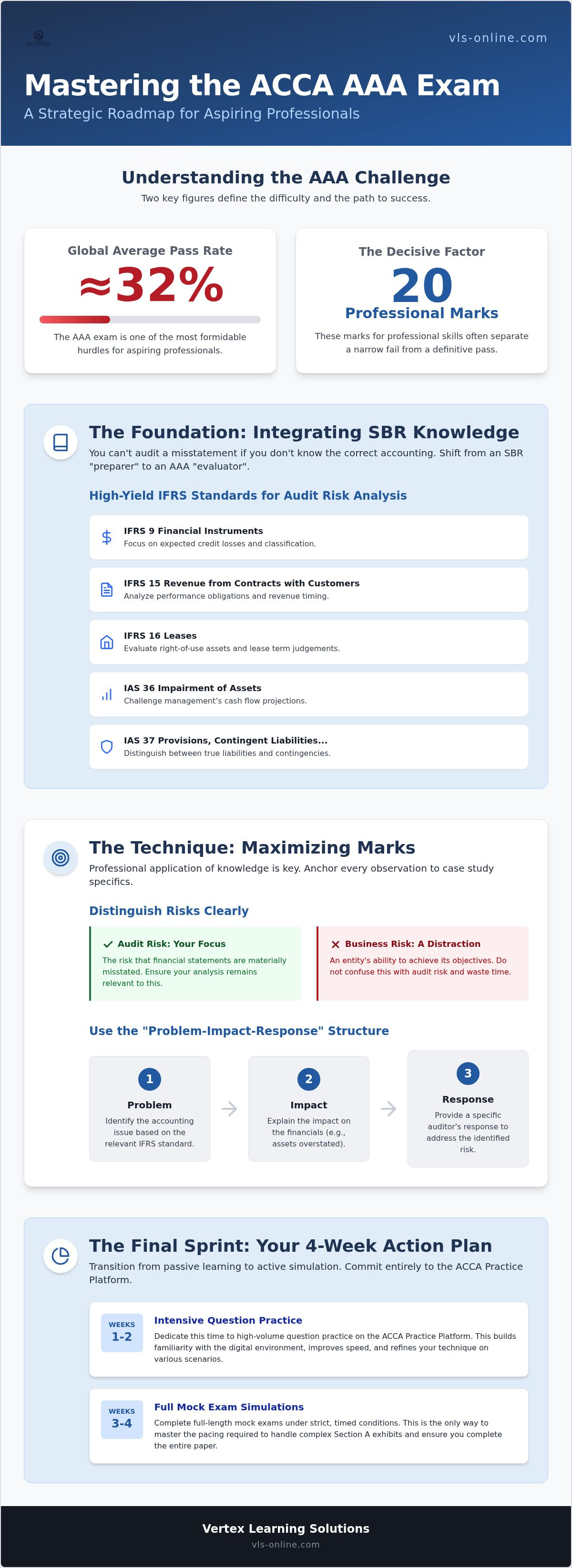
Explore Full AccessWith a global average pass rate of approximately 32%, the ACCA Advanced Audit and Assurance (AAA) exam remains one of the most formidable hurdles for aspiring professionals. You've likely felt the weight of the expansive syllabus or struggled to find actionable ACCA Advanced Audit and Assurance (AAA) exam tips that bridge the gap between SBR knowledge and practical application. It's common to feel a sense of unease regarding the 20 professional marks that often dictate the difference between a narrow fail and a definitive pass. We understand these pressures and provide the professional safety net you need to succeed.
This guide provides the strategic roadmap you need to master these complexities through expert-led insights and proven techniques. We'll explore essential strategies, from leveraging IFRS technicality to navigating the 2026 focus on ESG and technology. By the end of this article, you'll have the clarity and confidence required to think like a Senior Audit Manager during the December 2026 session.
Key takeaways
- Master the integration of Strategic Business Reporting knowledge into the audit environment, focusing on high-yield standards like IFRS 9 and 16 to eliminate technical vulnerabilities.
- Develop a structured approach to capturing the 20 professional marks by applying professional scepticism and commercial acumen to complex case studies.
- Implement proven ACCA Advanced Audit and Assurance (AAA) exam tips to clearly distinguish between audit and business risks, ensuring your analysis remains focused and relevant.
- Optimize your final four weeks of preparation through disciplined use of the ACCA Practice Platform and rigorous mock exam simulations to refine time management.
The Foundation: Integrating SBR Knowledge and Technical Mastery
The AAA exam is fundamentally an application of financial reporting standards within a complex audit framework. Many candidates fail because they treat audit as a purely procedural exercise, forgetting that you can't identify a misstatement if you don't know the correct accounting treatment. In the eyes of the Association of Chartered Certified Accountants (ACCA), a senior auditor must first be a master of financial reporting. Technical gaps in your SBR knowledge will directly translate into lost marks in AAA Section A.
Success requires a mental shift. While SBR asks you to prepare or explain figures, AAA demands you evaluate them for risk. You aren't just calculating a lease liability; you're assessing whether management's assumptions under IFRS 16 create a risk of material misstatement. This "evaluator" mindset is one of the most critical ACCA Advanced Audit and Assurance (AAA) exam tips for the 2026 syllabus. You must bridge the gap between knowing a standard and auditing its application.
Bridging the Gap: Essential IFRS Standards for Audit Risk
Focusing on high-yield standards ensures your revision remains efficient. These five areas frequently dominate Section A and carry the most weight for audit risk analysis:
IFRS 9 Financial Instruments: Focus on expected credit losses and classification.
IFRS 15 Revenue from Contracts with Customers: Analyze performance obligations and timing.
IFRS 16 Leases: Evaluate right-of-use assets and lease term judgements.
IAS 36 Impairment of Assets: Challenge management’s cash flow projections.
IAS 37 Provisions: Distinguish between liabilities and contingent liabilities.
Applying "Audit Logic" means looking beyond the numbers to find the risk. Ask yourself why management might want to overstate an asset or if the treatment aligns with the economic reality described in the scenario. If your technical foundation feels shaky, our ACCA Strategic Business Reporting course provides the necessary refresher to secure your knowledge. Precise technical application is the bedrock of earning professional marks in every scenario.
The Exam Technique: Winning Professional Marks and Scenario Analysis
Success in AAA requires more than technical accuracy; it demands the professional application of knowledge. The 20 professional marks awarded for analysis, evaluation, scepticism, commercial acumen, and communication represent nearly a quarter of the total marks available. To secure these, you must move beyond generic statements. Every observation must be anchored in the specific exhibits provided in the case study. One of the most effective ACCA Advanced Audit and Assurance (AAA) exam tips is to never confuse audit risk with business risk. While business risk affects the entity's ability to achieve objectives, audit risk specifically concerns the risk that financial statements are materially misstated. Mixing these concepts wastes valuable time and signals a lack of professional precision.
Mastering the Audit Risk and Auditor's Response Framework
To maximize marks in Section A, we recommend using the "Problem-Impact-Response" structure. First, identify the accounting problem based on the relevant IFRS. Next, explain the impact on the financial statements, explicitly stating whether an account is likely overstated or understated. Finally, provide a specific auditor's response that addresses the risk, such as inspecting third-party evidence or reviewing board minutes. It's essential to calculate materiality early in your answer, as it establishes the framework for your entire audit strategy. Professional Scepticism is the ability to look beyond management representations with documented evidence. Refining these techniques with our ACCA courses ensures you approach the exam with the mindset of a seasoned practitioner rather than a student.
The Final Sprint: Practice, Mock Exams, and Expert Support
The final four weeks of your journey require a disciplined transition from passive content consumption to active, high-stakes simulation. One of the most significant ACCA Advanced Audit and Assurance (AAA) exam tips is to abandon paper-based revision and commit entirely to the ACCA Practice Platform. Replicating the digital environment is essential for navigating the 3-hour 15-minute challenge effectively. Completing full-length mock exams under timed conditions is the only way to master the pacing needed to handle the complex exhibits found in Section A. A structured approach during this sprint should include:
Weeks 1-2: Intensive question practice on the Practice Platform, focusing on Section A audit risk scenarios.
Weeks 3-4: Full-length timed mock exams to master pacing and exhibit navigation.
Daily: Reviewing recorded lectures to address persistent technical weaknesses in SBR integration.
Leveraging VLS Tutor Support for Exam Readiness
Clarifying complex ISA requirements or ethical dilemmas doesn't have to be a solitary struggle. Our direct WhatsApp tutor support provides a professional safety net, giving you immediate access to expert guidance when you encounter a challenging concept. Weekly live sessions further enhance your preparation by deconstructing 2026 "hot topics," such as the introduction of ISSA 5000 and the impact of AI on audit evidence. By choosing to enroll in our ACCA Advanced Audit and Assurance (AAA) course, you gain a strategic partner committed to helping you navigate the 2026 syllabus with confidence and integrity.
Achieving Strategic Success in Your Audit Career
Mastering the AAA paper requires more than standard memorization; it demands a synergy of technical SBR knowledge and a disciplined evaluation of audit risk. By focusing on high-yield IFRS standards and deconstructing the 20 professional marks, you transition from a student to a senior manager mindset. Implementing these ACCA Advanced Audit and Assurance (AAA) exam tips through rigorous practice on the official platform ensures you're prepared for the 2026 cycle. We provide the professional safety net you need to navigate these complexities with confidence. Our approach combines exam-focused 2026 study materials with direct WhatsApp tutor support and weekly live classroom simulations to clarify your doubts in real-time.
Secure your ACCA AAA success with VLS expert-led courses and step into your exam with the certainty of a prepared professional. You've got the talent to succeed; let's refine your strategy together.