ACCA Performance Management (PM) Tips: The Strategic Guide to Passing in 2026
Struggling with the ACCA PM exam? Get our expert ACCA Performance Management (PM) tips for 2026. Learn to master interpretation and the CBE for a confident p...
In this article
Ready to qualify online?
Get full access to expert-led ACCA & CIMA exam preparation with live tutor support.
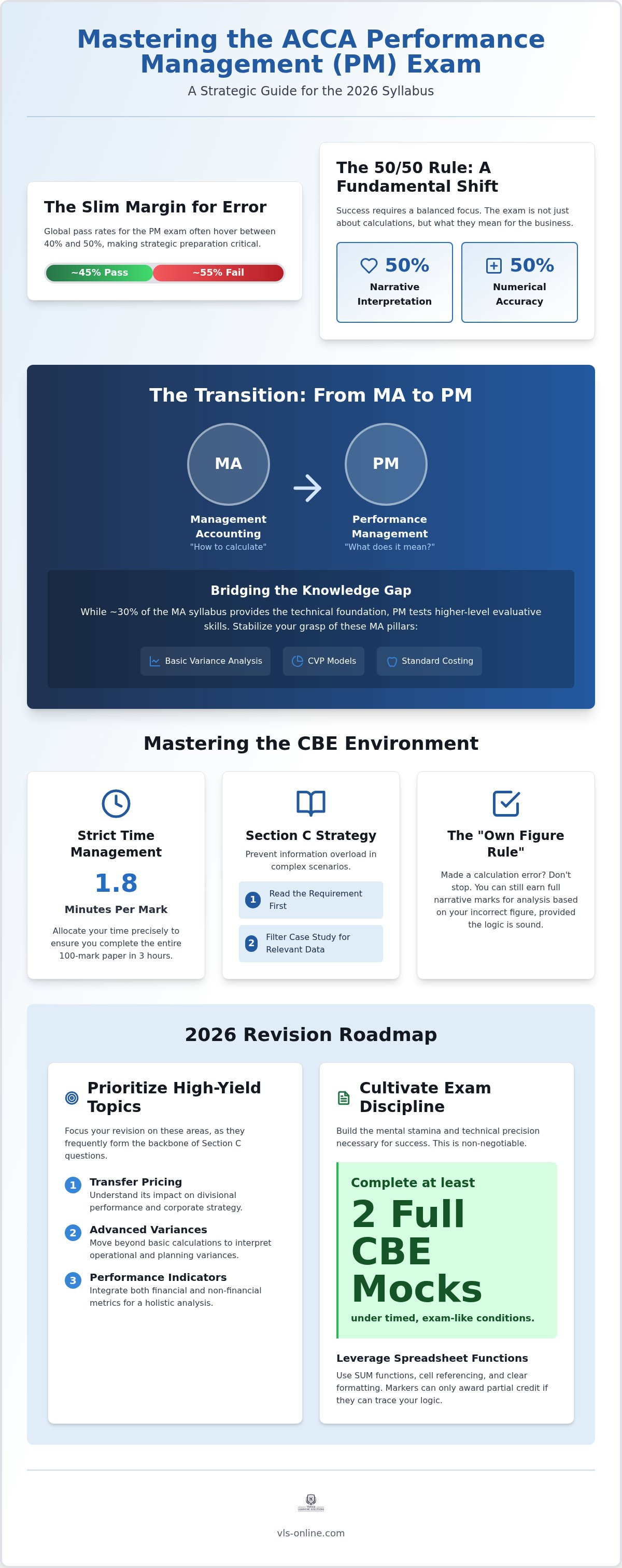
Explore Full AccessWith global pass rates for the PM exam often hovering between 40% and 50%, the margin for error is remarkably slim. You've likely spent hours perfecting your linear programming and throughput accounting, yet applying these ACCA Performance Management (PM) tips effectively requires a shift from pure calculation to management interpretation. It's a daunting challenge to move from the comfort of numbers to the nuanced demands of a 50% narrative exam. We understand the pressure of the CBE environment and the complexity of applying abstract theories to specific, high-stakes scenarios.
This guide offers a structured roadmap specifically designed for the 2026 syllabus. You'll learn how to master the CBE spreadsheet tool and secure easy marks in narrative sections. By the end of this article, you'll have a clear strategy to transform your technical knowledge into the professional analysis that examiners demand. We'll cover everything from time management to the specific interpretation techniques that turn a failing script into a confident pass.
Key takeaways
- Transition from a calculation-focused mindset to one of strategic interpretation by leveraging the foundational overlap between Management Accounting and the Performance Management syllabus.
- Optimize your performance in the CBE environment by applying specialized ACCA Performance Management (PM) tips designed to mitigate information overload during complex Section C scenarios.
- Prioritize high-impact syllabus areas, including Transfer Pricing and advanced Performance Indicators, to ensure your preparation aligns with the most rigorous requirements of the 2026 exams.
- Establish a rigorous revision discipline through full-scale mock examinations to cultivate the stamina and spreadsheet precision necessary for success in the professional environment.
The MA to PM Transition: Why Calculations Are No Longer Enough
Many candidates approach the PM exam as a more difficult version of Management Accounting (MA). This is a strategic error. While approximately 30% of the MA syllabus provides the technical foundation, the Association of Chartered Certified Accountants (ACCA) designs this paper to test evaluative skills. The fundamental shift moves from "how to calculate" to "what does this mean for the business?" Success requires adhering to the 50/50 Rule: numerical accuracy and narrative interpretation carry equal weight. Students who rely solely on memorized formulas often fail Constructed Response questions because they cannot explain the "why" behind the numbers. In the 2026 exam environment, your ability to provide professional commentary is what separates a 48% from a 52%.
Bridging the Knowledge Gap from Management Accounting
Before advancing, you must stabilize your grasp of foundational concepts. PM builds directly upon several MA pillars:
Basic variance analysis and its operational causes.
Cost-volume-profit (CVP) models and break-even analysis.
Standard costing techniques in traditional environments.
Performance Management adds complexity through modern manufacturing environments and environmental accounting. These topics require you to look beyond the ledger. Performance Management is the strategic application of accounting data to drive organizational goals. Using targeted ACCA Performance Management (PM) tips, such as linking variances to operational decisions, helps bridge this gap. At Vertex Learning Solutions, we emphasize this transition to ensure you don't just calculate, but consult. We provide a safety net for those struggling with this conceptual leap, offering structured support to simplify these high-level models and secure your professional future.
Mastering the CBE Environment: Strategic Tips for Sections A, B, and C
Efficiency in the Computer-Based Exam (CBE) environment is non-negotiable for 2026. For Sections A and B, you must develop the professional stamina to process objective test questions rapidly. Don't over-analyze; bank your marks and maintain momentum. Stamina is built through consistent practice on the official platform, allowing you to navigate the interface without hesitation. When approaching Section C, one of the most effective ACCA Performance Management (PM) tips involves reading the requirement before the scenario. This prevents information overload and allows you to filter the case study for relevant data only.
Strict time management is your primary defense against failure. You should allocate exactly 1.8 minutes per mark to ensure you complete the 100-mark paper within the three-hour limit. If a calculation goes wrong, don't stop. The "Own Figure Rule" ensures you still earn narrative marks for your analysis, provided your logic is sound based on your initial figure. Examiners value your ability to interpret data, even if the underlying number contains a mechanical error.
Leveraging Spreadsheet Functions for Performance Analysis
Professionalism in Section C depends on your spreadsheet proficiency. Use SUM functions, basic formatting, and cell referencing to create a dynamic, clear structure. This isn't just about speed; it's about transparency. Markers can only award partial credit if they can trace your logic through your formulas. Formatting your response with clear headings and bold totals helps you maintain a logical flow under exam pressure. For a broader perspective on exam strategy, consult our ACCA Applied Skills guide. If you find these technical requirements overwhelming, our experts at Vertex Learning Solutions provide the structured support needed to master these tools effectively.
The 2026 Revision Roadmap: High-Yield Topics and Professional Support
Success in the 2026 session requires a disciplined focus on high-yield syllabus areas. You must prioritize Transfer Pricing, Advanced Variances, and the integration of Financial and Non-Financial Performance Indicators. These topics frequently form the backbone of Section C. Mastery here isn't just about the math; it's about explaining how these metrics influence corporate strategy. One of the most vital ACCA Performance Management (PM) tips is to implement a "Mock Exam" discipline. Completing at least two full CBE mocks under timed conditions is non-negotiable. It builds the mental resilience needed to handle the 1.8-minute-per-mark constraint without compromising your narrative quality.
During your final week, you should stop trying to learn new content. Shift your focus to refining exam techniques and polishing your narrative flow. Use Active Recall with our structured study notes to internalize management theories quickly. This method ensures that concepts like the Balanced Scorecard or Building Block Model are accessible under pressure, allowing you to draft responses that are both concise and professionally rigorous. Refining your ability to link theory to the specific scenario is what transforms a standard answer into a passing one.
Vertex Learning Solutions: Your Strategic Partner for PM Success
We provide a professional safety net that traditional textbooks cannot offer. Our tutor-led WhatsApp support resolves "blocker" questions in real-time. This immediate access prevents study fatigue when you're stuck on complex topics like shadow pricing. We also integrate weekly live sessions to simulate the classroom environment, fostering a sense of community and expert guidance. To secure your path to qualification, explore our ACCA courses online and select the PM module that aligns with your professional schedule. Our proactive approach ensures you're never navigating the complexities of the 2026 syllabus alone.
Securing Your Professional Qualification in 2026
Mastering the PM exam requires more than numerical precision; it demands a strategic shift toward business interpretation and CBE technical proficiency. You've explored how to bridge the MA gap and navigate Section C with the 1.8-minute-per-mark discipline. These ACCA Performance Management (PM) tips provide the necessary framework, yet successful execution depends on consistent, expert-backed practice. The complexity of the 2026 syllabus shouldn't be a barrier to your career progression when structured support is available.
To ensure your success, Enroll in the Vertex ACCA PM Course for Expert Tutor Support. Our program provides a comprehensive safety net, including direct WhatsApp tutor support, interactive practice questions, and fully updated materials for the 2026 syllabus. With a clear roadmap and professional guidance, you'll approach the exam hall with the calm confidence of a seasoned consultant. We're ready to stand as your strategic partner throughout this journey.