Vertex Learning Solutions


With graduate schemes at Deloitte and PwC receiving thousands of applications for every open seat, your university degree is no longer a differentiator; it's merely a baseline. It's natural to feel that a non-target background or the sheer volume of competition might block your path to a global firm like EY or KPMG. You've likely questioned whether a professional qualification can truly bridge the gap between academic theory and the high-stakes reality of international accounting. This 2026 career guide demonstrates exactly how ACCA helps in getting a job in the Big 4 by aligning your technical expertise with the rigorous standards these firms demand.
You'll gain a clear roadmap for matching your Applied Skills papers to specific departments and learn how to leverage the latest syllabus updates, including IFRS 18 and ESG reporting, to stand out during interviews. We provide a structured approach to navigating the recruitment process, giving you the confidence to secure a role before the major qualification redesign in 2027. By the end of this article, you'll understand how to transform your studies into a strategic advantage that recruiters cannot ignore. Our goal is to provide the professional clarity you need to move from applicant to associate with absolute certainty.
Key Takeaways
- Understand why global firms like Deloitte and PwC prioritize the ACCA qualification as a benchmark for technical competence and international reporting standards.
- Identify the strategic alignment between specific modules, such as Audit and Assurance (AA) and Advanced Audit and Assurance (AAA), and core Big 4 service lines.
- Discover how ACCA helps in getting a job in the Big 4 by integrating advanced digital literacy and ESG reporting into your professional profile.
- Leverage the Ethics and Professional Skills Module (EPSM) to differentiate your application and demonstrate the integrity required for elite advisory roles.
- Learn how to transition from an academic focus to a professional mindset through structured mentorship and simulated feedback loops.
Table of Contents
The Global Recognition of ACCA within Big 4 Recruitment
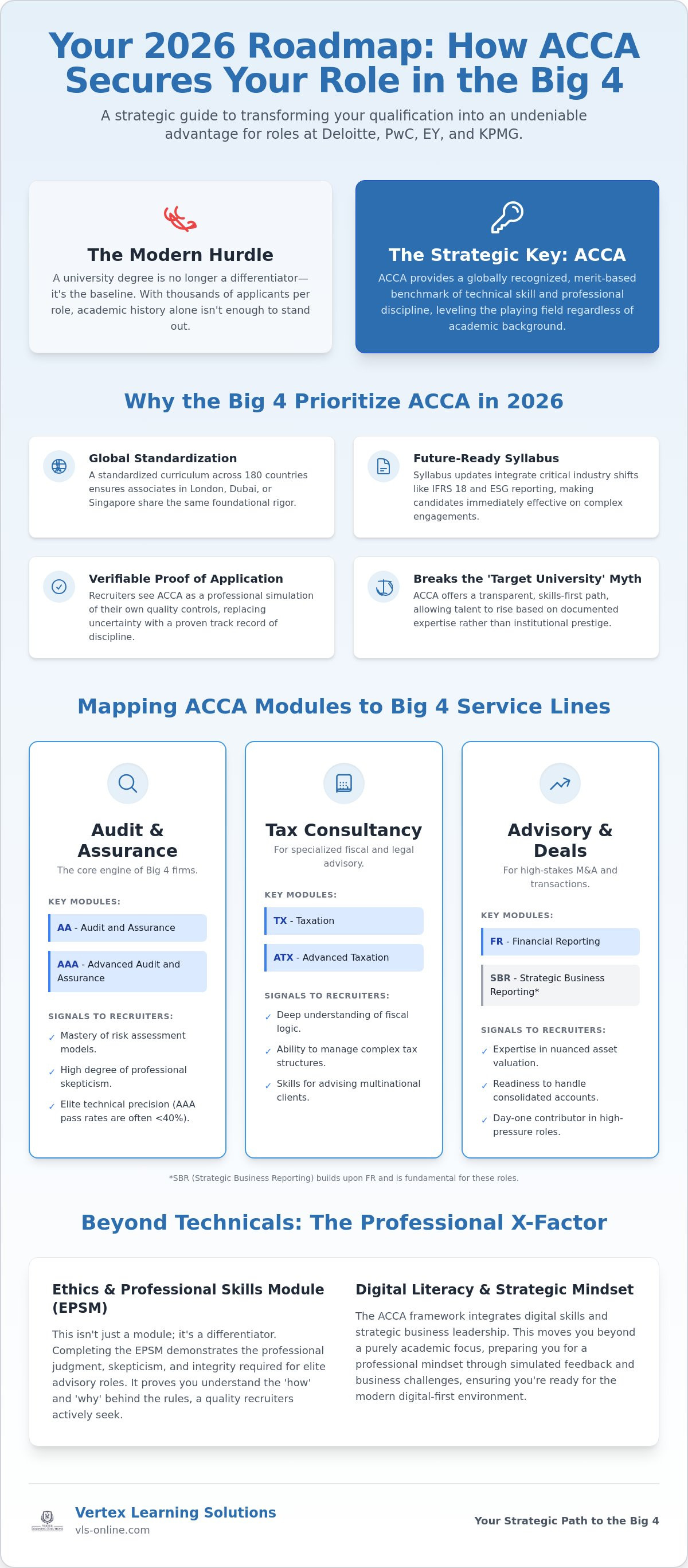
The Big 4 firms operate as integrated global networks, requiring a level of technical uniformity that traditional academic degrees often fail to provide. This is where the Association of Chartered Certified Accountants (ACCA) serves as a critical bridge. By establishing a rigorous, standardized curriculum across 180 countries, the qualification ensures that an associate in London possesses the same foundational rigor as one in Dubai or Singapore. Understanding how ACCA helps in getting a job in the Big 4 starts with recognizing this global alignment. Deloitte, PwC, EY, and KPMG don't just view the qualification as an academic achievement. They see it as a professional simulation of their own internal quality controls.
Traditional degree-only screening is rapidly losing ground to professional certifications that offer verifiable proof of application. In the 2026 market, recruiters look for candidates who can navigate the complexities of cross-border assignments without extensive retraining. The status of being part of a global professional body carries immense weight. It signals to partners that you're prepared for the high-pressure environment of international advisory. This is fundamentally how ACCA helps in getting a job in the Big 4; it replaces uncertainty with a proven track record of professional discipline and technical precision.
Why the Big 4 Prefer ACCA Candidates in 2026
The focus on International Financial Reporting Standards (IFRS) has become even more acute with the mandatory introduction of IFRS 18. ACCA’s syllabus updates directly mirror these shifts, making candidates immediately billable on complex audit engagements. Most Big 4 firms maintain "Pre-Approved Employer" status with ACCA, which signifies that the firm’s own internal training programs are already mapped to ACCA’s high professional standards. Engaging with structured ACCA courses ensures that candidates are prepared for the specific technical challenges found within these elite firms.
Breaking the 'Target University' Myth
The recruitment landscape has shifted toward a skills-first methodology. While a degree from a top-tier university remains valuable, it's no longer the sole gatekeeper for entry into the accounting elite. ACCA levels the playing field by providing a transparent, merit-based benchmark that proves your capability regardless of your undergraduate institution. It offers a structured path to demonstrating the high-level analytical skills that Big 4 recruiters prioritize over historical academic pedigree. This shift provides a secure professional safety net for those coming from diverse academic backgrounds, allowing talent to rise based on documented expertise rather than institutional prestige.
Mapping ACCA Modules to Big 4 Service Lines
Deloitte, PwC, EY, and KPMG aren't monoliths. They're structured into distinct service lines, each requiring a specific technical lens. This structural alignment is exactly how ACCA helps in getting a job in the Big 4. It allows you to tailor your elective choices to match the firm's business needs. By selecting Strategic Professional papers that mirror a specific department's core functions, you demonstrate strategic foresight. Generalist candidates often lack this targeted approach, making your application significantly more compelling to specialized recruiters.
Specialized tax consultancies require a deep dive into fiscal logic. The combination of ACCA Taxation (TX) and ACCA Advanced Taxation (ATX) is indispensable here. These modules don't just teach compliance. They develop the planning skills required to manage complex structures for multinational clients. Similarly, ACCA Financial Reporting (FR) provides the bedrock for Advisory and Deals departments. Understanding the nuances of asset valuation and consolidated accounts is a daily requirement in these high-stakes roles. This technical depth ensures you're ready to contribute from day one.
The Audit Path: AA and AAA Excellence
Audit remains the core engine of the Big 4 firms. Partners prioritize candidates with exceptional performance in ACCA Audit and Assurance (AA) and ACCA Advanced Audit and Assurance (AAA). These papers simulate the exact risk assessment models used in modern audit software logic. Scoring well in AAA signals professional skepticism. Since AAA pass rates are often below 40%, high marks prove you possess the technical precision needed for senior associate roles. It shows you can handle the scrutiny of international regulatory standards with ease.
Advisory and Consulting: The SBL Advantage
The ACCA Strategic Business Leader (SBL) module is a direct simulation of a Big 4 consulting engagement. It forces you to synthesize data sets into actionable board-level advice. For those looking to enter technical advisory, mastering the ACCA Strategic Business Reporting course is essential. It provides the depth required to interpret complex accounting standards like the newly introduced IFRS 18. Building this department-specific expertise is a strategic investment. You can explore our structured ACCA study paths to ensure your module choices align with your target service line.
Beyond Technical Knowledge: Professional Ethics and Digital Skills
The Big 4 firms demand more than just numerical accuracy; they require professionals who embody integrity and adaptability. While technical mastery is foundational, how ACCA helps in getting a job in the Big 4 is often through the cultivation of these critical professional attributes. Recruiters look for candidates who can navigate the gray areas of professional judgment with composure. The qualification instills a level of discipline and resilience that mirrors the high-intensity environment of top-tier audit and advisory. This cultural fit is frequently the deciding factor during the final partner interview.
Environmental, Social, and Governance (ESG) reporting has moved from a niche interest to a core business requirement in 2026. The updated Strategic Business Reporting (SBR) syllabus now places a significant emphasis on sustainability reporting and social impact. This ensures that ACCA students are prepared for the growing demand for ESG expertise within firms like EY and PwC. By demonstrating knowledge of these evolving disclosure requirements, you position yourself as a future-proof asset. It shows you're ready to lead in a corporate world that prioritizes transparent, purpose-driven reporting.
The 2026 Digital Shift in Big 4 Accounting
Data analytics is no longer a separate department; it's integrated into every audit procedure. The ACCA curriculum, starting from the Business and Technology (BT) module, embeds digital literacy as a core competency. You'll learn to interpret complex data sets and use digital tools to identify systemic anomalies. This digital-first mindset is highly prized by firms who have shifted toward tech-enabled auditing. Understanding how ACCA helps in getting a job in the Big 4 requires recognizing that technical skills must be paired with the ability to leverage emerging technologies.
Mastering the Ethics and Professional Skills Module
The Ethics and Professional Skills Module (EPSM) is a primary differentiator in the recruitment process. It places you in simulated, high-pressure ethical dilemmas that reflect real-world Big 4 scenarios. Completing this module before your final exams demonstrates a proactive commitment to the highest professional standards. If you're looking for ways to optimize your preparation, check out these Accounting Exam Study Tips. This strategic preparation ensures you approach the EPSM with the necessary professional skepticism. To start building your professional profile today, explore our comprehensive ACCA training programs.
Strategic Career Pathing with Vertex Learning Solutions
Securing a role at Deloitte or KPMG requires more than just passing grades; it demands a transition from a student perspective to a professional mindset. This evolution is central to how ACCA helps in getting a job in the Big 4 when paired with a structured learning environment. Vertex Learning Solutions acts as a strategic partner in this journey, providing a professional safety net that extends beyond technical syllabus coverage. Our methodology focuses on the systemic understanding of accounting principles, ensuring you can articulate complex solutions with the clarity expected by senior partners. We don't just prepare you for an exam; we prepare you for the boardroom.
Flexible ACCA courses online allow you to balance rigorous study with the internships or part-time roles that Big 4 recruiters value. For those aiming to enter the 2026 or 2027 graduate intake cycles, our "Full Access" model provides the resources to complete the qualification at an accelerated pace. This structured approach ensures you aren't just memorizing facts but are instead building the operational stability required for a high-performance career. It's a method designed for those who seek elite expert proximity and a clear path to professional success.
The Vertex Advantage: Exam Focus and Professionalism
The transition to a Big 4 environment often hinges on communication. Our exam-focused study notes are designed to mirror the executive summaries used in elite reporting, teaching you to distill complex data into actionable insights. Direct tutor support via WhatsApp further refines this, simulating the professional feedback loops you'll encounter during your first year as an associate. It's about developing a disciplined, detail-oriented character that firms like PwC and EY prioritize during their selection process. This focus on precision is exactly how ACCA helps in getting a job in the Big 4 for our graduates.
Planning Your Journey to the Big 4
A successful application requires precise timing and a logical sequence of milestones. We recommend completing your Applied Skills papers at least six months before the major graduate application windows to ensure your technical foundation is unquestionable. This timeline allows you to focus on the Ethics and Professional Skills Module, which is a key differentiator in the 2026 recruitment landscape. For advanced candidates, our guide on Mastering the ACCA Strategic Professional Level provides the deeper insights needed for the final hurdle. To secure your professional future, enroll in a professional ACCA course today and begin your journey toward the global elite.
Elevating Your Professional Standing for the 2026 Intake
The path to a global firm requires a deliberate alignment of technical rigor and professional ethics. You've seen how specific modules prepare you for targeted service lines and how the qualification provides a benchmark that transcends traditional academic boundaries. Understanding how ACCA helps in getting a job in the Big 4 is the first step; the second is executing a study plan that reflects these elite standards. By mastering digital literacy and the Ethics and Professional Skills Module, you transform from a standard applicant into a strategic asset ready for the boardroom.
Vertex Learning Solutions provides the professional safety net needed to navigate this transition with absolute certainty. With expert tutor support via WhatsApp and exam-focused study materials updated for 2026, you'll join a global student community already making an impact at top-tier firms. We ensure your preparation is precise, disciplined, and focused on the long-term strategic goals of your career. Our methodology simplifies the complex, allowing you to focus on building the character and expertise that Deloitte, PwC, EY, and KPMG demand.
Start your journey to the Big 4 with Vertex ACCA Courses and secure the expert proximity required for success. Your potential to lead in the accounting sector is within reach. We're here to ensure you have the technical depth and professional confidence to claim your place among the industry's best.
Frequently Asked Questions
Do Big 4 firms prefer ACCA or a University Degree?
Big 4 firms typically view a university degree as a prerequisite for graduate entry, but they treat the ACCA qualification as the definitive benchmark for professional competence. While a degree demonstrates your academic potential, the ACCA syllabus provides the specific technical rigor and IFRS knowledge required for immediate client work. In the 2026 recruitment landscape, possessing both signals that you have the theoretical foundation and the professional discipline required for elite accounting roles.
Can I apply to a Big 4 firm if I have only passed a few ACCA papers?
You can certainly apply to Big 4 graduate schemes or associate roles while being part-qualified. Demonstrating consistent progress through several papers shows recruiters that you're committed to the profession and have already begun building the technical skills they require. This is essentially how ACCA helps in getting a job in the Big 4 at an early stage; it distinguishes your application from candidates who only offer a general degree without professional direction.
Which Big 4 firm is best for ACCA students?
All Big 4 firms are excellent choices, as Deloitte, PwC, EY, and KPMG all hold "Approved Employer" status with ACCA. The best firm for you depends on your desired service line and the specific firm culture. For instance, PwC is traditionally recognized for its dominant audit practice, while Deloitte is frequently cited for its expansive consulting and advisory divisions. Each firm provides a highly structured environment where your studies are integrated into your daily professional development.
How does the ACCA Practical Experience Requirement (PER) work at a Big 4 firm?
The Practical Experience Requirement is streamlined at Big 4 firms because they hold "Platinum Approved Employer" status. This means the firm's internal training and appraisal systems are already mapped to ACCA's performance objectives. You won't need to document individual objectives in the same detail as students at non-approved firms. Instead, your supervisor confirms that you've completed the firm's rigorous internal training program over the required 36 months of experience.
Does the Big 4 pay for your ACCA exams and tuition?
Most Big 4 firms cover the costs of your professional qualification as part of their graduate training contracts. This typically includes registration fees, tuition for approved courses, and standard entry exam fees. They also provide dedicated study leave to ensure you can focus on your exams without compromising your work performance. This financial and operational support is a primary reason why many students pursue their qualification within these top-tier organizations to ensure professional stability.