Vertex Learning Solutions


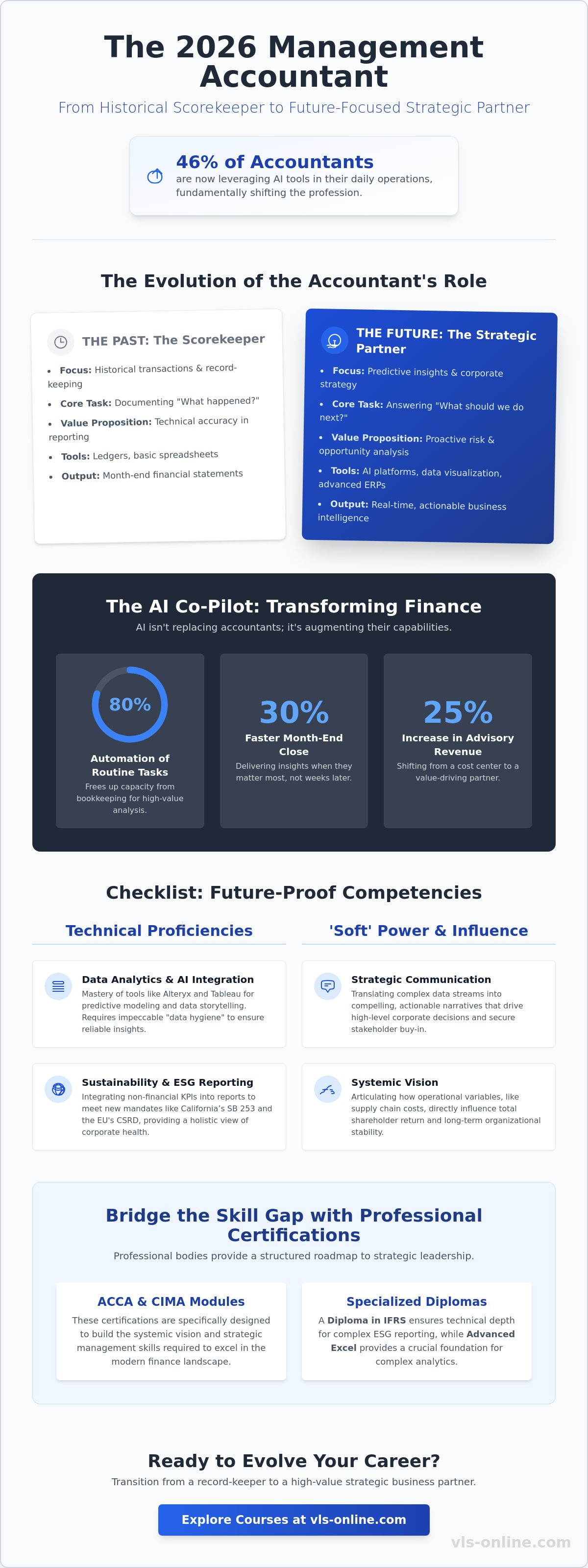
With 46% of accountants now utilizing AI tools in their daily operations, the boundary between human judgment and automated processing has fundamentally shifted. It's a reality where AI can automate up to 80% of routine bookkeeping, leaving many professionals concerned that their traditional roles are becoming obsolete. You likely feel the pressure of being a mere scorekeeper in an era that demands proactive insight. The uncertainty regarding which professional certifications actually build future-proof value is a valid concern in this complex and rapidly evolving regulatory environment.
Mastering the skills every management accountant needs in 2026 is the only reliable way to transition from a record-keeper to a high-value strategic business partner. This article provides a definitive roadmap to bridge that gap. You'll discover a structured checklist of competencies, from data storytelling to navigating new ESG reporting mandates like California’s SB 253. We'll also examine how leveraging specific ACCA and CIMA modules can elevate your professional standing, ensuring you possess the systemic vision required to command a higher salary and provide the analytical security your organization expects.
Key Takeaways
- Transition from reporting historical data to providing predictive strategic insights that drive high-level corporate decision-making.
- Identify the critical technical skills every management accountant needs, focusing on predictive modeling and the integration of ESG metrics into risk frameworks.
- Cultivate a systemic vision to articulate how operational variables, such as shifts in supply chain costs, directly influence total shareholder return.
- Master sophisticated negotiation and influence strategies to secure stakeholder alignment and departmental buy-in for complex budgetary initiatives.
- Discover how specific ACCA and CIMA modules provide a structured professional roadmap to achieve operational excellence and strategic leadership.
Table of Contents
- The Evolution of Management Accounting: From Data Entry to Strategic Insight
- Essential Technical Proficiencies: Mastering Data, Risk, and ESG
- The 'Soft' Power: Communication, Negotiation, and Systemic Vision
- Bridging the Skill Gap: How Professional Certifications Build 2026-Ready Accountants
The Evolution of Management Accounting: From Data Entry to Strategic Insight
The landscape of 2026 defines Management accounting as the critical intersection of finance, corporate strategy, and disruptive technology. The era of the "scorekeeper" who merely documents historical transactions has ended. Today, the role demands a "strategic partner" capable of delivering predictive insights that safeguard organizational stability. While technical accuracy is essential, it's now considered a baseline requirement rather than a professional differentiator. A Strategic Management Accountant serves as the narrative translator who converts complex data streams into actionable business stories.
Why 'Number Crunching' is No Longer Enough
Automation has fundamentally changed the value proposition of the finance department. With AI now capable of automating up to 80% of routine bookkeeping tasks, basic data entry is effectively a commodity. The modern professional must focus on the skills every management accountant needs to remain relevant, specifically in the area of real-time decision support. In volatile global markets, stakeholders no longer wait for month-end reports. They require immediate answers to the question "What should we do next?" rather than a post-mortem of "What happened?"
Firms that successfully integrate AI report a 30% faster month-end close and a 25% increase in advisory revenue, according to current industry data. This speed isn't just about efficiency; it's about freeing up the intellectual capacity to identify risks before they manifest on the balance sheet. Developing these skills every management accountant needs ensures you aren't just processing numbers, but actively steering the company's strategic direction through a structured, analytical lens. By moving beyond the ledger, you provide the professional protective net that businesses require in an increasingly complex regulatory environment.
Essential Technical Proficiencies: Mastering Data, Risk, and ESG
Professional excellence in 2026 is anchored in the ability to navigate complex digital ecosystems with precision. It's not enough to be proficient in a single software; you must master AI-driven environments including Alteryx for data preparation, Tableau for visualization, and advanced ERP systems. These tools form the backbone of modern Enterprise Risk Management (ERM). They allow you to identify non-financial risks, such as supply chain disruptions or regulatory shifts, before they impact the bottom line. If you're looking to solidify your foundation, starting with Advanced Excel for Accountants provides the logical bridge to these more complex analytical platforms.
Data Analytics and AI Integration
AI now serves as a sophisticated co-pilot for variance analysis and forecasting. High-performing teams use machine learning to identify statistical relationships between disparate data points that human observation might miss. This level of insight requires impeccable "data hygiene." You must ensure that the underlying data is clean, structured, and reliable. According to the CPA Journal's discussion on New Competencies for Management Accountants, the ability to interpret these technological outputs is one of the most vital skills every management accountant needs today.
Sustainability and ESG Reporting
Sustainability is no longer a peripheral concern; it's a core finance function. With California's SB 253 requiring Scope 1 and Scope 2 emissions reporting by August 10, 2026, and the EU's CSRD in full effect, the demand for ESG expertise is surging. You're now responsible for integrating non-financial KPIs into traditional management reports to provide a holistic view of corporate health. Mastering these standards is essential for long-term career stability. For those seeking a rigorous, standards-based framework for reporting, pursuing a Diploma in IFRS ensures you have the technical depth to handle these complex global requirements.
The 'Soft' Power: Communication, Negotiation, and Systemic Vision
Technical mastery provides the foundation, but interpersonal influence determines the height of your professional ceiling. In 2026, the ability to lead through influence is a primary differentiator for those seeking senior leadership roles. Systemic vision allows an accountant to see the organization as a living organism rather than a set of siloed departments. This perspective is vital for understanding how a seemingly minor 1% change in supply chain costs can ripple through the financial structure to significantly impact total shareholder return. Cultivating this high-level perspective is one of the most essential skills every management accountant needs to move beyond the back office.
Securing departmental buy-in for budget constraints requires more than just presenting figures; it demands sophisticated negotiation and empathy. You must navigate the grey areas of corporate governance with unwavering financial integrity, acting as the ethical compass of the organization. This role involves balancing the aggressive growth targets of sales teams with the prudent risk management required for long-term stability. When you provide this level of professional security, you transition from a cost center to a value creator.
Translating Financial Data for Non-Financial Stakeholders
Financial storytelling is the art of converting complex spreadsheets into persuasive business cases that resonate with diverse audiences. You must simplify intricate financial mechanisms without losing the professional precision that your role demands. An Operations Manager requires specific insights into labor efficiency and wastage, while a CFO focuses on capital allocation and return on investment. Tailoring your communication ensures that your data-driven insights lead to actual organizational change. To develop the high-level leadership required for these interactions, consider enrolling in our strategic ACCA professional modules to refine your business partnering capabilities.
Bridging the Skill Gap: How Professional Certifications Build 2026-Ready Accountants
Professional certification serves as more than a credential; it functions as a rigorous training ground for the skills every management accountant needs to thrive in 2026. While the baseline of technical accounting is now largely automated, the ability to synthesize data into strategic direction remains a human-centric value. The ACCA and CIMA syllabi have evolved to address these specific needs, shifting focus from calculation to evaluation. For instance, mastering ACCA Strategic Business Reporting is essential for developing the high-level analytical capacity required to interpret complex reporting standards through a strategic lens.
CIMA’s professional qualification remains a benchmark for operational excellence, structured around its core pillars of business, people, and leadership. These frameworks ensure that you aren't just a financial expert but a business-savvy leader who understands the human and operational drivers of value. Continuous learning is a requirement for maintaining professional relevance in a landscape where regulatory requirements and technological tools update in real-time. By adhering to these structured learning paths, you build a professional protective net that guarantees your value to any organization.
Leveraging ACCA and CIMA for Skill Mastery
The Strategic Business Leader (SBL) module within the ACCA qualification represents the ultimate test of systemic vision and professional communication. It forces you to step out of the ledger and into the role of a consultant, requiring you to provide solutions for complex, multi-faceted business problems. Similarly, Advanced Performance Management (APM) teaches you to master the link between long-term strategy and the granular metrics used to measure success. This prevents the common pitfall of tracking data that doesn't actually drive organizational value. To ensure you're fully prepared for these high-stakes assessments, you can access tutor-supported preparation through Vertex Learning Solutions' ACCA courses, where we provide the structured guidance necessary to bridge your individual skills every management accountant needs.
Securing Your Future in a Data-Driven Economy
The transition from a historical record-keeper to a strategic business partner is no longer optional; it's a professional necessity. By mastering the skills every management accountant needs, you provide the analytical security and systemic vision your organization requires to navigate a volatile global market. You've seen how integrating ESG reporting and AI-driven forecasting transforms your role from a cost center into a primary driver of shareholder return. Professional certifications like ACCA and CIMA offer the structured roadmap needed to bridge this competency gap with precision and confidence.
Your journey toward becoming a strategic leader requires a partner who understands the complexities of the modern finance landscape. We provide the professional protective net you need to succeed in your exams and your career. Enroll in Vertex Learning Solutions' ACCA or CIMA courses to master these 2026-ready skills today. Our platform ensures global accessibility through recorded lecture videos, complemented by exam-focused study notes and active tutor support via WhatsApp for immediate clarification. Take the decisive step toward a higher salary potential and a role that defines the strategic direction of your business. Your professional evolution starts here.
Frequently Asked Questions
What is the most important skill for a management accountant in 2026?
The most critical competency is the ability to translate complex financial data into strategic narratives that drive corporate growth. In 2026, technical accuracy is merely the baseline requirement. The "strategic partner" role requires you to interpret how various financial variables influence broader corporate objectives. This is one of the primary skills every management accountant needs to move beyond mere compliance and into boardroom level decision support.
How does AI change the skills needed for management accounting?
AI shifts your professional focus from manual data processing to high level oversight and predictive modeling. Since automated tools can now handle up to 80% of routine bookkeeping tasks, your value lies in identifying statistical anomalies and providing real time decision support. You must learn to act as an AI co-pilot. This involves ensuring data hygiene and interpreting the strategic "why" behind automated forecasts rather than just generating the reports.
Can I become a management accountant without a professional certification like ACCA or CIMA?
You can hold a management accounting title without these credentials, but your career ceiling and salary potential will be significantly limited. Certifications like ACCA and CIMA provide a rigorous, standards based framework that is essential for strategic leadership. These qualifications offer the professional protective net and systemic vision that global employers demand for high value advisory positions in an increasingly complex regulatory environment.
What is 'systemic vision' in a finance context?
Systemic vision is the capacity to perceive the entire organization as an interconnected living organism rather than a collection of isolated departments. In a finance context, it means understanding how a minor fluctuation in one area, such as a 1% change in supply chain logistics, creates ripple effects across total shareholder return. It's a fundamental part of the skills every management accountant needs to provide holistic, proactive solutions for the business.
How do I improve my financial storytelling skills?
Improving financial storytelling begins with simplifying intricate financial mechanisms without sacrificing professional precision. You must tailor your message to the specific needs of your audience. A CFO requires capital allocation insights, whereas an Operations Manager needs granular efficiency data. Focus on creating a persuasive business case that answers the question "What should we do next?" based on the predictive data you've analyzed.