Vertex Learning Solutions


What if your professional value was measured not by how accurately you recorded the past, but by how precisely you navigated the future? Many accountants today feel confined by the repetitive nature of compliance-based reporting, sensing a disconnect between their daily tasks and the strategic direction of their organizations. It's a common frustration to feel like a historian of finance when you possess the analytical potential to be a business architect. This guide outlines exactly how to move from financial to management accounting by 2026, offering a disciplined path to transition from backward-looking data entry to forward-looking strategic insight.
You'll gain a clear understanding of the essential skill pivots needed to master forecasting and variance analysis with confidence. We examine the specific professional qualification paths, including which CIMA levels or ACCA modules like Performance Management (PM) and Strategic Business Leader (SBL) you should prioritize for maximum impact. By the end of this article, you'll have a structured roadmap to evolve your career into a value-driven management role where your expertise directly influences corporate growth and operational stability.
Key Takeaways
- Transition from a compliance-oriented focus on historical accuracy to a forward-looking perspective that prioritizes strategic decision support and organizational value creation.
- Master the systematic process of how to move from financial to management accounting by shifting your focus from identifying past variances to analyzing future business drivers.
- Determine the optimal educational roadmap for your transition, evaluating how the CIMA Professional Qualification or ACCA Performance Management (PM) modules align with your career objectives.
- Implement practical steps to build your professional profile, such as engaging in cross-departmental business partnering and mastering predictive financial modeling techniques.
- Modernize your reporting capabilities by transitioning from static financial tables to interactive dashboards, providing the clarity required for high-level executive decision-making.
Table of Contents
- The Fundamental Shift: Moving from Compliance to Strategy
- The Skillset Pivot: Essential Competencies for Management Accountants
- Mapping Your Educational Path: ACCA and CIMA Roadmaps
- Practical Steps to Execute Your Career Move
The Fundamental Shift: Moving from Compliance to Strategy
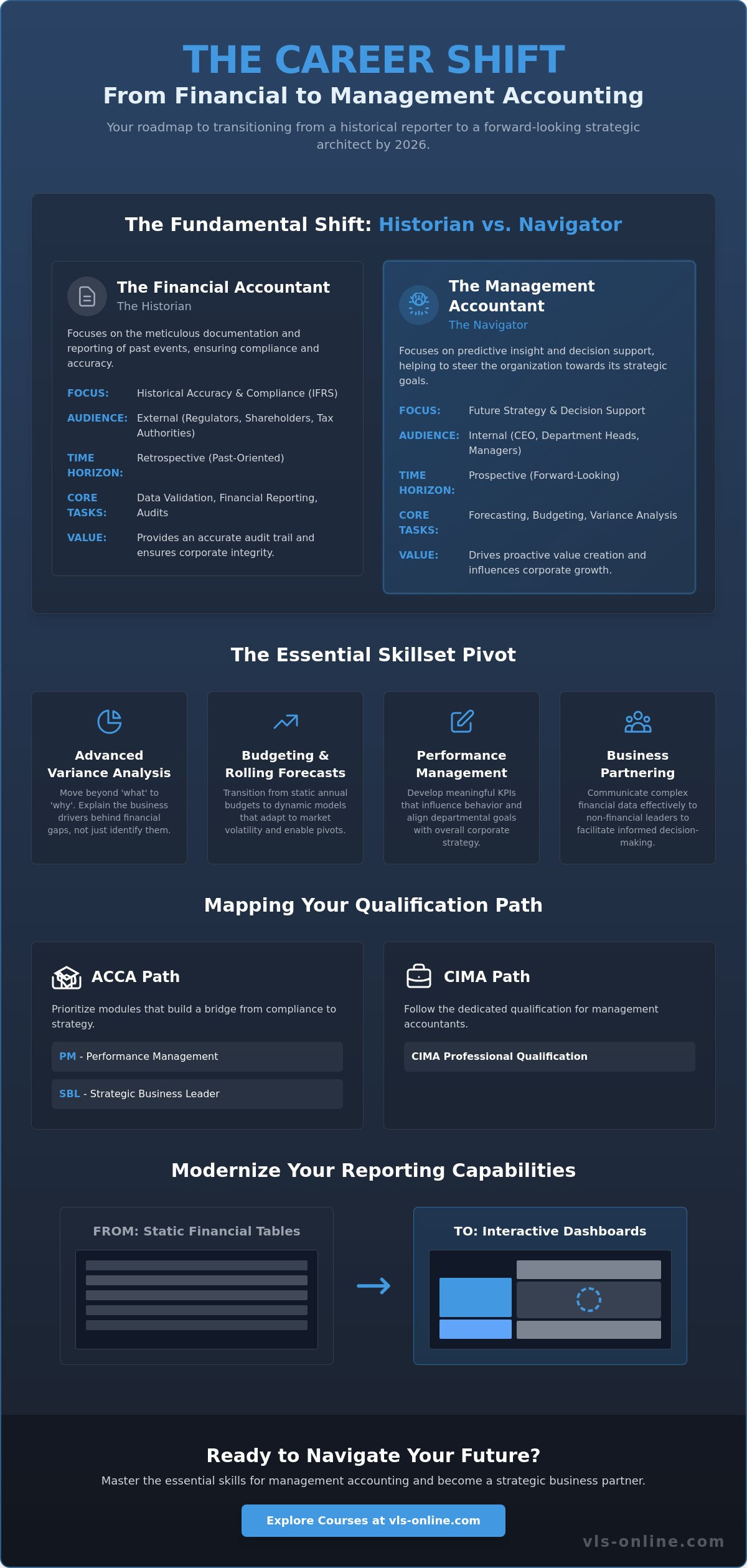
Financial accounting serves as the bedrock of corporate integrity, but it's fundamentally a retrospective discipline. In this role, your primary objective is the meticulous documentation of historical data, ensuring every transaction adheres to IFRS standards and regulatory requirements. It's a world of absolute accuracy where the audience is external, primarily tax authorities and shareholders who demand a precise audit trail. However, if you're exploring how to move from financial to management accounting, you must prepare for a shift toward a forward-looking, strategic mindset that prioritizes predictive insight over historical record-keeping.
Management accounting functions as the internal engine of business growth. Instead of focusing on what happened last quarter, you'll concentrate on forecasting, budgeting, and decision support. Learning how to move from financial to management accounting involves mastering this predictive capability. This transition is currently the most viable path for professionals aiming for C-suite positions in 2026, as modern CFOs are expected to act as strategic partners rather than just heads of reporting. By analyzing Management vs. Financial Accounting, it becomes clear that the value you provide shifts from compliance to proactive value creation.
The audience you serve changes significantly. You're no longer reporting to faceless regulators; you're partnering with CEOs and department heads. They don't need a list of past expenses. They need to know if current cash flow supports a planned expansion or how a price change might impact long-term profitability. This shift is about becoming a business partner who understands the operational pulse of the company.
The 'Historian' vs. The 'Navigator' Mindset
The transition often presents a psychological hurdle. Financial accountants are trained to pursue 100% accuracy, yet in the strategic environment, a decision-ready insight delivered today is often more valuable than a perfect report delivered next week. You'll need to balance the trade-off between precision and speed. In management accounting, the 'what' of the data is secondary to the 'why'. You aren't just reporting a variance; you're explaining the operational drivers behind it to leadership, helping them navigate complex market conditions with confidence.
The Skillset Pivot: Essential Competencies for Management Accountants
Executing a successful career transition requires more than a change in perspective; it demands a rigorous expansion of your technical and interpersonal capabilities. When you evaluate how to move from financial to management accounting, you'll find that data validation is replaced by data interpretation. You're no longer just confirming that the books are balanced. Instead, you're explaining why specific results occurred and how those results influence the organization's future trajectory.
The core competencies for this role center on the following areas:
Advanced Variance Analysis: You'll move beyond identifying gaps to explaining the underlying business drivers, such as identifying if a labor cost overrun was caused by operational inefficiency or a strategic decision to prioritize speed.
Budgeting and Rolling Forecasts: Mastering predictive financial modeling is essential. You'll transition from static annual budgets to dynamic forecasts that allow the business to pivot in response to market volatility.
Performance Management: This involves developing KPIs that actually influence employee behavior and lead to measurable business outcomes, ensuring departmental goals align with corporate strategy.
Business Partnering: This is the critical ability to communicate complex financial data to non-financial managers in a way that facilitates effective decision-making.
Technical Mastery: Beyond the General Ledger
A deep proficiency in data manipulation is non-negotiable in a strategy-focused environment. Mastering Advanced Excel for Accountants allows you to build sophisticated financial models that simulate various business scenarios. This technical foundation supports a move from rigid IFRS compliance toward internal cost-volume-profit (CVP) analysis. These models are essential for determining break-even points and margin safety levels, providing the clarity leadership needs to authorize new projects. If you're looking to strengthen these foundations, exploring ACCA courses focused on performance management can provide the structured learning path you need.
Soft Skills: The Language of Influence
Business Partnering is the ability to translate complex financial metrics into actionable strategic advice that non-financial managers can implement immediately. You don't just provide numbers; you provide context. Negotiation and persuasion skills are equally vital. To be effective, you need a seat at the strategy table where you can advocate for financial discipline while supporting operational growth.
Mapping Your Educational Path: ACCA and CIMA Roadmaps
Selecting a structured educational framework is a critical step in understanding how to move from financial to management accounting effectively. While your existing experience in financial reporting provides a solid technical base, the transition requires a focused academic pivot toward performance management and strategic leadership. The ACCA Applied Skills level acts as a primary bridge here. It moves you from the foundational principles of Financial Accounting (FA) to the analytical rigors of Performance Management (PM). For those targeting senior executive roles, the Advanced Performance Management (APM) optional paper is indispensable. It equips you with the sophisticated frameworks needed to evaluate complex organizational performance in a global context.
The CIMA Professional Qualification offers an alternative, highly specialized route. Unlike broader accounting certifications, CIMA is built from the ground up for the management discipline. It focuses heavily on the intersection of finance and business strategy. If you're currently planning your module selection, consulting an ACCA Applied Skills Guide can help you align your studies with your specific career objectives and ensure you don't overlook critical bridging modules.
ACCA vs. CIMA: Which is Right for Your Move?
The choice depends on your long-term regional and sectoral goals. ACCA's Management Accounting (MA) and Performance Management (PM) papers provide a robust transition for those already within the ACCA stream. These modules mirror the logic found in CIMA's P-pillar (Performance pillar), focusing on cost accounting and decision-making techniques. Utilizing Vertex Learning Solutions' tutor support ensures you master the strategic logic required to pass these exams, rather than just memorizing formulas. This professional guidance provides the safety net needed when tackling complex case study scenarios.
The Role of Specialist Certifications
Even in a management role, technical depth remains a protective asset. A Diploma in IFRS adds significant value within multinational environments where internal reporting must still align with group standards. Similarly, the Strategic Business Reporting (SBR) module is vital. It helps you understand how reporting decisions influence stakeholder perception and corporate reputation. To secure your professional future, you can access our full course library and begin your structured transition today.
Practical Steps to Execute Your Career Move
Transitioning into a strategic role requires a disciplined execution of specific career milestones. Knowing how to move from financial to management accounting is not merely about gaining theoretical knowledge; it's about demonstrating your capacity to drive business value before you even hold the title. You must shift your professional narrative from being a processor of data to a provider of insights. This involves a tactical approach to your daily responsibilities and a structured plan for your professional development.
Volunteer for cross-departmental projects: Proactively seek opportunities to work with sales, operations, or marketing teams. This builds the "business partnering" experience essential for understanding the operational drivers behind the numbers.
Master data visualization tools: Move beyond static Excel tables. Develop interactive dashboards that allow executives to visualize trends and anomalies in real-time, transforming raw data into a compelling narrative.
Align your studies with career goals: Use your exam preparation as a laboratory for real-world application. For a structured approach to your certifications, consult these Accounting Exam Study Tips to ensure your learning translates into professional authority.
Refine your CV: Update your professional profile to highlight "value added" rather than "reports produced." Focus on instances where your analysis led to cost savings, revenue growth, or improved operational efficiency.
Internal Transition vs. External Hire
An internal move is often the most secure path. Pitch your transition to the management accounting team by demonstrating how your deep understanding of the company's financial structure can enhance their forecasting accuracy. If an immediate move isn't available, look for "Commercial Accountant" or "Financial Analyst" roles. These positions serve as vital stepping stones, allowing you to build the analytical portfolio required for senior management accounting roles.
Leveraging the Vertex Learning Community
You don't have to navigate this complex transition in isolation. Our weekly live sessions provide a secure environment to discuss real-world management accounting scenarios with experienced tutors and peers. This interaction helps bridge the gap between exam theory and boardroom reality, giving you the confidence to speak the language of strategy. To begin your professional evolution, explore our full range of ACCA and CIMA courses and start your strategic pivot today.
Securing Your Strategic Future in Finance
The transition from compliance to strategy is a deliberate evolution that requires both a technical pivot and a fundamental psychological shift. You've explored the critical differences between being a historian of past data and a navigator of future business performance. By mastering advanced variance analysis and selecting the optimal educational roadmap through specialized ACCA or CIMA modules, you're positioning yourself at the center of organizational decision-making. Learning how to move from financial to management accounting is the most reliable method to ensure your professional longevity and relevance in an increasingly automated corporate environment.
Your journey toward becoming a strategic business partner deserves a structured and professional support system. Accelerate your career transition with Vertex Learning Solutions' ACCA & CIMA courses today. Our platform offers the security of direct expert tutor support via WhatsApp and immersive weekly live classroom simulations that mirror real-world business challenges. With our exam-focused study notes designed specifically for the 2026 cycles, you'll have the professional protective net required to master complex strategic logic with total confidence. The path from the general ledger to the strategy table is now open; your commitment to growth will define your success.
Frequently Asked Questions
Is it hard to move from financial accounting to management accounting?
The difficulty of the transition lies primarily in the psychological shift from absolute accuracy to decision-relevant reporting. You'll need to adapt to a faster pace where predictive insights are prioritized over historical reconciliation. While your technical base remains relevant, the application of data for strategic planning requires a proactive approach that many compliance-focused professionals find challenging at first.
Do I need a new certification to become a management accountant if I'm already an ACCA member?
You don't strictly require a new qualification, but focusing on specific strategic modules is essential for professional credibility. If you've already completed your ACCA, your foundation is secure. However, mastering the Strategic Business Leader (SBL) or Advanced Performance Management (APM) frameworks provides the specialized strategic logic needed for high-level management roles. These certifications demonstrate a commitment to moving beyond standard compliance-based reporting.
Which pays more: financial accounting or management accounting in 2026?
Management accounting roles generally offer higher compensation ceilings because they directly influence corporate profitability and strategy. Professionals who act as strategic partners are in higher demand than those focused solely on historical compliance. While entry-level salaries may be comparable, the growth trajectory for management accountants often leads to more lucrative C-suite positions where value creation is rewarded over data processing.
Can I move to management accounting without prior experience in budgeting?
Yes, you can transition by demonstrating a strong grasp of cost-volume-profit analysis and variance logic. When considering how to move from financial to management accounting without direct budgeting experience, focus on your ability to interpret financial trends. Use your existing reporting skills to show how you can provide predictive value to internal stakeholders through structured, logical analysis.
What is the most important skill for a management accountant?
Business partnering is the most critical competency in the current professional landscape. This involves the ability to translate complex financial metrics into actionable strategic advice for non-financial department heads. You must be able to communicate the logic behind the numbers. This ensures your insights lead to measurable improvements in organizational performance and operational stability.