Vertex Learning Solutions


What if the most decisive advantage for a non-finance leader in 2026 isn't a traditional MBA, but a rigorous professional accounting qualification? For many managers and entrepreneurs, the benefits of ACCA for non-accountants represent the difference between merely following a budget and actively shaping a company's fiscal future. You've likely experienced the discomfort of feeling "lost" during high-stakes financial reviews or the frustration of being unable to translate a technical project into clear ROI for stakeholders. It's a common pain point that creates an unnecessary dependency on finance teams for basic decision-making.
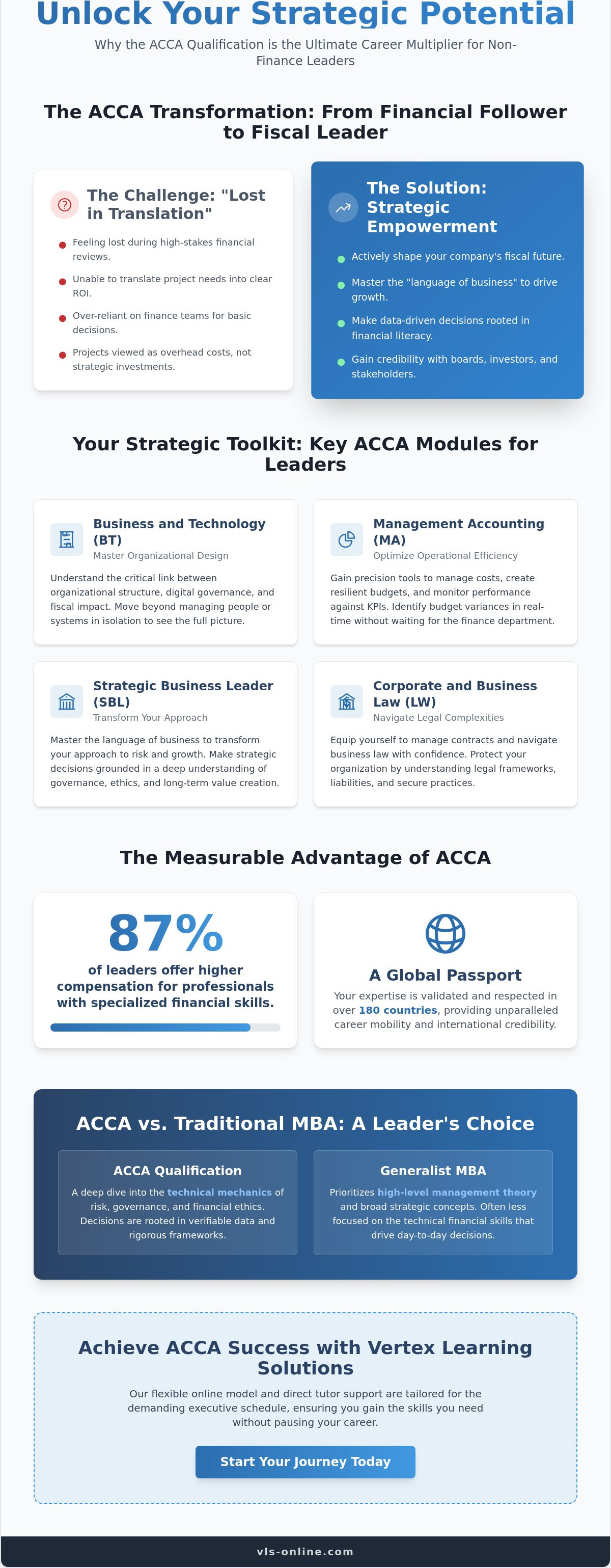
We'll show you how this qualification serves as a sophisticated strategic toolkit for those outside the finance department. You'll discover how mastering the "language of business" through modules like Strategic Business Leader (SBL) can transform your approach to risk and growth. We will examine how 87% of leaders now offer higher compensation for these specialized skills. You'll learn how to leverage this expertise to enhance your leadership profile in an increasingly complex, AI-driven market where financial literacy is the foundation of professional security.
Key Takeaways
- Understand how the ACCA qualification serves as a comprehensive global business framework, providing the foundational financial literacy required for modern leadership.
- Explore the strategic benefits of ACCA for non-accountants, specifically how to translate complex financial data into actionable insights for project ROI and organizational growth.
- Analyze the practical applications of the Business and Technology (BT) and Management Accounting (MA) modules for optimizing operational efficiency and departmental performance.
- Identify a streamlined roadmap for non-finance professionals to acquire targeted skills in performance management and strategic leadership through the Applied Knowledge level.
- Learn how Vertex Learning Solutions facilitates professional development through a flexible online model and direct tutor support tailored for the demanding executive schedule.
Beyond the Ledger: Why ACCA is the Global Language of Business
The Association of Chartered Certified Accountants (ACCA) provides much more than a ledger-based education. It functions as a comprehensive business framework designed to decode the complexities of the global market. While many perceive it as a path for auditors, the benefits of ACCA for non-accountants lie in its ability to provide a structured, logic-based approach to organizational health. In 2026, professional success isn't defined by siloed expertise. It requires a systems-level understanding of how capital, technology, and strategy intersect. This financial literacy has become a non-negotiable prerequisite for modern leadership.
Unlike a generalist MBA, which often prioritizes high-level management theory, ACCA offers a deep dive into the technicalities of risk, governance, and financial ethics. This technical rigor ensures that a leader's decisions are rooted in verifiable data. For international business consultants, the qualification's global portability serves as a universal credential. It validates your expertise across 180 countries, ensuring your strategic advice carries weight in any legal or economic jurisdiction. It's a professional safety net in an increasingly volatile regulatory environment.
The Shift from Compliance to Strategy
Modern business environments now demand "Integrated Reporting," a practice that blends financial data with sustainability and ESG performance. A project manager who understands a balance sheet moves beyond simple cost-tracking. They can analyze how project delays impact cash flow or how capital allocation affects long-term solvency. This shift from mere compliance to active strategy is essential for anyone aiming for the C-suite. You'll stop being a passive recipient of financial reports and start being an active architect of fiscal policy.
ACCA as a Career Multiplier
For roles like an Operations Director or a Head of HR, holding an ACCA qualification acts as a significant career multiplier. It builds immediate credibility with board members and investors who need to know that leadership understands the fiscal consequences of operational decisions. By mastering these competencies through specialized ACCA courses, non-finance professionals gain a protective professional shield. This ensures their projects are seen as strategic investments rather than overhead costs, significantly enhancing their influence within the organization.
Strategic Skills: How ACCA Empowers Non-Finance Leaders
The true power of the qualification lies in its modular structure, which allows professionals to acquire specific, high-impact competencies. For an HR Director or a Chief Technology Officer, the Business and Technology (BT) module provides a sophisticated understanding of how organizational structure and digital governance interact. It's no longer enough to manage people or systems in isolation. You must understand the fiscal ripple effects of every operational pivot. ACCA provides the analytical framework to turn raw data into strategic foresight. By internalizing these principles, leaders can differentiate themselves through a certification that proves technical depth beyond general management theory.
Operational efficiency is often the primary driver for those seeking the benefits of ACCA for non-accountants. The Management Accounting (MA) module serves as a precision tool for this purpose. It teaches you how to manage costs, create resilient budgets, and monitor performance against strategic KPIs. Instead of relying on the finance department to explain why a project is over budget, you'll have the skills to identify variances in real-time. Similarly, the Corporate and Business Law (LW) module is invaluable for contract management. It equips you to navigate the complexities of fraudulent behavior and criminal liability, ensuring your business dealings remain within a secure legal framework.
Mastering Digital Transformation and Tech
The 2026 syllabus has been specifically redesigned to address the intersection of finance and technology. With an increased focus on data analytics, AI prompting, and fintech, the qualification ensures you're prepared for the automated future. You can explore how these tech-finance synergies begin at the foundational level in this guide to ACCA Applied Knowledge. This foundation is essential for leaders who must govern AI systems and validate the integrity of digital financial data.
Risk Management and Corporate Governance
Systemic risk identification is a core pillar of the ACCA curriculum. Non-accountants learn to view their departments through the lens of corporate governance and ethical responsibility. This is particularly relevant as ESG (Environmental, Social, and Governance) requirements become more stringent in 2026. The framework helps you navigate these non-financial performance metrics with the same rigor applied to a profit and loss statement. If you're ready to build this professional shield, consider exploring the structured ACCA curriculum to find the right entry point for your career stage.
The Non-Accountant’s Roadmap: Navigating the ACCA Path
A common misconception is that the benefits of ACCA for non-accountants only materialize after completing the entire 13-exam syllabus. In reality, the qualification is structured as a progressive journey where value is unlocked at every level. For those in leadership roles, the goal isn't necessarily to become a chartered accountant but to acquire a specific set of financial tools. This roadmap allows you to target modules that offer the highest return on investment for your specific career trajectory.
The first stage involves the Applied Knowledge level. These three papers build a high-impact foundation in business technology and management accounting. With pass rates for these papers historically ranging between 60% and 87%, this level is highly accessible and provides immediate dividends in understanding organizational finances. From there, you can pivot to the Applied Skills level, specifically focusing on Performance Management (PM). This module is essential for ROI-focused roles, as it provides the methodology to evaluate departmental efficiency and project viability with clinical precision.
For professionals in international law or global trade, the Diploma in IFRS (DipIFR) offers a specialized alternative. With the 2026 focus on IFRS 18, which replaces IAS 1, understanding these global standards is critical for maintaining regulatory compliance across borders. Finally, the Strategic Business Leader (SBL) module serves as the ultimate executive capstone. It integrates technical knowledge with high-level strategy, preparing you to lead at the board level with total confidence.
Choosing the Right Entry Point
You don't always have to start from the beginning. Many professionals with non-finance degrees are eligible for exemptions, allowing them to skip foundational papers and move directly into more strategic content. It's vital to assess your eligibility to save time and resources. For a detailed breakdown of how to enter the qualification at a higher level, you can consult our guide to ACCA Applied Skills.
Specializing Without Becoming an Auditor
You can tailor your learning to suit your operational needs. If your focus is on cost optimization and internal efficiency, the Management Accounting stream is your best path. Alternatively, those working in global regulatory environments should consider the Diploma in IFRS to master the complexities of international reporting. If you're ready to define your own professional roadmap, explore our modular course options to find the perfect fit for your leadership goals.
Achieving ACCA Success with Vertex Learning Solutions
For a non-finance executive, the greatest barrier to upskilling isn't intellectual capacity; it's the scarcity of time. Vertex Learning Solutions (VLS) addresses this by providing a structured, digital-first environment that respects the constraints of a leadership schedule. One of the primary benefits of ACCA for non-accountants is the ability to leverage financial data for decision-making, but the transition requires expert guidance. VLS acts as the bridge between daunting accounting jargon and practical business application. Rather than struggling with complex concepts in isolation, students benefit from direct WhatsApp tutor support. This model ensures that technical roadblocks are cleared quickly, allowing you to maintain momentum. Weekly live sessions simulate a professional classroom environment, allowing for real-time interaction and peer discussion without the need for physical travel.
Expert Support for Career Switchers and Upskillers
VLS provides exam-focused study notes that cut through technical noise, focusing strictly on what's required for professional mastery. This targeted approach is ideal for professionals who need to upskill rapidly without sacrificing their current output. You don't need to sift through thousands of pages of theory. Instead, you'll receive a refined professional toolkit designed for high-impact learning. To begin your journey, explore our ACCA courses online for a foundation tailored to your specific industry needs.
Tailored Learning for Global Professionals
Global leadership often involves navigating multiple time zones and unpredictable schedules. VLS accommodates this by providing recorded lectures accessible at any hour, ensuring that professional development never conflicts with operational duties. It's a system designed for those who demand excellence but require flexibility. To fully integrate these financial competencies into your leadership profile, enroll in a full access package to master the financial side of your industry with total professional security.
Securing Your Strategic Future in 2026
Mastering the intersection of finance, technology, and governance is the ultimate differentiator for the modern leader. We've explored how the benefits of ACCA for non-accountants extend far beyond basic bookkeeping, providing a robust analytical framework for operations, HR, and legal professionals. By targeting specific modules like Performance Management or Strategic Business Leader, you'll gain the precise technical depth needed to turn complex data into actionable growth strategies. This qualification doesn't just add a credential to your CV; it fundamentally changes how you perceive and manage organizational risk.
Vertex Learning Solutions provides the professional safety net you need to navigate this rigorous journey alongside a demanding career. You'll benefit from real-time WhatsApp tutor support and weekly live sessions that simulate a collaborative classroom environment. Our exam-focused materials are engineered to cut through the noise, ensuring high pass rates for busy executives who need results, not fluff. It's time to bridge the gap between technical project management and financial ROI. Start your ACCA journey with Vertex Learning Solutions today and claim your seat at the strategic table with total confidence. Your future leadership potential is a direct result of the technical foundations you build today.
Frequently Asked Questions
Do I need a math background to study ACCA as a non-accountant?
You don't need advanced mathematics to succeed in the qualification. The curriculum prioritizes logical reasoning, data interpretation, and the ability to apply financial principles to complex business scenarios. While basic arithmetic is necessary, the exams focus on the strategic implications of numbers rather than complex calculus. This accessibility is one of the primary benefits of ACCA for non-accountants who wish to master the language of business without a specialized math degree.
Can I take only specific ACCA modules without completing the full qualification?
Yes, professionals can choose to study specific modules that align with their immediate career objectives. You aren't required to complete all 13 exams if your goal is targeted upskilling in areas like Performance Management (PM) or Corporate and Business Law (LW). This modular flexibility allows managers to build a custom toolkit for operational efficiency or contract oversight without the multi-year commitment of full membership. It provides a surgical approach to professional development.
How long does it take for a non-finance professional to see the benefits of ACCA?
The advantages of the qualification are realized as soon as you complete your first module. Unlike long-term degrees, each paper delivers immediate, practical skills that you can apply to your current role. For instance, completing the Management Accounting (MA) module provides instant clarity on budgeting and cost control. Industry data from 2026 suggests that 87% of leaders prioritize candidates with these specialized skills, leading to faster career progression and improved decision-making.
Is ACCA better than an MBA for non-accountants in 2026?
In the current business landscape, ACCA often provides a more rigorous technical foundation than a generalist MBA. While an MBA focuses on broad leadership theory, ACCA delivers specific expertise in risk management, international reporting standards, and corporate governance. For non-accountants, this technical depth acts as a professional shield, ensuring that strategic decisions are backed by financial reality and regulatory compliance. It's the definitive choice for those seeking specialized differentiation in a competitive market.
What are the entry requirements for non-accountants starting ACCA?
Entry requirements depend on your existing educational background and professional experience. Most professionals with a recognized university degree can enter directly and may even qualify for exemptions from foundational papers. For those without a degree, the minimum requirement typically includes two A-levels and three GCSEs in separate subjects, including English and Mathematics. This inclusive pathway ensures that professionals from diverse backgrounds can access the strategic benefits of ACCA for non-accountants.