Vertex Learning Solutions


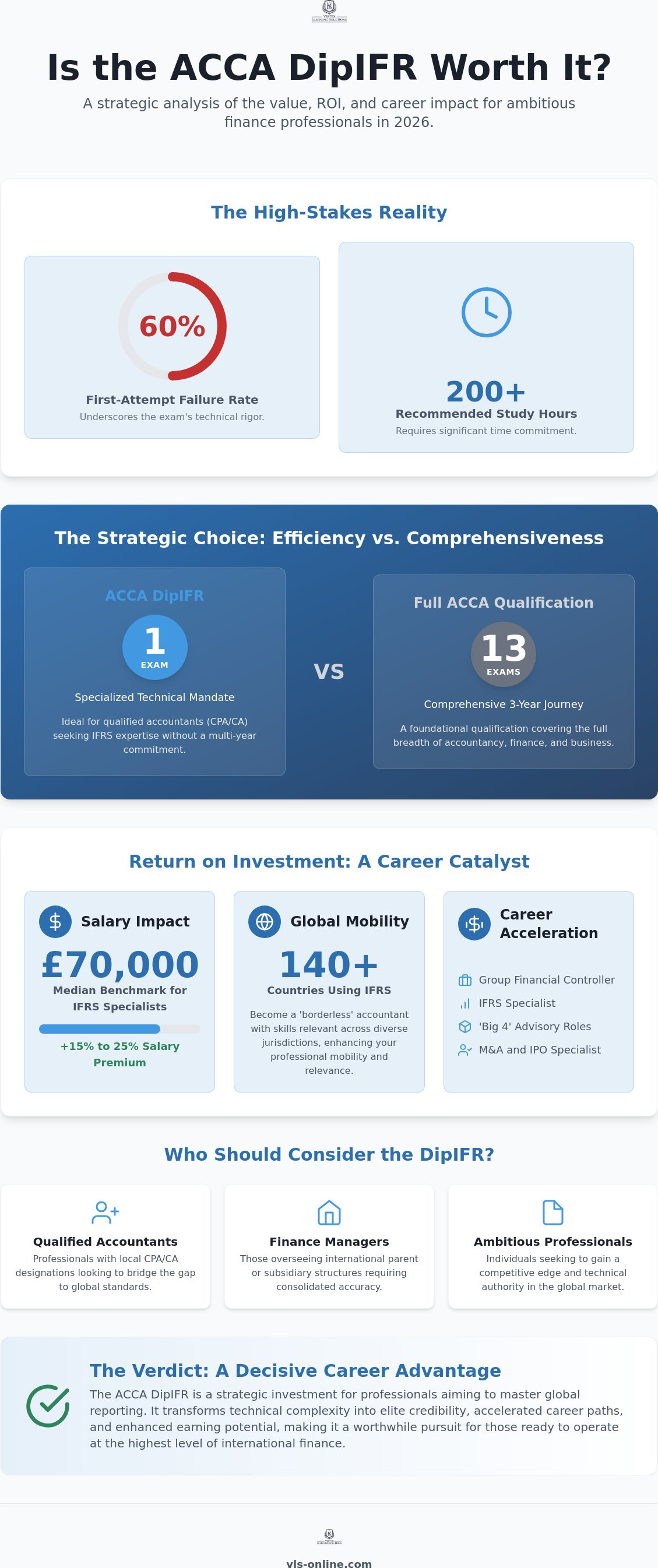
Nearly 60% of candidates fail the ACCA DipIFR on their first attempt, a statistic that underscores the rigorous technical authority required to master global reporting. If you feel restricted by local accounting frameworks, you're likely questioning whether the intense 200-hour study commitment will yield a genuine return on investment. The central question for many ambitious professionals remains: is dipifr worth it in a volatile global market? We understand the anxiety that stems from balancing a demanding career with such a high-stakes examination.
This strategic analysis provides the clarity you need to decide if this qualification is your optimal next move. We'll explore the definitive career value and salary impact, including the £70,000 median benchmark for IFRS specialists. By the end of this guide, you'll have a clear understanding of the professional trade-offs involved and a structured framework to ensure you navigate the complexities of the 2026 exam cycle with confidence and precision. We provide the professional safety net you need to transform technical complexity into a decisive career advantage.
Key Takeaways
- Gain a comprehensive understanding of how the Diploma in IFRS acts as a strategic bridge between local reporting and global financial frameworks.
- Analyze the definitive salary benchmarks and global mobility benefits to conclude whether the ACCA DipIFR is worth it for your 2026 career objectives.
- Distinguish between the introductory Certificate in IFRS and the professional Diploma to ensure your credentials match your desired level of authority.
- Learn how to navigate the rigorous exam structure and complex consolidation standards through a structured, expert-led preparation strategy.
- Access a professional safety net designed to mitigate the risks of high failure rates and optimize your study time for a first-attempt pass.
Table of Contents
Understanding the Strategic Value of DipIFR in 2026
The Diploma in International Financial Reporting (DipIFR) isn't just an additional certificate; it's a specialized technical mandate. Developed by the Association of Chartered Certified Accountants (ACCA), this qualification serves as a critical bridge for those anchored in local GAAP who need to transition to global reporting standards. As we move through 2026, the question of whether is dipifr worth it becomes clearer when you observe the shift in multi-national corporate requirements. IFRS expertise has transitioned from a niche advantage to a non-negotiable prerequisite for senior finance roles within globalized markets.
Who should consider the Diploma in IFRS?
Qualified accountants often reach a plateau where local expertise no longer facilitates upward movement. If you're a finance manager overseeing international parent or subsidiary structures, you need a common language to ensure regulatory compliance and consolidated accuracy. Professionals seeking specialist accounting qualifications use this diploma to boost their global mobility. It's specifically tailored for those with existing degrees or significant accounting experience who require a professional safety net against technical obsolescence.
DipIFR vs. Full ACCA: The Strategic Choice
Choosing between the full ACCA qualification and the DipIFR is a matter of strategic resource allocation. While the full ACCA involves a comprehensive 13-exam journey, the DipIFR is a single, high-level specialist exam. This makes it an ideal path for those who already hold a local CPA or CA designation but need the technical depth found at the ACCA Strategic Professional level. You gain expert-level reporting skills without committing to a multi-year program. For many, this efficiency is exactly why is dipifr worth it in a fast-paced corporate environment. You can find structured, exam-focused preparation for this specific path through the DipIFR program at Vertex Learning Solutions.
The ROI Analysis: Salary, Authority, and Global Mobility
Measuring the return on investment for professional credentials involves more than just looking at the initial exam fees. When you ask if is dipifr worth it, you're essentially weighing six months of intensive study against a lifetime of expanded career horizons. Certified professionals often command a salary premium of 15% to 25%, a figure that reflects the scarcity of high-level technical expertise in the current market. This advantage is supported by the global adoption of International Financial Reporting Standards (IFRS), which are now utilized in over 140 countries. By becoming a 'borderless' accountant, you gain the mobility to transition between diverse jurisdictions without losing professional relevance.
Efficiency defines this strategic move. While a full qualification might take three years to complete, the Diploma allows you to achieve specialist status in a fraction of that time. You'll develop a mastery of complex standards such as IFRS 9 (Financial Instruments), IFRS 15 (Revenue from Contracts), and IFRS 16 (Leases). This builds elite credibility among peers and executive leadership alike, ensuring your contributions are viewed through the lens of technical authority.
Career Path Acceleration
This qualification serves as a catalyst for entry into 'Big 4' advisory or specialized corporate reporting roles. It prepares you for high-level titles such as Group Financial Controller or IFRS Specialist. If your career trajectory involves international mergers, acquisitions, or initial public offerings (IPOs), the technical depth provided here is indispensable. You're no longer just reporting data; you're interpreting the strategic implications of global standards.
The 'Expert' Perception
Recruiters search for specific signals of authority. Adding the 'DipIFR' suffix to your profile immediately changes how your expertise is perceived by stakeholders and hiring managers. It signals that you've moved beyond basic reporting into the realm of complex interpretation and application. This builds a foundation of trust that is vital when navigating complicated regulatory environments. To maximize your chances of securing this professional edge, engaging with structured DipIFR preparation can provide the necessary safety net for your exam success.
Difficulty vs. Value: Is the Challenge Worth the Reward?
The ACCA Diploma in International Financial Reporting (DipIFR) is notoriously rigorous, demanding a fundamental shift from passive knowledge to active technical application. Many candidates find the transition difficult because the exam doesn't reward simple memorization; it requires the ability to interpret complex scenarios under significant time pressure. With a global pass rate of 46% in the December 2025 session, it's clear that success isn't guaranteed. When evaluating if is dipifr worth it, you must recognize that the difficulty itself creates the qualification's elite market value. High barriers to entry ensure that those who hold the diploma are recognized as true specialists.
Comparing IFRS Certification Levels
Choosing the right level of certification is a strategic decision. The Certificate in IFRS is an introductory route best suited for basic awareness and junior-level understanding. In contrast, the Diploma is a professional-level credential designed for those who sign off on financial statements or lead reporting teams. While the Certificate often utilizes simpler assessment methods, the Diploma involves a three-hour and fifteen-minute computer-based exam that tests deep analytical skills across consolidated accounts and complex standards.
Managing the Work-Study Balance
Success in the 2026 exam cycle depends on your ability to integrate accounting exam study tips into a demanding professional schedule. You'll need to dedicate approximately 200 hours of study to master the syllabus. We recommend prioritizing mock exams and past paper practice to familiarize yourself with the reasoning-heavy nature of current questions. This structured approach helps you move from the 60% of candidates who fail their first attempt into the successful minority. To secure your path to success with a professional safety net, explore the DipIFR preparation resources at Vertex Learning Solutions.
Strategic Preparation: How to Pass DipIFR on Your First Attempt
Success in this rigorous examination is never an accident. While self-study remains a theoretical option, the 60% first-time failure rate suggests that navigating the complexities of international standards alone is a high-risk strategy. Professional tuition acts as a technical safety net; it provides the structure necessary to move beyond rote learning into the realm of professional application. Expert guidance is often the deciding factor in whether you pass or find yourself caught in a cycle of expensive repeat attempts. If you value your time and career momentum, is dipifr worth it only when paired with a methodology that ensures a definitive result.
The Vertex Advantage for DipIFR Students
Vertex Learning Solutions provides a structured environment designed for busy professionals who cannot afford wasted effort. By utilizing active WhatsApp tutor support, students receive instant clarification on challenging areas like IFRS 9 or complex consolidation adjustments. Weekly live sessions simulate an elite classroom environment, which significantly improves retention compared to passive reading. This proactive approach simplifies the most daunting technical questions into manageable, logical frameworks. You can access these resources through our Diploma in IFRS course to begin your preparation with confidence.
Your 6-Month Success Roadmap
A disciplined timeline is essential for mastering the 200-hour syllabus without burnout. We recommend a phased approach that balances technical mastery with exam technique:
- Months 1-3: Focus on concept mastery. Review recorded lectures and study notes to build a stable foundation in every standard.
- Months 4-5: Shift toward intensive question practice. Participate in tutor-led workshops to refine your reasoning and application skills.
- Month 6: Dedicate this final period to mock exams. Simulating the computer-based environment is vital for building the stamina and confidence required on exam day.
The final verdict is clear. If you have a structured plan and expert support, the return on your investment will be substantial. The technical authority and global mobility you gain make the ACCA DipIFR worth it for any accountant aiming for a senior, multi-national reporting role in 2026. Precision in your preparation today ensures professional security tomorrow.
Securing Your Professional Authority in a Global Market
The financial landscape of 2026 demands more than just generalist accounting knowledge; it requires a specialized technical language that transcends borders. We've examined the significant salary impact and the rigorous application-based format of the current exam cycle. The answer to whether is dipifr worth it is a resounding yes for those aiming for elite corporate roles and global mobility. Success depends on your ability to master complex IFRS standards and apply them with precision under significant pressure.
To navigate this path with confidence, you need a professional safety net. Vertex Learning Solutions offers the structured guidance required to ensure you don't fall into the high percentage of candidates who fail their first attempt. Our program provides exam-focused study notes, weekly live interactive sessions, and direct WhatsApp tutor support for immediate clarification of complex standards. This methodology simplifies technical complexity into a logical, manageable framework.
Take the decisive step toward your professional advancement today. Enroll in the Vertex DipIFR Course for Expert Tutor Support and transform technical challenges into your most significant career advantage. We're committed to ensuring your transition to international reporting is stable, successful, and strategically sound.
Frequently Asked Questions
What is the difference between DipIFR and the Certificate in IFRS?
The primary distinction lies in the depth of technical application and the professional authority granted. While the Certificate in IFRS provides an introductory awareness of international standards, the Diploma in IFRS is a professional-level credential designed for those responsible for signing off on financial statements. The Diploma's computer-based exam focuses on complex interpretation rather than just basic recognition, making it the definitive choice for senior reporting roles.
Can I take the DipIFR exam without being an ACCA member?
You don't need to be an ACCA member to attempt the DipIFR. This qualification is specifically structured as a standalone specialist module for professionals who may already hold local CPA or CA designations. It offers a strategic bridge to international standards without requiring the multi-year commitment of the full ACCA qualification. This flexibility allows experienced accountants to gain global technical authority while maintaining their existing professional memberships.
How many hours of study are required to pass DipIFR?
Candidates should dedicate approximately 200 hours of focused study to successfully navigate the DipIFR syllabus. This commitment includes reviewing recorded lectures, mastering the logic of various standards, and engaging in intensive question practice. Many professionals ask if dipifr worth it when considering this requirement, but the resulting technical authority justifies the investment. Distributing these hours over a structured six-month roadmap is essential for building the analytical stamina required for the exam.
Is the Diploma in IFRS recognized in the USA or Canada?
Recognition depends on the specific regulatory environment of each jurisdiction. While the USA primarily utilizes US GAAP, IFRS is the reporting standard for publicly accountable enterprises in Canada. For professionals working within multi-national corporations or firms with international clients in these regions, the DipIFR provides significant technical credibility. It signals a mastery of the global reporting language used in over 140 countries, even where local standards still prevail.
What are the eligibility criteria for the DipIFR exam in 2026?
Eligibility for the 2026 exam cycle requires meeting one of three specific professional criteria. You must either be a member of a recognized professional accounting body, hold a relevant university degree with two years of accounting experience, or possess the ACCA Certificate in International Financial Reporting alongside two years of experience. These requirements ensure that candidates have the foundational knowledge necessary to handle the rigorous, application-based nature of the diploma.