Vertex Learning Solutions


What if the thirteen exams you're currently navigating are actually the most straightforward part of your journey toward professional accreditation? While the academic load is significant, many aspirants find that the true challenge lies in the strategic alignment of technical knowledge with the rigorous ACCA membership requirements. It's common to feel a sense of fatigue when balancing a full-time career with the 7-year Strategic Professional time limit, especially when the path to documenting your professional impact feels opaque.
We understand that you seek more than just a list of rules; you require a professional safety net to ensure your efforts translate into a chartered status. This guide promises to help you master the three essential pillars of ACCA membership with our expert roadmap to becoming a chartered certified accountant. You'll find a structured checklist of the 2026 regulations, proven strategies to accelerate your exam progress, and a clear framework for documenting your Practical Experience Requirements (PER) with absolute precision.
Key Takeaways
- Master the tripartite structure of the qualification, which integrates 13 technical examinations, 36 months of supervised experience, and professional ethics.
- Plan your progression from Applied Knowledge to Strategic Professional levels to effectively manage the seven-year time limit and maintain professional momentum.
- Implement precise methods for documenting the Practical Experience Requirement (PER) to ensure your professional milestones are officially recognised by your supervisor.
- Gain a comprehensive understanding of the 2026 ACCA membership requirements, providing you with a secure roadmap from completing your final paper to achieving full chartered status.
- Discover how the Ethics and Professional Skills Module (EPSM) bridges the gap between academic theory and the high-level integrity required in a modern regulatory environment.
Table of Contents
- The Three Pillars of ACCA Membership Requirements
- Navigating the 13 Exams: From Applied Knowledge to Strategic Professional
- Mastering the Practical Experience Requirement (PER) and Ethics
- The Final Steps: Application, Fees, and Achieving Membership
The Three Pillars of ACCA Membership Requirements
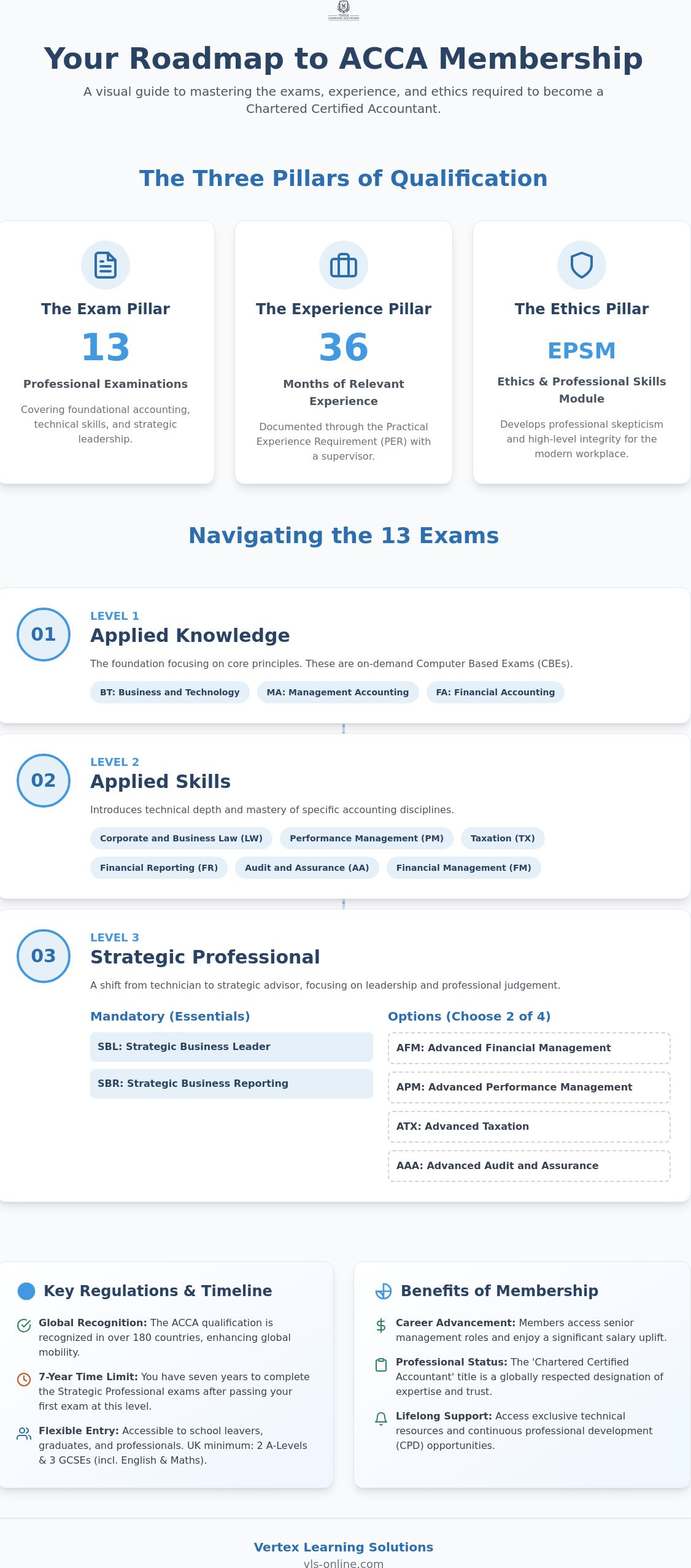
Achieving the status of a Chartered Certified Accountant requires a strategic commitment to three foundational areas. The Association of Chartered Certified Accountants (ACCA) has designed a framework that ensures every member possesses technical knowledge, practical competence, and ethical integrity. Meeting the full ACCA membership requirements involves a synchronized approach to these components, ensuring you don't just pass tests but actually grow as a professional leader.
This professional designation is built upon three mandatory pillars:
The Exam Pillar: You must complete 13 professional examinations, ranging from foundational accounting to strategic leadership, unless your previous qualifications grant you specific exemptions.
The Experience Pillar: You're required to document 36 months of relevant, supervised work experience through the Practical Experience Requirement (PER), which can be completed before, during, or after your exams.
The Ethics Pillar: The Ethics and Professional Skills Module (EPSM) provides the necessary grounding in professional skepticism and high-level integrity required in modern finance.
Why ACCA Membership Matters in 2026
The global landscape in 2026 demands accountants who can navigate complex regulatory environments across borders. Holding this qualification provides enhanced global mobility, as it's recognized in over 180 countries. Beyond the prestige of "chartered" status, members typically access senior management roles and enjoy a measurable salary uplift compared to non-qualified peers. Membership also provides a professional protective layer through lifelong learning and exclusive access to technical resources through Continuous Professional Development (CPD).
Who is Eligible to Start?
The pathway is accessible to a wide range of candidates. School leavers, university graduates, and mature students can all find a suitable entry route. It's essential to investigate potential exam exemptions based on your prior academic achievements to avoid redundant study and accelerate your progress. For UK-based students, the minimum entry requirement consists of two A-levels and three GCSEs in five separate subjects, including English and Mathematics. You can explore structured ACCA courses to begin your journey with a clear, professional roadmap.
Navigating the 13 Exams: From Applied Knowledge to Strategic Professional
The exam journey is often perceived as the most arduous of the ACCA membership requirements. However, viewing these 13 papers as a strategic progression rather than a hurdle allows for better mental preparation. The curriculum is divided into three distinct tiers, each designed to build upon the last. You can explore our comprehensive ACCA courses to see how this progression is structured for maximum efficiency. Understanding how each level contributes to the broader ACCA membership requirements helps maintain focus during long study sessions.
The Applied Knowledge Foundation
The journey begins with ACCA Business and Technology (BT), Management Accounting (MA), and Financial Accounting (FA). These On-Demand Computer Based Exams (CBEs) focus on core principles and require a different study approach than later papers. Because they're available year-round, students often underestimate the discipline required. You're building the professional lexicon here. For a deeper dive into this starting point, refer to our guide on ACCA Applied Knowledge.
Once the foundation is secure, the Applied Skills level introduces technical depth. You'll master specific disciplines like Taxation (TX), Audit and Assurance (AA), and Financial Reporting (FR). This is where the workload intensifies, requiring a balance between calculation and theory. It's the stage where many candidates begin to feel the pressure of balancing full-time work with the 13-exam requirement.
Conquering the Strategic Professional Level
This final tier represents a significant shift in expectations. You're no longer just a technician; you're a strategic advisor. Strategic Business Leader (SBL) and Strategic Business Reporting (SBR) are mandatory. You must also select two options from Advanced Financial Management (AFM), Performance Management (APM), Taxation (ATX), or Audit (AAA). Choosing these based on your career trajectory, rather than perceived difficulty, is vital for long-term success. To navigate this complexity, you might consider getting full access to SBR preparation to ensure you meet the high standards of modern reporting.
Mastering the Practical Experience Requirement (PER) and Ethics
Theoretical mastery remains incomplete without the ability to apply it in a high-stakes business environment. The Practical Experience Requirement (PER) serves as the bridge between academic knowledge and professional competence. As a core part of the ACCA membership requirements, you must complete 36 months of supervised experience. This timeframe isn't restricted to your post-exam life; you can count relevant work performed before, during, or after your studies. Your Practical Experience Supervisor plays a vital role here, acting as a mentor who verifies your progress across nine specific performance objectives.
These objectives are structured to ensure a well-rounded professional profile. You'll complete five "Essentials" objectives covering professional ethics and governance, then select four "Technical" objectives that align with your specific role in audit, taxation, or financial management. This structure ensures that your qualification is both rigorous and relevant to your chosen career path.
How to Document Your Professional Impact
Effective documentation is often the most overlooked aspect of the process. You're required to write "challenge questions" for each objective, which are brief narratives demonstrating your practical competence. Success lies in mapping your daily tasks to these requirements with precision. If you find the administrative side of the qualification overwhelming, our full access packages provide the structured support needed to manage your professional documentation alongside your exams.
The Ethics and Professional Skills Module (EPSM)
The EPSM is a 20-hour interactive module that shifts the focus from calculation to professional judgment. It's not a traditional exam, yet it's essential for meeting the full ACCA membership requirements in 2026. Completing this module before your Strategic Professional papers, particularly SBL, gives you a significant advantage. It develops the professional skepticism and communication skills required to handle complex case studies. For more insights on integrating these modules into your schedule, see our accounting exam study tips. To ensure your career stays on track, visit vls-online.com to find a course that matches your current professional level.
The Final Steps: Application, Fees, and Achieving Membership
Passing your final Strategic Professional paper is a landmark achievement, yet it marks the beginning of a final administrative transition. You're now an "Affiliate," a status that holds until all three pillars of the ACCA membership requirements are officially reconciled. The process is methodical. Once your 36 months of experience and the ethics module are verified in the portal, ACCA will issue a formal invitation to apply for full membership. This isn't an immediate shift; it requires a final review of your professional records to ensure every standard has been met with precision.
Professional accreditation involves specific financial commitments that support the organization's global regulatory framework. For 2026, the admission to membership fee is £326, which is matched by an annual membership subscription fee of £326. These fees secure your place in a global network and provide the professional safety net necessary for high-level practice. To maintain your standing, you'll also need to engage in Continuing Professional Development (CPD), documenting 40 credits of learning each year to ensure your expertise remains current.
The "ACCA" Letters: Professional Branding
Displaying the "ACCA" designation on your LinkedIn profile and CV is a powerful statement of your strategic value. It's essential to wait for formal confirmation before using these letters, as they represent a protected professional title. After five years of continuous membership and compliant CPD records, you'll be elevated to Fellowship status, earning the right to use the "FCCA" letters. You can begin building this high-level expertise today with our Advanced Financial Management resources.
Next Steps for Aspiring Members
Reaching the finish line requires a disciplined 12-month roadmap. Your plan should balance your final Strategic Professional papers with regular updates to your PER objectives. Many students find that the complexity of the final papers, combined with professional responsibilities, makes tutor support indispensable for maintaining momentum. Join Vertex Learning Solutions to access expert-led ACCA preparation and the tutor-backed support you need to navigate these final requirements with confidence.
Securing Your Professional Future as a Chartered Accountant
Navigating the rigorous landscape of international accreditation requires a disciplined approach to the three mandatory pillars. You've seen how the ACCA membership requirements demand a precise balance of technical examination success, 36 months of verified experience, and a deep grounding in professional ethics. Achieving this elite status isn't just about passing your final paper; it's about the strategic documentation of your professional impact and the methodical transition from Affiliate to Member status.
Your journey toward becoming a chartered certified accountant doesn't have to be a solitary endeavor. We provide the professional safety net you need to manage your studies alongside your career commitments. With expert tutor support via WhatsApp, weekly live sessions, and exam-focused study notes, you can approach every challenge with absolute confidence. Our structured approach simplifies the complex, ensuring your progress remains stable and predictable throughout the final stages of your qualification.
Achieve your ACCA goals with Vertex Learning Solutions—Explore our courses. Your professional future is within reach, and with the right strategic partner, you'll navigate these milestones with ease.
Frequently Asked Questions
How long does it take to meet all ACCA membership requirements?
Completion typically spans three to four years of disciplined study and professional practice. Since the Practical Experience Requirement necessitates 36 months of supervised work, this timeframe often dictates the minimum duration. Most candidates synchronize their 13 professional examinations with their employment to meet the full ACCA membership requirements within this window while adhering to the seven-year limit for the Strategic Professional level.
Can I get ACCA membership without a university degree?
You can certainly achieve membership without a prior university degree through the Foundations in Accountancy pathway. This entry route is specifically designed for school leavers or mature students, allowing them to build foundational knowledge before progressing to the main qualification. It ensures that professional accounting remains an accessible career path for dedicated individuals regardless of their initial academic background.
What counts as relevant practical experience for the PER?
Relevant experience includes any role where you apply accounting and finance principles, such as financial reporting, audit, taxation, or management accounting. To satisfy the ACCA membership requirements, your work must be supervised by a qualified Practical Experience Supervisor. This ensures your professional development is verified against the five essential and four technical performance objectives mandated by the Association.
Do I need to pay a fee to become an ACCA member?
Yes, achieving and maintaining membership involves specific professional fees. Upon being invited to join, you'll need to pay a one-time admission fee of £326. Subsequently, an annual membership subscription of £326 is required to retain your chartered status and access the exclusive resources and global recognition provided by the organization.
What happens if I fail to complete my CPD after becoming a member?
Failing to meet Continuing Professional Development requirements can jeopardize your professional standing and lead to removal from the member register. As membership is a commitment to lifelong learning, the Association monitors compliance to ensure every member maintains high technical standards. If you encounter difficulties, it's vital to communicate with the regulatory body early to discuss potential extensions or waivers.