Vertex Learning Solutions


What if the greatest barrier to your global accounting career isn't the complexity of IFRS standards, but the administrative hurdle of proving you belong in the exam room? For many senior practitioners, the path to international recognition feels obscured by the technicalities of the entry requirements for DipIFR. You might worry if your specific degree is considered relevant enough or feel a sense of unease regarding the Experience Confirmation Form. It's a high-stakes process where a single documentation error can delay your professional advancement by an entire cycle. We recognise that you don't just need information; you need a professional protective net to navigate these regulations.
This guide is designed to help you master the eligibility criteria and documentation process, ensuring you secure your place in the globally recognised Diploma in International Financial Reporting. We will provide a clear confirmation of your eligibility status, offer a step-by-step documentation checklist, and outline the precise path from CertIFR to DipIFR for the 2026 sessions. By the end of this analysis, you'll have the calm confidence that comes from a structured, strategic approach to your professional certification. Your goals are within reach, and we're here to ensure the path remains clear and secure.
Key Takeaways
- Understand how the Diploma in International Financial Reporting serves as a strategic asset for professionals navigating the complexities of global financial standards.
- Identify which of the three distinct professional pathways aligns with your career history to satisfy the formal entry requirements for DipIFR.
- Learn how to accurately complete the Experience Confirmation Form by identifying relevant tasks in financial reporting, auditing, and management accounting.
- Clarify the specific relationship between your academic qualifications and the mandatory years of verified experience to ensure a seamless registration process.
- Discover how to bridge the gap between meeting eligibility criteria and achieving exam success through a structured, tutor-supported preparation model.
Table of Contents
What is the DipIFR Qualification and Who is it For?
The Diploma in International Financial Reporting (DipIFR) is a specialized professional certification awarded by the Association of Chartered Certified Accountants (ACCA). It stands as a rigorous benchmark for finance professionals who must apply complex accounting standards within a globalized economy. Rather than offering a broad overview of business management, this diploma focuses with surgical precision on the technical application of International Financial Reporting Standards (IFRS). It plays a vital role in harmonizing financial data across borders, allowing multinational corporations to maintain the transparency and comparability that global investors demand.
This qualification is specifically engineered for practicing auditors, financial controllers, and senior accountants who are currently proficient in local GAAP but require a sophisticated international perspective. It's often described as an elite "fast-track" to IFRS mastery. Many practitioners choose this path because it provides a globally recognized credential without the extensive, multi-year commitment required for full ACCA membership. However, before you can begin your preparation, you must conduct a professional audit of your own career history to ensure you meet the specific entry requirements for DipIFR for the 2026 exam sessions.
The Strategic Value of IFRS Mastery in 2026
The demand for IFRS expertise has reached a critical peak. Currently, over 140 countries require or permit IFRS for publicly listed companies, and more than 30,000 companies globally report under these standards. For those holding national accounting qualifications, the DipIFR acts as a professional bridge. It translates local expertise into a technical language understood by the "Big 4" and Fortune 500 firms. In markets where convergence with international standards is ongoing, this certification provides the structural security and risk management capabilities that modern businesses prioritize. It's a proactive investment in your professional protective net, ensuring your skills remain relevant as regulatory environments continue to evolve.
The Three Primary Entry Requirements for DipIFR
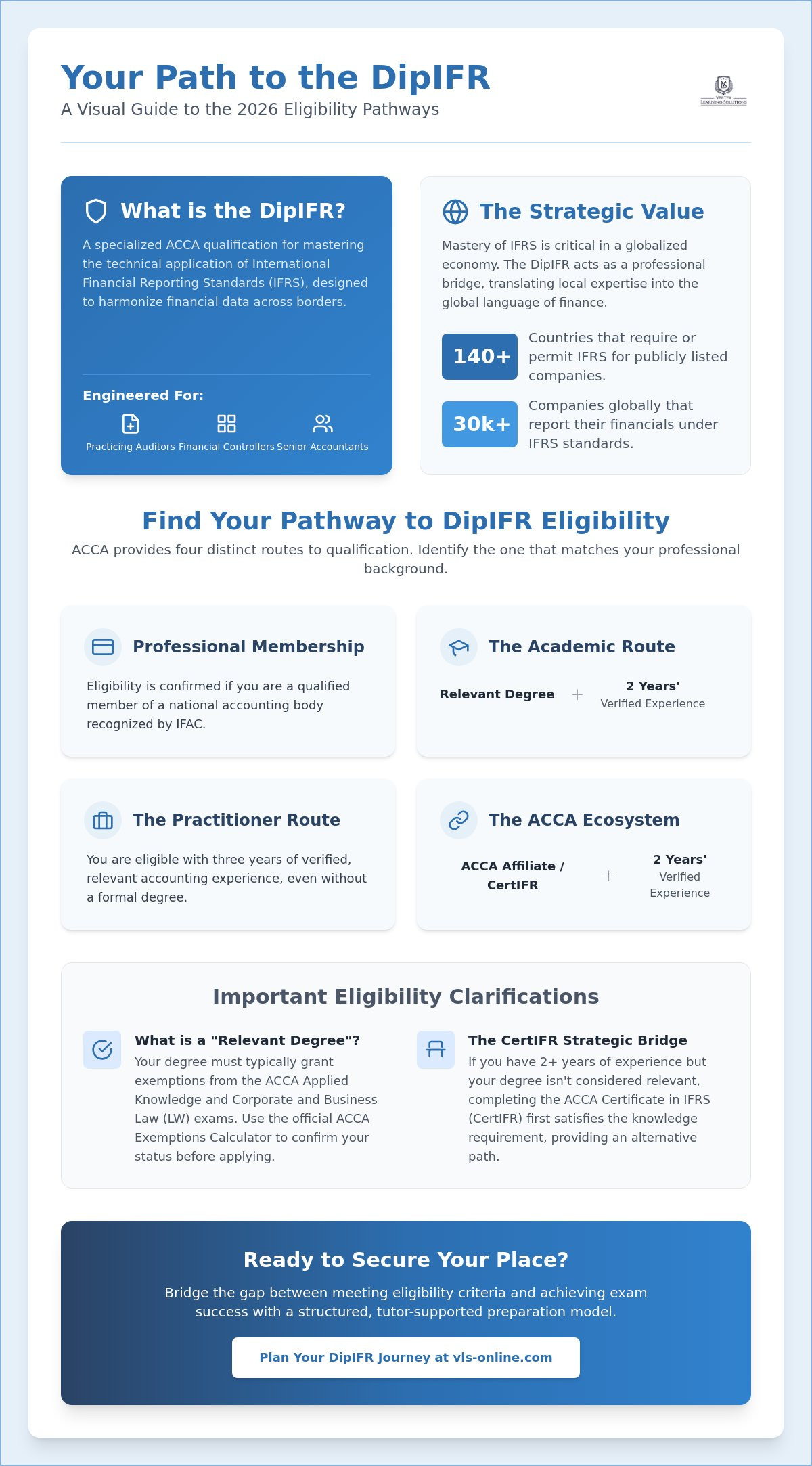
The entry requirements for DipIFR are structured to be inclusive while maintaining the qualification's elite status. ACCA recognizes that professional expertise is built through various combinations of academic study and practical application. For the 2026 exam sessions, there are four distinct pathways to confirm your eligibility:
Professional Membership: If you're a member of an IFAC-recognised body, such as a Chartered Accountant, your eligibility is confirmed immediately.
The Academic Route: This requires a relevant degree paired with two years of verified accounting experience.
The Practitioner Route: Professionals with three years of relevant accounting experience are eligible, even without a formal degree.
The ACCA Ecosystem: Holding ACCA Affiliate status or the ACCA Certificate in International Financial Reporting combined with two years of experience provides a direct path.
Choosing the correct route is a strategic decision that depends on your specific background and career goals. It's essential to audit your documentation early to avoid registration delays.
Verifying Your Degree and Exemptions
Confusion often arises over what constitutes a "relevant" degree. To qualify under the academic route, your degree must typically attract exemptions from the ACCA Applied Knowledge papers and the Corporate and Business Law (LW) exam. This ensures you've mastered the legal and foundational frameworks required for high-level reporting. You should use the official ACCA Exemptions Calculator to confirm your status before starting your application. If your degree doesn't meet these specific criteria, you'll need to satisfy the entry requirements for DipIFR through the practitioner or certificate routes.
The CertIFR Bridge: The Alternative Path
If you have two years of experience but your degree isn't considered "relevant" by ACCA standards, the ACCA Certificate in International Financial Reporting serves as a strategic bridge. By completing this certificate first, you satisfy the technical knowledge requirement, allowing you to bypass the need for a specific degree. This is often the most efficient route for professionals who've transitioned into accounting from other business disciplines. If you're ready to begin this transition, you can explore our structured DipIFR preparation modules to see how we simplify these complex standards for every candidate.
How to Document Your Relevant Accounting Experience
Securing your place in the exam room isn't just about meeting the academic entry requirements for DipIFR; it's about the precision of your professional paper trail. The Experience Confirmation Form (ECF) is the definitive document ACCA uses to verify your practitioner status. It's not a mere formality. It's a structured audit of your career that requires a signature from a supervisor or employer who can attest to your professional integrity. This process provides the security and professional protective net that keeps the qualification's global reputation intact.
The most common reason for registration delays is a lack of detail or inconsistent dating within this form. You must ensure that your professional history is presented with the same logic and closure you'd apply to a financial statement. If you've worked across multiple firms to reach the three year requirement, you'll need separate sign-offs for each period of employment. Don't leave this until the final weeks before the March or September deadlines; employer verification can often take longer than anticipated.
Defining Relevant Accounting Tasks
Candidates often worry that they lack "IFRS-specific" experience. However, ACCA defines relevance through the lens of general accounting and finance. You don't need to be an expert in international standards yet. You simply need to prove you've been working within a professional framework. Relevant tasks include:
Preparing or reviewing financial statements under any recognized GAAP.
Conducting statutory audits or internal control evaluations.
Financial analysis, budgeting, and management reporting.
Corporate tax compliance and strategic tax planning.
The Verification Checklist for 2026
Precision is your greatest ally when finalizing your ECF. Registration rejections often stem from simple clerical inconsistencies that suggest a lack of professional rigor. Before you upload your documents, confirm that all employment dates match your CV and degree certificates exactly. Verify that your employer is a recognized entity, such as a registered professional practice or a legally incorporated company. High-level Specialist Accounting Qualifications always require this level of scrutiny to maintain their elite status. If you're ready to move past the administrative hurdles and start your technical preparation, our DipIFR modules provide the structured support you need to master the syllabus.
Planning Your DipIFR Journey with Vertex Learning Solutions
Once you've confirmed that you meet the entry requirements for DipIFR, your focus must shift from administrative compliance to technical mastery. The syllabus is notoriously dense; it requires a structured, system-level approach to ensure success within a single exam cycle. We understand that for a busy professional, the transition from documentation to study can feel overwhelming. Our role is to provide the professional protective net that allows you to focus entirely on your learning while we assist with the nuances of the registration process.
The Vertex advantage lies in our commitment to proactive, expert-led support. We don't simply provide recorded content. We offer direct access to tutors via WhatsApp and host weekly live sessions to address the specific complexities of the current standards. This high-touch model ensures that your questions are answered with the precision and depth they deserve. Many of our candidates find that mastering these standards serves as a vital technical foundation for ACCA Strategic Business Reporting (SBR), making the Diploma a strategic stepping stone for those pursuing full membership.
Expert Support for Professional Success
Success in this exam requires more than just reading. It demands an exam-focused strategy. We replace generic, exhaustive textbooks with distilled study notes that target the specific marking schemes used by ACCA examiners. Our simulated classroom environment allows you to engage with IFRS standards through a practical lens, ensuring you can apply theoretical knowledge to the case-study-driven questions you'll face on exam day. This methodical preparation builds the intellecutal security needed to perform under pressure.
Next Steps: Registration and Enrollment
The path to global recognition starts with a single, well-timed decision. With the entry requirements for DipIFR clearly defined, your next move is to align your study schedule with the upcoming June or December exam windows. We recommend reviewing your DipIFR enrollment options immediately to secure your place in our next cohort. Start your application today to ensure all documentation is verified well before the ACCA registration deadlines. Your professional advancement is a strategic project; let's begin the execution phase together.
Advancing Your Professional Integrity in a Global Market
Securing the Diploma in International Financial Reporting is a transformative milestone that requires both administrative precision and technical dedication. By accurately navigating the entry requirements for DipIFR and finalizing your Experience Confirmation Form with rigor, you establish a stable foundation for your future career. We've explored the various pathways to eligibility and the critical importance of documenting relevant tasks to satisfy ACCA standards. Now, the focus shifts from meeting criteria to mastering the complex syllabus that defines modern global reporting.
Vertex Learning Solutions acts as your strategic partner throughout this journey. Our approach provides a professional protective net, combining comprehensive study notes with the expertise of London-based tutors. You'll benefit from live weekly sessions and dedicated WhatsApp support for all enrolled students, ensuring that no technical nuance remains unresolved. This structured environment is designed to simplify complexity and foster the calm confidence required for exam success.
The 2026 sessions represent a significant opportunity to differentiate your professional profile. Secure your place in our DipIFR preparation course and master IFRS with tutor support to begin your advancement today. Your path to international recognition is clear, and we're ready to support every step of your professional evolution.
Frequently Asked Questions
Can I take DipIFR if I am not an ACCA member?
You can sit the DipIFR exam without being an ACCA member. This qualification is strategically designed for professional accountants or auditors who are members of an IFAC-recognised body. It also serves practitioners with several years of experience who seek international recognition without completing the full ACCA qualification. It's a specialized path that allows you to master international standards while maintaining your current professional status and focusing on your specific career goals.
What counts as a "relevant degree" for DipIFR eligibility?
A relevant degree is typically one that attracts exemptions from the ACCA Applied Knowledge exams and the Corporate and Business Law (LW) paper. This usually includes Bachelor's degrees in Accounting, Finance, or Commerce from accredited universities. You should use the ACCA Exemptions Calculator to verify your specific institution's standing. Ensuring your degree meets these entry requirements for DipIFR prevents administrative delays during the registration process and provides a clear path to enrollment.
How much relevant experience do I need if I have an accounting degree?
You need exactly two years of verified accounting experience if you hold a relevant degree. This experience must be documented through the Experience Confirmation Form and signed off by a professional supervisor or employer. The two year requirement ensures that candidates have the practical context necessary to apply complex IFRS standards in real-world scenarios. It's a structured approach that balances academic theory with the realities of professional practice, ensuring you're prepared for the exam's rigor.
What should I do if I do not meet any of the entry requirements for DipIFR?
If you don't currently meet the entry requirements for DipIFR, you should focus on accumulating three years of relevant accounting experience to qualify via the practitioner route. Alternatively, you can complete the ACCA Certificate in International Financial Reporting (CertIFR) and pair it with two years of experience. This certificate acts as a technical bridge, providing the foundational knowledge required to eventually transition into the more rigorous Diploma program while you build your professional history.
Is the CertIFR mandatory before taking the DipIFR exam?
The CertIFR is not mandatory if you already meet the eligibility criteria through your degree or professional membership. It's an optional, albeit highly beneficial, stepping stone for those who want a foundational understanding before tackling the Diploma's complexity. Many professionals use it as a strategic tool to satisfy the experience-based entry route more quickly or to refresh their knowledge. It's about choosing the path that offers you the most security and professional confidence.