Vertex Learning Solutions


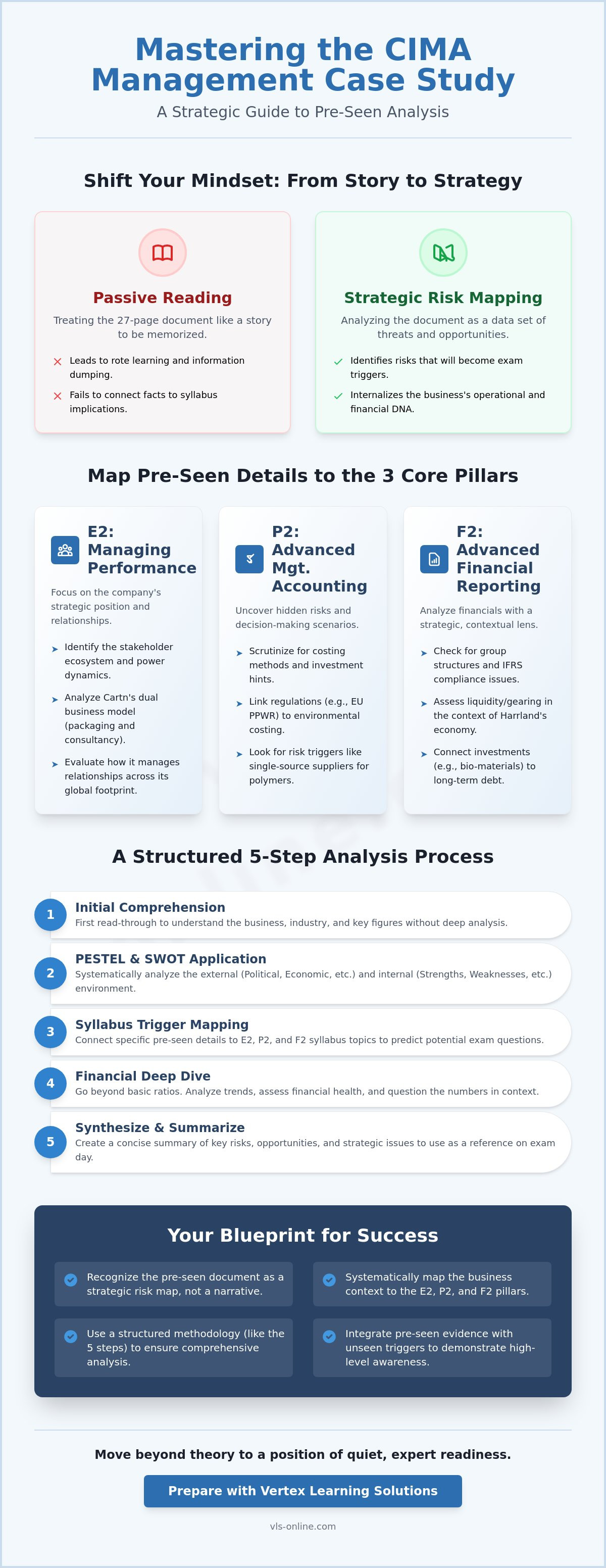
Reading the 27-page document for Cartn three times won't help you pass if you're treating it like a story instead of a strategic risk map. Most candidates approach their CIMA management case study pre-seen analysis as a simple reading exercise, yet the examiners aren't testing your memory of the text. They're testing your ability to act as a Finance Manager who can navigate the mid-2026 EU Packaging and Packaging Waste Regulation or the specific mandatory compliance deadlines for PFAS. It's completely natural to feel anxious about how to link these complex industry trends to your E2, P2, and F2 syllabus topics under the pressure of a timed exam.
This guide provides a structured methodology to turn information overload into a professional protective web of knowledge. You'll learn how to dissect Cartn's dual business model and identify the specific financial and operational risks that will likely appear as "unseen" triggers. We'll examine the precise links between the business context and your core technical pillars, giving you the stability and confidence to handle any challenge during the August 12-14 exam window. By the end of this analysis, you'll have moved beyond theory to a position of quiet, expert readiness.
Key Takeaways
- Recognize the pre-seen document as a strategic risk map rather than a narrative, providing the essential industry context and financial frameworks required for the Management Level.
- Systematically map the business context to the E2, P2, and F2 pillars to identify stakeholder ecosystems, costing methods, and critical financial reporting risks.
- Execute a structured CIMA management case study pre-seen analysis using a five-step methodology that transitions from initial comprehension to rigorous PESTEL and SWOT application.
- Master the integration of pre-seen evidence with unseen exam triggers to demonstrate high-level business awareness while avoiding the common pitfall of irrelevant information dumping.
Table of Contents
- What is the CIMA Management Case Study Pre-Seen Analysis?
- Mapping the Pre-Seen to the E2, P2, and F2 Pillars
- 5 Steps to a Comprehensive Pre-Seen Analysis
- Applying Your Analysis on Exam Day with Vertex
What is the CIMA Management Case Study Pre-Seen Analysis?
The pre-seen material is a meticulously crafted fictional business scenario released by the Chartered Institute of Management Accountants weeks before the examination. It serves as the primary foundation for the Management Case Study (MCS), providing a comprehensive overview of a specific company's history, industry environment, financial statements, and internal management hierarchy. A successful CIMA management case study pre-seen analysis is the process of internalizing a business's operational and financial DNA to predict exam requirements with precision. It isn't merely a reading task; it's a strategic deep dive designed to uncover latent threats and opportunities that will likely be triggered by the "unseen" information provided on exam day.
The Role of the Manager in the MCS
In this simulation, you adopt the persona of a Finance Manager. You aren't just an accountant; you're a strategic partner reporting directly to senior management. This role requires a sophisticated balance. While you must remain grounded in the financial data, your analysis has to account for operational realities. You'll need to interpret how a shift in packaging regulations, such as the EU PPWR, affects not just the balance sheet but also the engineering consultancy's long-term viability. Your perspective must be proactive, offering solutions that align with the company's broader strategic objectives.
Why Students Fail the Pre-Seen Phase
Many candidates treat the pre-seen like a narrative story. They read it passively, hoping the facts will stick. This is a critical error. The document is a complex data set, not a novel. Rote learning facts about a company like Cartn without understanding the underlying syllabus implications often leads to failure. If you can't link a specific financial ratio to a P2 risk management strategy or an E2 ecosystem model, the information remains inert. True success comes from viewing the document as a series of interconnected variables that demand logical, syllabus-grounded interpretation.
Mapping the Pre-Seen to the E2, P2, and F2 Pillars
Mapping the pre-seen document to the technical pillars requires a disciplined, systematic approach. You shouldn't just read; you must categorize. Every paragraph in the CIMA management case study pre-seen analysis serves as a potential trigger for a syllabus-based task. Creating a Syllabus Trigger Map allows you to anticipate how examiners will test your knowledge against the standards found on the CIMA Management Level official page. This map ensures that no detail, from the dual business model of Cartn to its consultancy division's performance metrics, remains unlinked to the core pillars.
E2 (Managing Performance): Identify the company's ecosystem and stakeholder power dynamics. Look for clues about Cartn's business model and how it manages relationships across its global footprint.
P2 (Advanced Management Accounting): Scrutinize the text for costing methods and capital investment hints. The 2026 focus on sustainability suggests potential questions on environmental costing or investment appraisal for recycling technologies.
F2 (Advanced Financial Reporting): Analyze the provided financial statements for group structures and IFRS compliance. Pay close attention to revenue recognition and asset valuations within the packaging industry.
F2 Financial Analysis: Beyond the Ratios
Interpreting the Statement of Financial Position is about more than calculating current ratios. You need to assess liquidity and gearing within the context of Harrland's economic stability. If the pre-seen mentions significant investment in bio-based materials, consider the impact on long-term debt and interest cover. For candidates seeking to refine their technical reporting skills to an elite level, our Diploma in IFRS provides the depth necessary to handle complex group reporting tasks with total confidence.
P2 and E2: Risk and Strategic Positioning
Operational descriptions in the pre-seen often contain hidden risks. A mention of a single-source supplier for specialized polymers is a major risk management trigger for the P2 pillar. In the 2026 business environment, digital maturity is paramount. Evaluate how Cartn utilizes AI to optimize packaging waste or manage its global consultancy division. These strategic positioning details allow you to provide answers that reflect the mindset of a pro-active, senior Finance Manager.
5 Steps to a Comprehensive Pre-Seen Analysis
Mastering the CIMA management case study pre-seen analysis requires a disciplined, multi-layered approach. You must move beyond passive reading to active, strategic interrogation of the text. This structured framework ensures you've internalized the operational nuances of the business before the exam begins. It provides the intellectual security needed to handle complex triggers under time pressure.
Step 1: The Initial Read-Through. Absorb the narrative and industry "vibe" without the distraction of note-taking. Focus on the company's tone and its perceived market position.
Step 2: Strategic Tool Application. Conduct a rigorous PESTEL and SWOT analysis based strictly on the evidence provided. This identifies the external pressures, such as mid-2026 regulatory changes, and internal capabilities.
Step 3: Financial Health Check. Calculate key performance indicators (KPIs) and compare them to industry benchmarks. For instance, evaluate Cartn's margins against the projected 6.06% CAGR of the global food packaging market.
Step 4: Stakeholder Mapping. Use Mendelow’s Matrix to identify the power and interest of every character and entity mentioned. This predicts potential conflicts or partnership opportunities.
Step 5: The "What If" Brainstorm. Predict 10 potential exam triggers based on the weaknesses identified. This proactive thinking prepares you for the "unseen" material.
Applying Porter’s Five Forces to the Industry
Analyzing the competitive landscape allows you to predict questions on pricing strategy or market entry. If the pre-seen indicates high supplier power due to specialized polymer requirements, expect a trigger on supply chain risk or vertical integration. Integrating current industry news, such as the global shift toward mono-materials, adds a "real-world" flair to your answers. This demonstrates the business awareness examiners prize. Our comprehensive CIMA Professional Qualification training provides the structured mentoring needed to master these frameworks.
The SWOT Analysis: Your Exam Day Cheat Sheet
A SWOT analysis acts as a bridge between the pre-seen and the unseen triggers by allowing you to project how external shifts will impact the company's internal capabilities. You should convert every identified "Weakness" into a strategic "Opportunity" for advice. If Cartn lacks digital maturity in its engineering division, a likely exam trigger will involve a proposed investment in AI-driven design tools. By preparing these links in advance, you can provide calm, logical recommendations that align with the company’s strategic goals.
Applying Your Analysis on Exam Day with Vertex
Success on exam day hinges on your ability to synthesize your CIMA management case study pre-seen analysis with the new, "unseen" information provided in each task. Business awareness is the primary marking criterion. It requires you to use pre-seen facts as the logical foundation for your advice. You must avoid "pre-seen dumping," the common mistake of reciting the document's contents without context. Instead, only select facts that directly support your answer to the specific trigger presented. This selective application demonstrates the maturity and professional focus expected of a Finance Manager.
Vertex Learning Solutions offers a professional protective net through direct tutor support via WhatsApp, ensuring no nuance of the pre-seen remains misunderstood. You can clarify complex financial structures or operational risks with experts who understand the 2026 exam landscape. Our weekly live sessions are designed to simulate the high-pressure MCS environment. These sessions force you to retrieve your analysis quickly, building the stable confidence needed to handle the August 12-14 exam window with total precision.
The Vertex Advantage for CIMA Management Level
Our students gain access to recorded lectures that deconstruct the current pre-seen company, such as Cartn, in exhaustive detail. These sessions link every operational detail to the E2, P2, and F2 pillars, ensuring your technical knowledge is never isolated from the business context. This integrated approach is a cornerstone of our CIMA Professional Qualification training. We prioritize strategic depth over rote memorization. We ensure you aren't just prepared for the exam, but for the professional challenges that follow in your career.
Final Checklist for the Week Before the Exam
During the final days of preparation, utilize the "One-Page Summary" technique to facilitate rapid mental recall. This document should condense your SWOT, PESTEL, and key financial ratios into a single, structured overview. It serves as your final mental map before entering the testing environment. Additionally, ensure your technical competency is sharp. Mastering Advanced Excel for Accountants allows you to interpret exam data and financial tables with greater speed. This efficiency grants you more time to focus on the strategic quality of your written responses.
Master Your Strategic Narrative for Exam Success
Transforming the pre-seen from a static document into a dynamic tactical map is the defining factor for success at the Management Level. By mapping every operational detail to the E2, P2, and F2 pillars, you ensure your answers reflect the precise business awareness examiners demand. This structured approach moves you beyond the risk of information overload and positions you as a pro-active Finance Manager ready for mid-2026 regulatory shifts. It's about more than memory; it's about strategic readiness.
Achieving this level of CIMA management case study pre-seen analysis requires more than solitary study; it demands a professional protective net. Vertex provides the stability you need through weekly live sessions that simulate the high-pressure MCS environment and exam-focused study notes that simplify complex reporting standards. With active tutor support via WhatsApp and recorded lectures deconstructing every facet of the business case, you're never navigating these complexities alone. We provide the expertise so you can focus on execution.
Enroll in the Vertex CIMA Management Level Course for Expert Pre-Seen Analysis
You have the technical foundation. Now, let's turn that knowledge into the calm confidence required for exam-day success. We're ready to help you bridge the gap.
Frequently Asked Questions
How many times should I read the CIMA MCS pre-seen?
You should read the document at least three to four times, but each iteration must have a distinct analytical objective. The first pass establishes the narrative and industry "vibe," while subsequent readings should focus on technical syllabus mapping and strategic risk identification. Simply reading the text repeatedly without a structured CIMA management case study pre-seen analysis framework is inefficient and fails to build the mental database required for rapid recall during the exam.
Can I take my pre-seen analysis notes into the exam?
No, you aren't permitted to bring any external notes, including your personal analysis or annotated documents, into the examination. The exam software provides a clean, electronic version of the pre-seen material for your reference during the session. This restriction highlights why you must internalize the company's operational and financial DNA during your preparation. You need to know the business well enough to navigate the text quickly when responding to new information.
What is an 'unseen trigger' in the CIMA Management Case Study?
An unseen trigger is a new piece of information, such as an internal email, a news report, or meeting minutes, introduced during the exam that demands a professional response. These triggers provide the specific context for your tasks, forcing you to apply your technical knowledge to a new development. Your success depends on how effectively you integrate these new facts with your existing CIMA management case study pre-seen analysis to provide logical, business-focused advice.
How much of the exam score is based on the pre-seen material?
While there isn't a specific percentage of marks allocated solely to the pre-seen, your entire score is influenced by how well you apply it. Examiners award marks for "business awareness," which is demonstrated by tailoring your technical E2, P2, and F2 knowledge to the company's specific circumstances. Providing generic, theoretical answers that ignore the pre-seen context will result in a lower grade, as it fails to meet the criteria for a professional Finance Manager.
Is the pre-seen the same for all students in the same exam window?
Yes, the pre-seen material remains identical for every candidate within a specific exam window, such as the May and August 2026 sessions. CIMA releases one document, for example, the "Cartn" case study, which forms the basis for all exam variants during that period. This ensures a standardized level of difficulty and allows for a fair assessment of how different candidates navigate the unique strategic and operational challenges facing the featured organization.