Vertex Learning Solutions


The image of a professional buried in static ledgers is a relic of the past; in 2026, the modern management accountant serves as the strategic GPS of a successful enterprise. If you're considering this path, you've likely wondered if the day in the life of a management accountant is merely a repetitive cycle of data entry. It's a valid concern for anyone seeking a career with genuine impact. In reality, the role has evolved into a proactive partnership where you don't just report numbers, you interpret them to safeguard the organization's future.
In this guide, you'll discover how your morning might start with AI-driven predictive analytics and end with providing critical decision support to the executive team. We'll clarify the often-confusing boundaries between financial and management accounting, ensuring you understand the unique value you'll bring to a business. Finally, we'll provide a structured roadmap to help you navigate the complexities of professional qualifications. Whether you're weighing the merits of ACCA or CIMA, we'll help you identify which path offers the most secure professional protective net for your specific career ambitions.
Key Takeaways
- Understand the transition from traditional compliance to a proactive strategic partnership that drives organizational growth and stability.
- Gain a structured perspective on the day in the life of a management accountant, from interpreting automated flash reports to conducting deep-dive variance analysis.
- Learn how to bridge the gap between finance and operations by translating complex data into actionable intelligence for non-finance stakeholders.
- Evaluate the strategic advantages of ACCA versus CIMA to determine which professional qualification provides the most robust protective net for your career.
- Discover how specific modules, such as ACCA Management Accounting (MA), offer a practical blueprint for managing real-world business challenges.
Table of Contents
- What is a Management Accountant? Defining the Strategic Partner
- The Morning Routine: From Raw Data to Business Intelligence
- The Collaborative Afternoon: Bridging Finance and Operations
- The Path to Becoming a Management Accountant in 2026
What is a Management Accountant? Defining the Strategic Partner
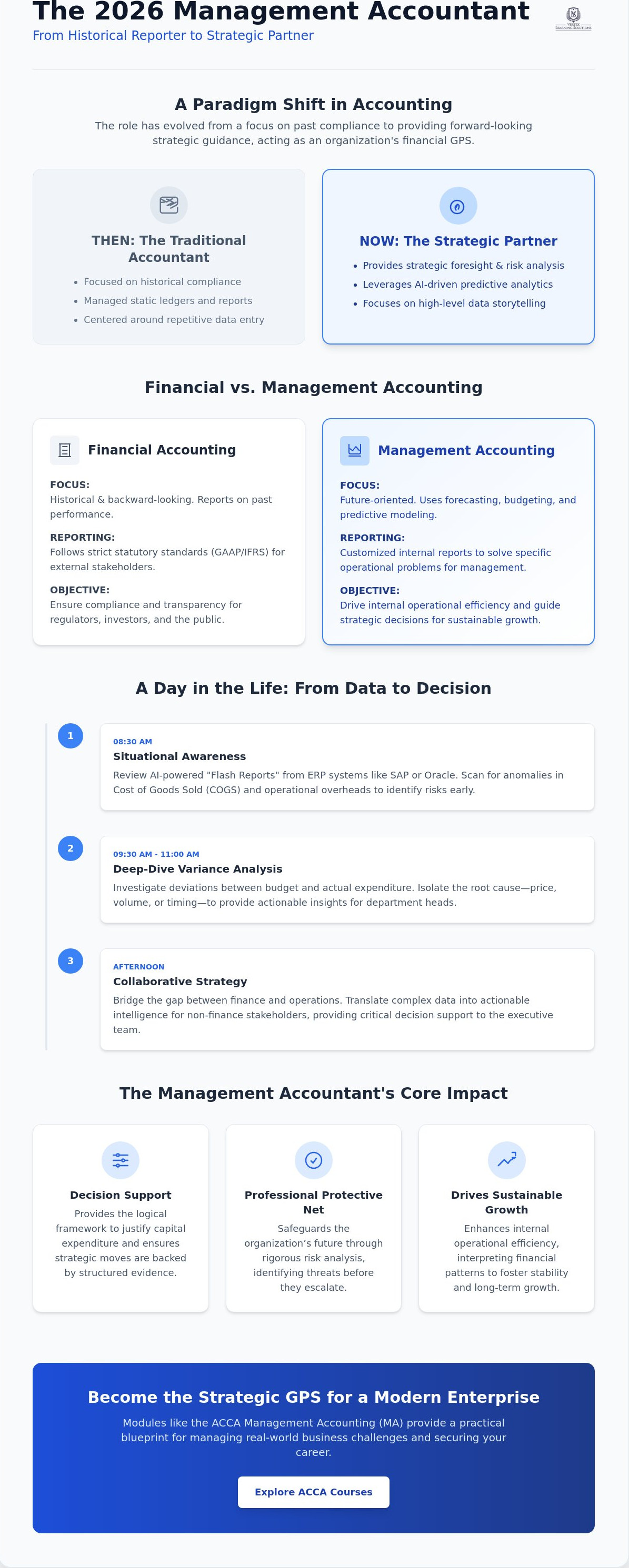
A management accountant serves as the internal architect of a company's financial trajectory. Unlike traditional roles that focus solely on historical compliance, this position functions as a strategic partner to the executive board. By 2026, the profession has moved decisively away from manual ledger management toward high-level data storytelling. This transition is fueled by the embedding of Artificial Intelligence into accounting software, which automates routine data entry and allows the professional to focus on interpreting complex patterns. For those exploring a day in the life of a management accountant, it's clear that the role is now defined by its ability to provide a professional protective net through rigorous risk analysis and strategic foresight.
CEOs and department heads view these specialists as indispensable advisors. Whether it's a decision to expand into a new territory or an overhaul of the production chain, the management accountant provides the logical framework to justify the capital expenditure. They don't just report what happened; they explain what should happen next. This level of insight is often built on the foundational principles covered in the ACCA Management Accounting (MA) syllabus, which bridges the gap between raw numbers and business logic.
The Forward-Looking Mindset
Management accountants utilize real-time data to architect predictive models that forecast future performance rather than merely documenting past transactions. This proactive approach centers on "Decision Support," which is the core value proposition of the role. It ensures that every strategic move is backed by structured evidence, reducing the uncertainty inherent in large-scale business operations.
Financial vs. Management Accounting: Key Differences
Understanding the distinction between these two branches is vital for career planning. Management accounting is primarily concerned with internal reporting, whereas financial accounting serves external stakeholders like regulators and shareholders. The differences include:
Strategic Focus: Financial accounting is historical and backward-looking; management accounting is future-oriented through forecasting and budgeting.
Reporting Requirements: Financial reports must follow strict statutory standards like GAAP or IFRS; management reports are customized to solve specific internal operational problems.
Primary Objective: One ensures compliance and transparency for the public; the other drives internal operational efficiency and sustainable growth.
In a typical day in the life of a management accountant, you'll find that the focus remains on the "why" and "what if" rather than just the "what." This shift toward advisory services makes the role one of the most resilient and intellectually stimulating paths in the modern financial sector.
The Morning Routine: From Raw Data to Business Intelligence
The first hour of a day in the life of a management accountant is dedicated to situational awareness. At 08:30, you review "Flash Reports." These automated dashboards, increasingly powered by AI-integrated ERP systems like SAP S/4HANA or Oracle Fusion, provide a real-time snapshot of the previous day's performance. You aren't just looking at totals; you're scanning for anomalies in the Cost of Goods Sold (COGS) or unexpected spikes in operational overheads. This phase is critical because it allows you to identify potential risks before they escalate into systemic issues.
The Power of Variance Analysis
Between 09:30 and 11:00, the focus shifts to Variance Analysis. This is where your strategic value becomes visible to the organization. When actual expenditure deviates from the budget, you must investigate the root cause. It's a structured, step-by-step process: you first isolate the variance, then determine if it's a price variance, a volume variance, or a timing issue. This task requires a rare combination of mathematical precision and investigative curiosity. By identifying these trends early, you provide a professional protective net for department heads, allowing them to recalibrate their spending strategies before the fiscal period closes.
Leveraging Modern Technology
While cloud-based ERP systems have streamlined the data collection phase, the actual interpretation and "storytelling" often happen in more flexible environments. Proficiency in Advanced Excel for Accountants remains a non-negotiable skill for high-level data manipulation and complex modeling. During the high-pressure "Month-End" cycle, these tools allow you to consolidate disparate data sets into a coherent, logical narrative. For those looking to master these complex workflows, developing a structured approach to spreadsheet logic is essential for maintaining professional stability and ensuring data integrity.
This morning routine serves as the foundation for the collaborative work that follows. By the time you head into afternoon meetings, you're no longer just an observer of data; you're an informed strategist ready to guide the business toward its financial objectives.
The Collaborative Afternoon: Bridging Finance and Operations
By early afternoon, the focus shifts from data interrogation to interpersonal influence. Between 13:00 and 15:00, the day in the life of a management accountant often centers on cross-functional collaboration. You'll find yourself in meetings with Marketing, Sales, or Production leads. In these sessions, you aren't merely a record-keeper; you're a "Business Partner" whose primary objective is to ensure that every department's KPIs align with the company's overarching financial trajectory. You provide the logical framework that allows other managers to hit their targets while maintaining the organization's fiscal stability.
During these interactions, you might conduct a rigorous Cost-Benefit Analysis for a high-stakes project, such as a new product launch or a warehouse expansion. This isn't about saying "no" to spending. Instead, it's about providing the objective evidence needed to move forward with confidence. By identifying the risks and potential rewards early, you offer a professional protective net that safeguards the business against poorly allocated resources.
Communicating the Numbers
Modern corporate structures rely on finance professionals who can translate complex financial metrics into actionable insights for non-finance managers. When you're explaining concepts like Net Present Value (NPV) or Return on Investment (ROI) to a Creative Director, clarity is your most powerful tool. You don't just present a spreadsheet; you tell a story that connects their operational goals to the company's financial health. This level of persuasive clarity turns technical data into a shared vision, ensuring that diverse teams work toward the same strategic outcomes.
Strategic Planning and Resource Allocation
The late afternoon is typically reserved for long-term forecasting and evaluating Capital Expenditure (CapEx) requests. This phase requires a deep understanding of organizational strategy and risk management. Building this expertise starts with mastering the ACCA Applied Skills modules, which provide the foundational knowledge required for high-level resource allocation. Successfully managing these diverse stakeholder expectations is what makes the day in the life of a management accountant both challenging and exceptionally rewarding.
If you're ready to transition into this strategic role and master the art of business partnering, explore our comprehensive ACCA course selection to begin your professional journey.
The Path to Becoming a Management Accountant in 2026
Transforming the theoretical understanding of a day in the life of a management accountant into a tangible career requires a structured professional roadmap. While a university degree provides a foundation, the modern corporate environment demands specialized certifications that prove your ability to navigate complex financial ecosystems. In 2026, the global standard for this expertise remains anchored in two primary pathways: ACCA and CIMA. These qualifications don't just provide letters after your name; they offer the technical rigor and ethical framework required to act as a strategic protective net for your organization.
For those entering the field, the ACCA Management Accounting (MA) module serves as a direct blueprint for the daily tasks discussed in previous sections. It bridges the gap between basic bookkeeping and strategic analysis, covering the essential mechanics of absorption costing, budgeting, and performance measurement. Mastery of these concepts ensures that you can handle the Investigative curiosity required for morning variance analysis with absolute confidence.
Choosing the Right Qualification
The decision between ACCA and CIMA often depends on your long-term career trajectory. ACCA provides a broad, comprehensive scope that covers everything from audit to taxation, making it ideal for those who value versatility across different financial sectors. Conversely, the CIMA Professional Qualification is specifically tailored for industry roles, focusing heavily on business strategy and internal operations. Both paths are highly respected by global employers, but CIMA is frequently favored by professionals aiming for leadership positions within manufacturing or commercial enterprises.
Preparing for Success with VLS
Vertex Learning Solutions (VLS) understands that balancing a demanding day in the life of a management accountant with intensive study requires a flexible, high-touch approach. Our platform provides high-definition recorded lectures and direct WhatsApp tutor support, ensuring that complex topics are simplified without losing their professional depth. As you progress toward senior-level roles, exploring the ACCA Strategic Professional Level will provide the advanced skills needed for high-level resource allocation and organizational leadership. Continuous learning isn't just a requirement for compliance; it's the mechanism that keeps your strategic advice relevant in an ever-evolving regulatory environment.
Mastering the Strategic Future of Finance
The evolution of the financial sector has transformed the day in the life of a management accountant into a high-stakes role defined by strategic foresight and investigative precision. You've seen how the morning's data interrogation leads to the afternoon's cross-functional influence, ensuring that every operational decision is anchored in fiscal reality. This career path offers more than just stability; it provides the opportunity to act as the primary architect of an organization's sustainable growth. Success in this field requires a commitment to rigorous professional standards and the ability to translate complex metrics into a logical, persuasive narrative.
Vertex Learning Solutions provides the professional protective net you need to master these competencies. Our structured approach includes expert tutor support via WhatsApp and weekly live interactive sessions to clarify the most complex syllabus points. You'll also gain access to exam-focused study notes and high-definition recorded lectures designed for the modern, busy professional. Start your journey toward becoming a Management Accountant with Vertex Learning Solutions today. Your transition from a technical expert to a strategic partner begins with the right educational foundation. We look forward to supporting your professional ascent.
Frequently Asked Questions
Is management accounting stressful during month-end?
The month-end period involves intensified deadlines, but it's a period of focused execution rather than unmanageable stress. Modern professionals utilize automated ERP systems to handle routine consolidation, which allows them to focus on investigative variance analysis and strategic reporting. This structured approach provides a professional protective net that ensures the workload remains high-pressure but professionally stable.
Do I need a degree to become a management accountant?
You don't strictly need a university degree to enter this field, as professional qualifications often serve as the primary currency for employment. Global bodies like ACCA and CIMA offer entry-level certifications that provide a direct pathway for those without a traditional academic background. These qualifications are frequently more highly valued by employers because they focus on practical, industry-specific competencies and ethical standards.
Which is better for management accounting: ACCA or CIMA?
The choice depends on whether you seek technical versatility or a specific focus on industrial management. CIMA is traditionally viewed as the gold standard for industry-based roles due to its heavy emphasis on strategic business management. ACCA offers a broader scope that includes audit and tax, providing greater flexibility across various sectors within the day in the life of a management accountant.
What are the most important soft skills for a management accountant?
Effective communication and persuasive storytelling are the most critical soft skills in the modern corporate environment. As a strategic partner, you must translate complex financial data into actionable insights for non-finance managers. This requires the ability to build trust and influence decision-making across diverse departments, ensuring that every operational move aligns with the company's fiscal objectives.
How much time does a management accountant spend in Excel?
A management accountant typically spends 30% to 50% of their day within Excel or similar data visualization tools. While AI-integrated ERP systems automate much of the data collection, Excel remains the primary environment for bespoke modeling and complex "what-if" scenarios. In the day in the life of a management accountant, these tools are indispensable for consolidating disparate data sets into a coherent strategic narrative.