Vertex Learning Solutions


A perfect score on your Strategic Professional exams is no longer the ultimate metric of professional readiness in the 2026 finance sector. While technical knowledge is foundational, the ability to execute financial modeling for ACCA students has become the definitive differentiator between a traditional accountant and a strategic advisor. You've likely mastered the theoretical mechanics of the three primary financial statements, yet you might still feel a sense of hesitation when tasked with building a live, integrated forecast. This practical gap is a common source of anxiety for those entering a market where 52% of finance professionals are already seeking more specialized, data-driven roles.
We believe that you shouldn't just aim to pass exams; you should aim to lead. This guide provides the structured roadmap required to bridge the divide between academic theory and elite professional practice. You'll discover how to master Excel for professional-grade reporting, gain the technical confidence to excel in your FM and AFM papers, and position yourself for high-level roles in project finance or investment banking. We'll examine the specific modeling frameworks that transform complex data into the logical, actionable intelligence that modern organizations demand.
Key Takeaways
- Identify why a numerical blueprint of a company's future is essential for meeting the heightened strategic demands of 2026's top-tier firms.
- Learn to construct an integrated three-statement model that adheres to the professional standards of consistency, robustness, flexibility, and transparency.
- Utilize financial modeling for ACCA students to gain a deeper, visual understanding of complex exam topics within the FM and AFM modules.
- Develop the technical proficiency in Excel required to transform abstract syllabus concepts into dynamic, high-level business intelligence.
- Transition into a strategic advisor role by applying a methodical approach to practical case studies and professional-grade reporting.
Table of Contents
- The Strategic Importance of Financial Modeling for ACCA Students
- Core Components: Building a Robust Three-Statement Model
- Synergizing Modeling Skills with ACCA Exam Success
- Elevating Your Career: From ACCA Student to Financial Modeler
The Strategic Importance of Financial Modeling for ACCA Students
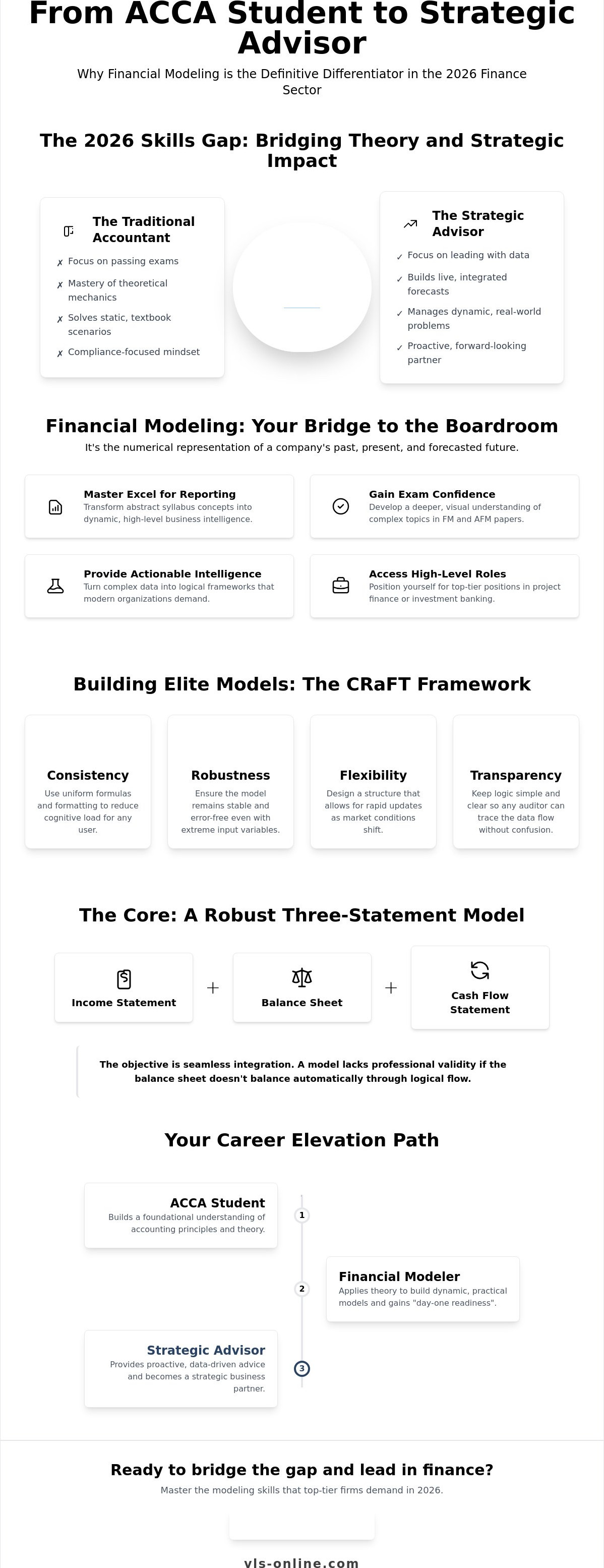
Understanding What is Financial Modeling? is the first step toward professional mastery. At its core, financial modeling is the numerical representation of a company's past, present, and forecasted future. For those pursuing their qualification through ACCA courses, financial modeling for ACCA students represents the bridge between abstract ledger entries and tangible strategic decisions. It isn't just about spreadsheets; it's about building a logical framework that captures how an organization creates value.
The global finance market in 2026 is increasingly competitive. While passing exams proves technical proficiency, top-tier firms now demand "day-one readiness." They look for candidates who don't just know the standards but can apply them to complex, real-world problems. Relying solely on textbook scenarios creates a theory-practice gap that can hinder career progression. Modeling serves as the laboratory where this gap is closed. It allows you to visualize how a 1% change in interest rates ripples through the entire financial structure of a firm.
The ACCA 2026 syllabus has evolved to reward this systemic thinking. Examiners now place a higher premium on analytical frameworks that demonstrate a deep grasp of organizational value drivers. Students who can model these drivers develop a superior level of insight, enabling them to provide the proactive, data-driven advice that modern boards of directors expect. This approach turns a compliance-focused accountant into a strategic business partner.
Bridging the Gap Between Classroom and Boardroom
Transitioning from solving static exam questions to building dynamic, live business scenarios is a significant milestone. In a classroom, variables are fixed. In the boardroom, they're volatile. Mastering these tools enhances your professional skepticism, a trait that's essential for success at the Strategic Professional levels. This skeptical mindset allows you to question assumptions and stress-test the integrity of financial data. Essentially, a well-constructed financial model acts as a digital twin of a business entity, allowing for risk-free experimentation before capital is committed.
Core Components: Building a Robust Three-Statement Model
Building a high-integrity model requires more than just technical dexterity; it demands a disciplined architectural approach. For those engaging with financial modeling for ACCA students, the primary objective is the seamless integration of the "Trinity": the Income Statement, Balance Sheet, and Cash Flow Statement. A model is only as strong as its weakest link. If your balance sheet doesn't balance automatically through logical flow rather than hard-coded adjustments, the model lacks professional validity and fails to provide a reliable protective shield for decision-makers.
To ensure your work meets elite institutional standards, we advocate for the CRaFT framework. This methodology ensures your output is beyond reproach:
Consistency: Use uniform formulas and formatting to reduce cognitive load for the user.
Robustness: Ensure the model remains stable even when extreme input variables are introduced.
Flexibility: Design the structure to allow for rapid updates as volatile market conditions shift.
Transparency: Keep logic simple and clear so any auditor can trace the data flow without confusion.
Best Practices in Model Architecture
Structural integrity starts with clear separation. You must isolate inputs, calculations, and outputs into distinct sections or worksheets. This modularity prevents accidental formula corruption and simplifies the error-trapping process. Professional-grade models include dedicated integrity check cells that immediately flag discrepancies, ensuring the model is always audit-ready. If you want to refine these underlying technical skills, our Advanced Excel for Accountants course provides the necessary engine for complex builds.
The Role of IFRS in Modern Modeling
In 2026, global consistency is non-negotiable for strategic partners. Your forecasted statements must align with international standards to maintain credibility in a regulated environment. Integrating Diploma in IFRS principles ensures that your modeling logic respects complex requirements like lease accounting and revenue recognition. This alignment transforms a simple spreadsheet into a sophisticated compliance tool that provides a secure foundation for multi-national reporting and high-level project finance.
Synergizing Modeling Skills with ACCA Exam Success
Mastering financial modeling for ACCA students isn't just a post-qualification asset; it's a potent tactical advantage during the exam journey itself. Many candidates struggle with Financial Management (FM) because they treat Net Present Value (NPV) and Internal Rate of Return (IRR) as isolated formulas. By building these into a dynamic model, you visualize the relationship between cash flows and discount rates. This visual intuition allows you to spot errors quickly and understand the sensitivity of a project's viability to minor input changes. For a broader view of exam strategy, see our guide on Mastering the ACCA Strategic Professional Level.
Dominating the AFM Paper with Modeling Logic
In the Advanced Financial Management (AFM) paper, complexity is the primary hurdle. Mastering valuations and merger scenarios requires a level of spreadsheet logic that transcends basic data entry. When you're familiar with model architecture, you reduce the risk of exam panic during the technical calculation phases. You can visualize capital structure changes and their impact on the Weighted Average Cost of Capital (WACC) before you even begin your written analysis. This methodical approach ensures your conclusions are grounded in structured data. If you're ready to secure your success in this challenging module, enroll in our ACCA AFM course today.
SBR and the Narrative of Numbers
Strategic Business Reporting (SBR) often challenges students to explain the "why" behind the figures. Modeling allows you to see the numbers behind the narrative, particularly in complex group accounts or pension accounting. When you understand how an accounting policy change flows through the statements, your written explanations become more authoritative and precise. You don't just report the numbers; you interpret the underlying business logic with confidence. To master these complexities, you can explore our ACCA SBR course for deeper exam-specific insights. Integrating financial modeling for ACCA students into your study routine transforms your preparation from rote memorization into a sophisticated professional exercise.
Elevating Your Career: From ACCA Student to Financial Modeler
The journey from a student to a strategic advisor requires a deliberate shift in focus. While your qualification provides the credential, your technical execution provides the value. In 2026, research indicates that 58% of finance professionals anticipate a pay increase of more than 5%, but these rewards are increasingly reserved for those who can demonstrate advanced technical capabilities. Mastering financial modeling for ACCA students is the specific catalyst for this transition. To elevate your career, you must follow a structured progression that begins with the engine of every model: professional-grade Excel.
Step 1: Master foundational Excel. You need more than basic formulas; you need a system for handling complex data sets with absolute precision.
Step 2: Integrate your syllabus knowledge with practical case studies. Theory remains abstract until you apply it to a live business scenario.
Step 3: Seek professional mentorship. Tutor-led guidance helps you avoid common architectural bad habits that can lead to model failure in a high-stakes environment.
Step 4: Leverage your skills to stand out. A candidate who is "day-one ready" with practical modeling skills is significantly more attractive to global investment banks and project finance firms.
Foundational Skills: Advanced Excel for Accountants
Generic Excel courses often fail because they lack the financial context required for high-stakes decision-making. Accountants don't just need to know how to use a function; they need to know how to structure that function within a regulated reporting framework. Our Advanced Excel for Accountants program is designed specifically to meet these professional requirements. It ensures your technical foundation is robust enough to support the most complex financial models without the risk of structural collapse or logical errors.
The VLS Advantage: Expert Support for Future Leaders
Self-study has its limits when dealing with intricate modeling logic. At VLS Online, we prioritize active tutor support to ensure you grasp the nuances of every calculation. Our weekly live sessions simulate the engagement of a real-world classroom, which significantly improves retention and the ability to apply concepts in practice. This methodical approach ensures you aren't just a passive learner but a proactive thinker who can navigate the complexities of the 2026 regulatory environment. Visit the VLS Online Homepage to explore how our specialized training can secure your professional future and provide the protective shield you need in a competitive market.
Securing Your Future as a Strategic Finance Leader
The 2026 finance landscape demands more than just a certificate; it requires the ability to turn complex data into strategic foresight. By mastering the core components of an integrated three-statement model, you bridge the gap between classroom theory and boardroom execution. We've explored how financial modeling for ACCA students isn't merely a technical skill but a systemic framework that enhances exam performance in papers like AFM and SBR. It's the definitive tool for those who seek to lead rather than follow.
As a London-based global educational institution, we provide the professional protective net you need to master these skills with confidence. Our programs offer exam-focused study materials and direct expert tutor support via WhatsApp to ensure your technical queries are resolved with precision. Don't let theoretical knowledge remain static. Enroll in our Advanced Excel for Accountants course to start your modeling journey today and transform your career trajectory. Your path to becoming a proactive, data-driven advisor starts with a single, structured step.
Frequently Asked Questions
Is financial modeling part of the official ACCA syllabus?
Financial modeling isn't a standalone paper, but it's deeply integrated into the practical application of the syllabus through the Computer Based Exam (CBE) environment. As the qualification evolves, students are increasingly required to use spreadsheet tools to solve complex strategic problems in real-time. Developing these skills ensures you can meet the technical requirements of the professional papers while preparing for the digital demands of the 2026 workplace.
Which ACCA paper is most relevant to financial modeling?
The Advanced Financial Management (AFM) and Financial Management (FM) papers are the most directly relevant modules for aspiring modelers. These exams require you to perform intricate calculations, such as Net Present Value (NPV) and business valuations, which form the structural core of any robust model. Mastering financial modeling for ACCA students allows you to visualize these concepts dynamically rather than treating them as static, isolated formulas.
Do I need to be an Excel expert before starting a financial modeling course?
You don't need to be an expert, but a disciplined understanding of spreadsheet logic is a fundamental prerequisite for success. Most students benefit from a structured program that focuses on the specific functions used in a professional finance environment. Starting with a targeted course like Advanced Excel for Accountants provides the necessary technical engine, allowing you to focus on strategic logic rather than struggling with basic software mechanics.
How does financial modeling help in the Strategic Professional exams?
Modeling transforms abstract accounting standards into a logical, integrated system that's significantly easier to analyze and interpret. In papers like Strategic Business Reporting (SBR), the ability to model the impact of a policy change provides a clearer perspective on organizational value drivers. This deep, systemic understanding allows you to write more authoritative reports and demonstrate the professional skepticism required at the higher levels of the qualification.
Can financial modeling skills help me get a job before I finish my ACCA?
Practical modeling proficiency is a significant differentiator that can accelerate your career before you've fully qualified. Employers in 2026 prioritize candidates who can contribute to strategic decision-making from their first day. By demonstrating that you can build integrated three-statement models, you position yourself for competitive roles in project finance or investment banking that might otherwise be unavailable to those who only possess theoretical knowledge.