Vertex Learning Solutions


Your final Strategic Case Study exam is a testament to your technical knowledge, but the Practical Experience Requirement is where you truly demonstrate your worth as a strategic business partner. Many professionals find themselves stalled at this final hurdle, feeling uncertain about which specific work activities qualify or fearing that their written narratives might face rejection. It's a high-stakes process that requires more than just a list of duties; it demands a structured, logical reflection of your professional growth and decision-making capabilities.
This CIMA practical experience requirements (PER) guide serves as your professional protective net, offering a clear, strategic roadmap to navigate the submission process with absolute confidence. We've designed this resource to simplify the complexity of the 2026 standards, ensuring your application is both compliant and compelling for the assessment board. You'll discover how to map your career to the 10 essential competencies, master the STAR technique for narratives between 500 and 750 words, and secure the right mentor to verify your successful transition to CGMA membership.
Key Takeaways
- Gain clarity on the 36-month rule to ensure your professional history aligns with the rigorous standards of modern finance.
- Identify how to balance technical proficiency with strategic business skills to meet the complex demands of the 10 core competencies.
- Follow this comprehensive CIMA practical experience requirements (PER) guide to master the STAR method and structure your narratives for seamless, first-time approval.
- Learn to avoid the common "we" trap by isolating your specific contributions, ensuring assessors can clearly validate your individual leadership and impact.
- Navigate the supervisor selection process with precision, including strategies for candidates whose direct managers do not hold a recognized professional qualification.
Table of Contents
- Understanding the CIMA Practical Experience Requirements (PER) Framework
- Navigating the 10 Core Competencies: What CIMA Expects
- Strategic Writing Guide: Crafting Narratives for First-Time Approval
- The Submission Process: Mentor Selection and Final Review
Understanding the CIMA Practical Experience Requirements (PER) Framework
Securing your status as a Chartered Global Management Accountant (CGMA) involves a rigorous validation of your real-world capabilities. The Practical Experience Requirement (PER) acts as the definitive gatekeeper; it ensures that every member possesses the maturity and strategic foresight to lead in a complex global market. This CIMA practical experience requirements (PER) guide emphasizes that your journey isn't merely about completing a checklist. Instead, it's about building a portfolio of professional excellence that mirrors the demands of the 2026 business landscape.
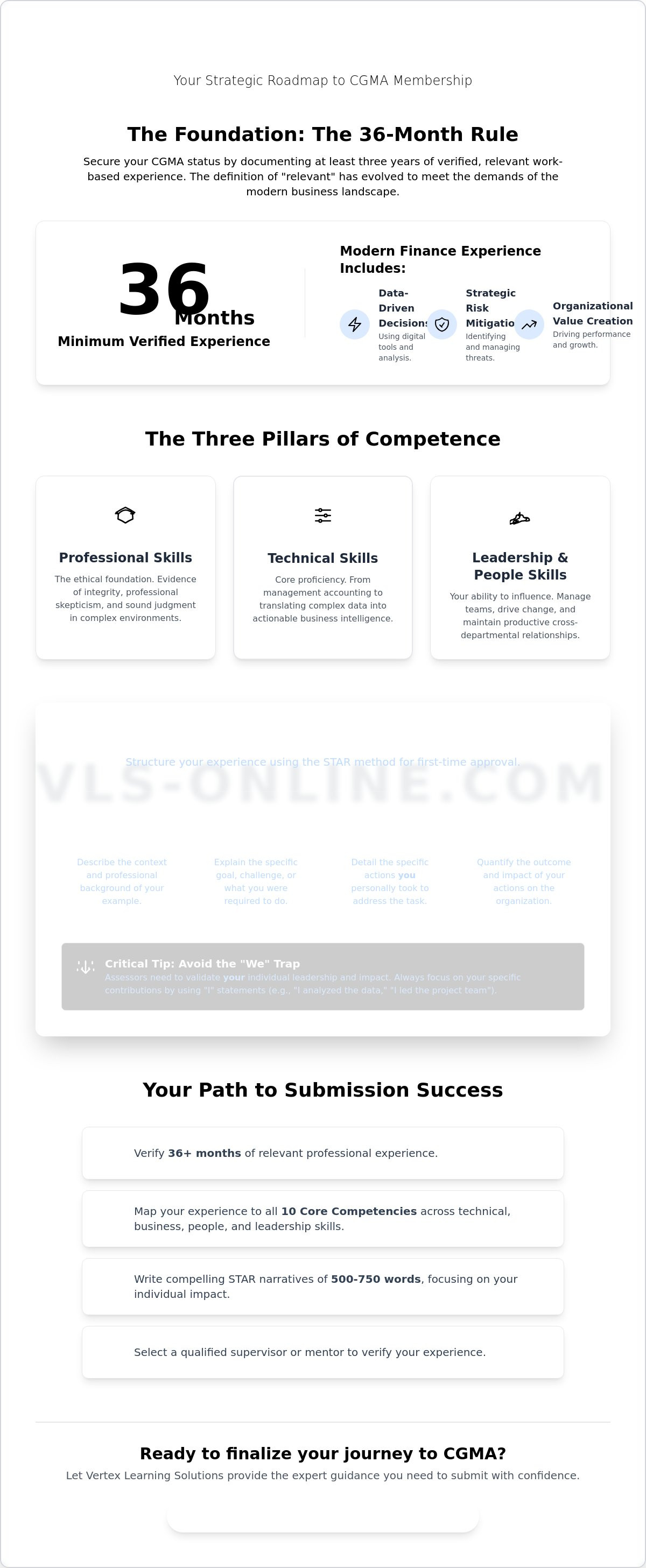
A central pillar of this process is the 36-month rule. You must document at least three years of verified work-based experience to qualify for membership. In the current finance environment, "relevant" experience has evolved far beyond traditional ledger management. The Chartered Institute of Management Accountants (CIMA) now prioritizes roles that involve data-driven decision making, risk mitigation, and value creation. Starting your record early provides a significant strategic advantage. It allows you to identify competency gaps while you still have time to seek out specific projects at work that satisfy the 2026 Professional Development framework.
The updated framework specifically integrates the impact of the digital ecosystem on business models. This means your PER submission should reflect how you use digital tools and data analysis to optimize organizational performance. It isn't enough to perform the task; you must understand the strategic intent behind your actions to satisfy the assessors.
The Three Pillars of Practical Experience
CIMA structures its expectations around three distinct areas of competence. You'll need to provide evidence that spans these categories to prove you're a well-rounded leader capable of operating at a strategic level.
Technical Skills: You must demonstrate proficiency in management accounting and financial reporting. This includes your ability to interpret complex data sets and translate them into actionable business intelligence that supports long-term goals.
Leadership and People Skills: Professional growth depends on your ability to influence stakeholders. You'll need to show how you manage teams, drive change, and maintain productive relationships across different departments.
Professional Skills: This pillar focuses on the ethical foundation of the profession. Assessors look for evidence of professional skepticism, integrity, and the sound judgment required to navigate complex regulatory environments.
By aligning your daily tasks with this CIMA practical experience requirements (PER) guide, you transform an administrative hurdle into a powerful career development tool that confirms your readiness for the CGMA designation.
Navigating the 10 Core Competencies: What CIMA Expects
The 10 core competencies represent the structural integrity of your future CGMA status. This CIMA practical experience requirements (PER) guide emphasizes that technical mastery, while essential, is only one facet of the modern professional. Assessors look for a balanced portfolio that spans technical, business, people, and leadership categories. Official documentation on CIMA Practical Experience Requirements confirms that candidates must demonstrate proficiency across all these areas to prove their readiness for strategic responsibility.
Technical competencies range from cost accounting to sophisticated risk management. You'll need to show you can move beyond data entry to provide meaningful analysis. Business skills like strategy and project management are equally vital; they prove you understand how finance drives organizational value. Above all, the "Ethical Requirement" stands as a non-negotiable foundational pillar. It isn't just a checkbox. It's a commitment to integrity and professional skepticism that underpins every decision you'll make as a member.
People and leadership skills often cause the most anxiety for those in junior positions. You don't need a managerial title to demonstrate these. Documenting how you've guided a new team member or facilitated a cross-departmental meeting provides the necessary evidence. For those looking to sharpen their understanding of these areas before submission, reviewing expertly structured resources can provide the professional edge required for a successful application.
Mapping Your Current Role to CIMA Competencies
Start with a rigorous gap analysis to identify which competencies your daily routine currently neglects. If your role is highly specialized, such as pure tax or audit, you might find certain business or leadership pillars difficult to fulfill. Seeking "stretch assignments" is a proactive way to bridge these gaps. Voluntarily leading a small project or assisting the strategy team with budget forecasting can provide the specific evidence you need. Integrating your professional growth with your studies is the most efficient path forward. Utilizing a CIMA Professional Qualification guide can help you align your exam preparation with these real-world requirements, ensuring your work experience and academic progress move in lockstep.
Strategic Writing Guide: Crafting Narratives for First-Time Approval
Writing your narratives is the most critical phase of the submission process. This CIMA practical experience requirements (PER) guide highlights that clarity and personal accountability are the twin pillars of a successful application. Assessors frequently reject submissions that fall into the "we" trap. While team collaboration is valuable, your record must isolate your specific contributions, decisions, and professional judgments. Use the first person singular to ensure there's no ambiguity about who drove the results. It's your individual competence being evaluated, not the department's collective effort.
Word count management is equally vital for a professional submission. According to the current 2026 standards, each narrative should fall between 500 and 750 words. This range requires you to pack maximum impact into a structured format without relying on filler or vague industry jargon. Common rejection reasons often include a lack of quantifiable results or failing to demonstrate how an ethical framework guided your actions. To ensure your technical skills are sharp enough to meet these rigorous standards, you might consider refining your reporting capabilities through Advanced Excel for Accountants or other targeted professional development.
STAR Method Template for Technical Competencies
The STAR method provides the logical closure required for professional narratives. It ensures your story has a clear trajectory, making it easier for the PER supervisor to verify your claims with confidence. By following this structure, you simplify the complexity of your work history into a compelling case for membership.
Situation and Task: Clearly define a specific financial problem or project you handled. For example, describe a period of unexpected budget variances or a transition to a new regulatory reporting standard.
Action: This is the most weighted section of your narrative. Detail the specific tools, models, or professional judgments you applied. Specify if you utilized a particular risk assessment framework or developed a custom forecasting model to address the task.
Result: Quantify the impact of your action on the business. Did your intervention reduce reporting lead times by 15% or identify cost savings of £20,000? Concrete data provides the intellectual security assessors need to grant first-time approval.
The Submission Process: Mentor Selection and Final Review
The final phase of your journey requires a mentor who can validate your professional integrity with authority. This CIMA practical experience requirements (PER) guide clarifies that your supervisor must hold membership in a recognized professional body within the International Federation of Accountants (IFAC). This requirement ensures that your experience is assessed by someone who understands the ethical and technical rigour of global management accounting. Their role is to provide the final professional protective net before you transition to membership.
If your immediate line manager isn't a member of a professional body, it doesn't have to stall your progress. You can appoint an additional supervisor, such as a senior colleague or a CFO within your organization, to act as your PER mentor. This individual focuses on the professional and ethical competencies, while your direct manager confirms the factual accuracy of your technical work history. This dual-verification approach provides a secure and logical framework for your application, ensuring all regulatory standards are met without compromise.
Once you hit "Submit" in the 2026 portal, your application enters the final review stage. The assessment team meticulously evaluates your narratives against the CGMA Competency Framework. This process typically moves with methodical precision, leading to the moment your professional status is officially updated.
Managing the Mentor Relationship
A proactive approach is essential for a smooth sign-off. Brief your mentor early on the specific criteria outlined in this CIMA practical experience requirements (PER) guide. Providing them with a summary of your narratives before the formal submission allows for a collaborative review. If your mentor requests revisions, view it as a strategic refinement of your professional portfolio. Their feedback is a form of elite expert guidance that strengthens your final submission.
Successful approval marks your official transition from a student to a CGMA designation holder. This milestone is the beginning of a new phase of strategic leadership. To maintain your professional momentum and continue scaling your expertise, exploring professional certification success ensures you remain protected and prepared in a volatile business environment. Once the process is complete, your membership details will be finalized, solidifying your status as a global business leader.
Securing Your Professional Legacy as a CGMA
Navigating the PER process is the final strategic step in validating your global expertise. By utilizing this CIMA practical experience requirements (PER) guide, you've gained the tools to map your career to the 10 core competencies and master the STAR technique. These narratives don't just fulfill a requirement; they prove your readiness for high-level decision making. Selecting a qualified mentor and documenting your personal contributions ensures your application stands up to the most rigorous professional scrutiny. It's a structured path that transforms your work history into a portfolio of leadership.
To maintain this momentum and ensure every stage of your qualification is handled with precision, advance your CIMA journey with Vertex Learning Solutions . We provide a professional safety net through expert tutor support via WhatsApp and weekly live sessions designed for interactive learning. Our exam-focused study materials cover all CIMA levels, offering the structured clarity you need to succeed. Your transition from student to CGMA member is a significant milestone that solidifies your position in the global business landscape. With the right preparation and strategic support, your path to professional membership is secure and within reach.
Frequently Asked Questions
Can I use experience from a previous job for my CIMA PER?
You can absolutely utilize experience from previous roles, provided the work aligns with the required competencies. CIMA allows you to document relevant experience gained at any point in your career, whether it occurred before, during, or after your studies. You simply need to ensure a former supervisor or a qualified professional who oversaw your work can verify the details in accordance with the current CIMA practical experience requirements (PER) guide.
Who can sign off my CIMA PER if my manager is not an accountant?
If your direct manager isn't a qualified accountant, you must appoint a second supervisor who holds a recognized professional qualification from an IFAC body. This individual acts as your PER mentor to verify your professional and ethical development. Your line manager still confirms the factual accuracy of your day-to-day activities, ensuring a secure and compliant submission that meets all regulatory standards.
How long does the CIMA PER assessment process take in 2026?
The assessment process typically takes between four to six weeks once you've submitted your application through the My Profile portal. This duration allows the assessment team to conduct a methodical review of your narratives and supervisor verifications. You'll receive a notification regarding your official CGMA membership status immediately after the final decision is recorded in the system.
What happens if my CIMA PER application is rejected?
If your application is rejected, CIMA provides detailed feedback identifying the specific areas or competencies that require further evidence. You aren't penalized for a rejection; instead, you're encouraged to refine your narratives based on the assessor's guidance. Following a comprehensive CIMA practical experience requirements (PER) guide helps you address these gaps effectively before your second submission to ensure a successful outcome.
Can I submit my PER before I finish all my CIMA exams?
You can record and even submit your PER application before completing the Strategic Level exams, though membership is only conferred once all academic and practical requirements are met. Many candidates find it strategically beneficial to document their experience as they gain it. This proactive approach ensures that your record is ready for final assessment the moment your exam results are confirmed.