Vertex Learning Solutions


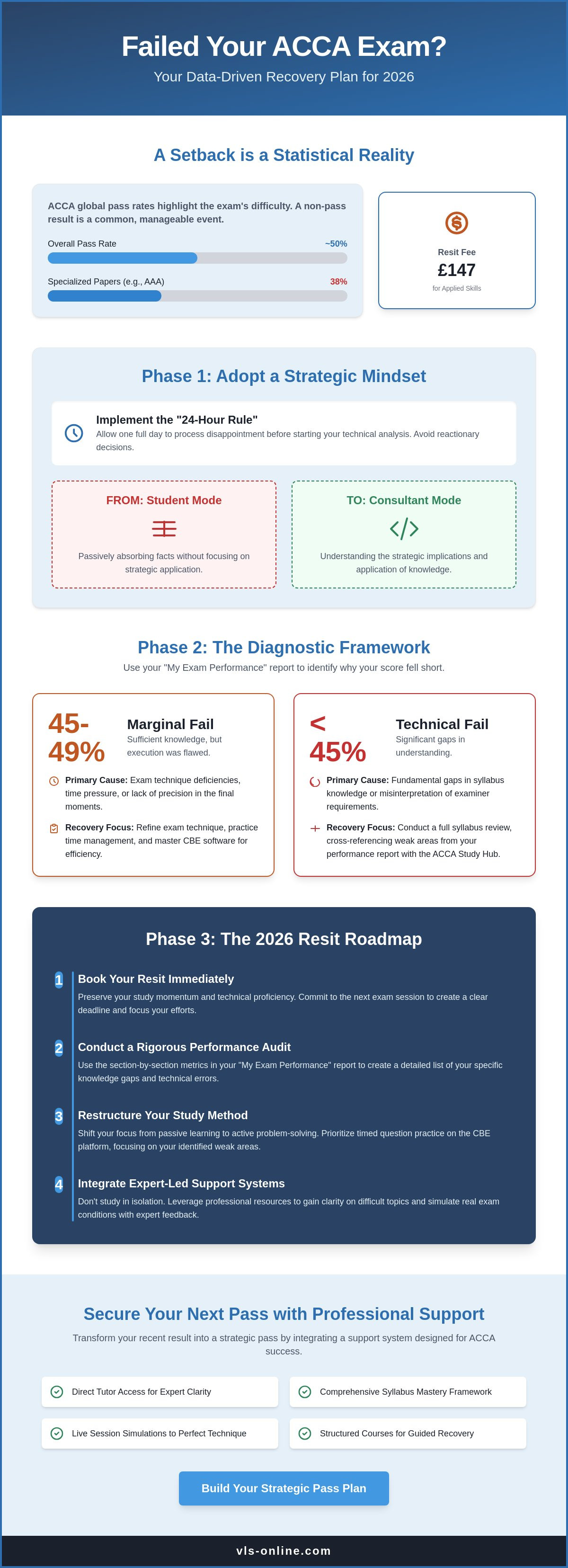
With overall ACCA pass rates hovering near 50% and specialized papers like Advanced Audit and Assurance (AAA) seeing success for only 38% of candidates, a single setback isn't a professional ceiling; it's a statistical reality. Determining exactly what to do after failing an ACCA exam requires a disciplined shift in perspective, moving from disappointment toward a data-driven analysis of your performance. We recognize the frustration of losing momentum and the financial weight of a £147 Applied Skills resit fee, particularly when examiner feedback appears ambiguous or difficult to implement.
This guide provides the professional clarity you need to move forward with absolute certainty. We'll outline a recovery strategy for 2026 that includes a rigorous diagnostic framework, a restructured study method, and a clear roadmap to restore your confidence before the next session. By shifting your focus toward systematic optimization, you'll learn how to identify specific knowledge gaps and technical errors. By the end of this article, you'll have a precise plan to transform your recent result into a strategic pass.
Key Takeaways
- Adopt a strategic diagnostic mindset by treating your exam result as a professional data point rather than a permanent setback.
- Conduct a rigorous performance audit using "My Exam Performance" reports to differentiate between technical knowledge gaps and exam technique deficiencies.
- Establish a structured 2026 recovery roadmap by booking your resit immediately to preserve study momentum and technical proficiency.
- Learn precisely what to do after failing an ACCA exam by integrating expert-led support systems, such as direct tutor access and live session simulations, into your preparation.
Table of Contents
- Depathologising Failure: Shifting to a Strategic Diagnostic Mindset
- The Diagnostic Framework: Identifying Why Your Score Fell Short
- The 2026 Resit Roadmap: Tactical Steps for Your Next Attempt
- Securing Your Pass: Professional Support Systems with Vertex
Depathologising Failure: Shifting to a Strategic Diagnostic Mindset
A professional setback is rarely the result of a single error; it's usually a systemic misalignment between study methodology and examiner expectations. When you're determining what to do after failing an ACCA exam, you must view the result as a diagnostic roadmap rather than a professional ceiling. The Association of Chartered Certified Accountants (ACCA) designs its examinations to mirror the complexity of the global financial environment. Therefore, a score below the 50% threshold is a clear signal that your current application of technical knowledge requires recalibration to meet these rigorous standards.
Professional integrity requires emotional stability during times of crisis. We recommend the "24-Hour Rule": allow one full day to process the disappointment before initiating a technical post-mortem. This period of reflection prevents reactionary decisions and ensures that when you finally analyze your performance report, you do so with the objective distance of a senior auditor. Initiating a technical post-mortem is the first logical step in determining what to do after failing an ACCA exam, as it moves the conversation from emotional frustration to strategic planning.
High-tier employers in the financial sector value candidates who demonstrate the grit to overcome setbacks. Proving you can refine your strategy after a marginal fail shows you possess the professional resilience required for senior leadership. Demonstrating this persistence is a hallmark of a future-proof accountant. For broader context on maintaining this discipline, you can explore our accounting exam study tips for 2026.
The Professionalism of Persistence
The Strategic Professional level tests your ability to function under duress as much as your technical proficiency. To succeed in your next attempt, you must transition from "student mode," which involves the passive absorption of facts, to "consultant mode." A consultant doesn't just know the accounting standards; they understand the strategic implications of their application. Reviewing your results through this lens allows you to identify whether the failure was due to a lack of knowledge or a failure of professional judgment. This shift in perspective is what separates those who struggle from those who eventually lead the profession.
The Diagnostic Framework: Identifying Why Your Score Fell Short
A failed result is not a binary outcome; it is a complex set of performance data. To understand exactly what to do after failing an ACCA exam, you must move beyond the headline percentage and interrogate the "My Exam Performance" report available through your student portal. This report provides a granular breakdown of your proficiency across specific syllabus areas, allowing you to identify whether your failure was a localized technical error or a systemic breakdown in exam technique. Analyzing these section-by-section metrics is the only way to ensure your next attempt is built on a foundation of objective evidence.
We categorize failures into two distinct strategic groups. A marginal fail (45-49) usually indicates that you possess sufficient technical knowledge but lacked the precision to secure the final "low-hanging fruit" marks in the closing minutes. Conversely, a technical fail (below 45) suggests fundamental gaps in syllabus coverage or a failure to interpret the examiner's requirements correctly. Utilizing official ACCA Exam Support materials during this audit helps you align your self-assessment with the actual marking criteria used by the examiners.
Knowledge Gaps and Syllabus Coverage
Professional exams in 2026 leave no room for selectivity. Relying on "question spotting" is a high-risk strategy that almost inevitably leads to failure in modern Computer Based Exams (CBEs) because the software pulls from a vast bank of potential requirements. Use the ACCA Study Hub to cross-reference your performance report against the full syllabus. If your score was particularly low in Section A or B, it's a clear indicator that your breadth of knowledge is insufficient. For those seeking to bridge these gaps systematically, our structured ACCA courses provide a comprehensive framework for complete syllabus mastery.
Exam Technique and CBE Software Proficiency
Technical knowledge is worthless if you can't communicate it effectively through the CBE platform. Many candidates lose vital marks not because they don't know the accounting standards, but because they struggle with spreadsheet formatting or word processing efficiency. Time management remains the most frequent cause of failure. If you left high-mark requirements unanswered or rushed your conclusions, your resit strategy must prioritize mock exams under timed conditions to build the necessary operational stamina. Proficiency in the software tools is just as critical as the technical content itself.
The 2026 Resit Roadmap: Tactical Steps for Your Next Attempt
Determining exactly what to do after failing an ACCA exam involves transitioning from analysis to aggressive tactical execution. The most critical decision you'll make is booking your resit immediately. Delaying the next attempt allows technical proficiency to decay and erodes the professional momentum you've already built. Maintaining a consistent study rhythm ensures that the knowledge remains accessible, reducing the cognitive load required for the second attempt. This is especially true for those moving through the ACCA Applied Skills Guide, where foundational concepts are rapidly built upon.
Success in 2026 demands a shift from passive reading to "Active Recall." You must prioritize intensive question bank practice over textbook review. By engaging with the material through the lens of specific requirements, you train your brain to retrieve and apply information under pressure. We also emphasize the importance of reviewing the latest Examiner Reports. These documents reveal the specific language and "markers’ preferences" that distinguish a passing script from a failing one in the current exam cycle. Understanding these nuances allows you to align your output with the exact expectations of the marking team.
Intensive Question Practice
Spending 70% of your resit preparation on questions and only 30% on targeted theory review is the most efficient path to a pass. This "70/30 Rule" ensures that your time is spent on the highest-value activities. Simulating exam conditions through a full mock exam in a quiet environment is non-negotiable. It builds the mental stamina needed to maintain focus during the final hour of the actual sitting, which is often where marginal fails occur. To ensure your next attempt meets these professional standards, consider enrolling in our comprehensive ACCA training modules for expert-led guidance.
Refining Your Answer Structure
Help the marker award you points by using clear headings and professional formatting within the CBE software. In Strategic Professional papers like SBR, the ability to link technical standards back to the provided scenario is what secures the pass. Avoid generic answers; instead, provide tailored advice that addresses the specific needs of the business described in the case study. A structured, easy-to-read response demonstrates the professional competence that examiners are looking for at this elite level.
Securing Your Pass: Professional Support Systems with Vertex
When you're determining what to do after failing an ACCA exam, the transition from independent study to mentored learning often marks the definitive turning point between repeated failure and a final pass. Vertex Learning Solutions (VLS) provides a structured professional safety net designed to eliminate the isolation of resit preparation. Our weekly live sessions recreate the discipline of a classroom environment, which is vital for addressing exam anxiety and building technical confidence. These sessions allow you to engage with complex scenarios in real time, ensuring that your understanding aligns with the 2026 examiner expectations.
We replace generic textbooks with exam-focused study notes that prioritize mark-earning potential over dense, theoretical text. This streamlined approach ensures that your limited resit time is spent mastering the specific concepts that carry the most weight in the marking scheme. To ensure your next ACCA attempt is your last, we invite you to explore our Full Access Packages, which combine these resources into a single, pass-oriented roadmap for 2026.
Expert Mentorship via WhatsApp
Resit candidates often encounter a "frustration plateau" where specific concepts remain stubbornly unclear despite repeated reading. Our direct WhatsApp tutor support provides immediate clarity, preventing these intellectual bottlenecks from stalling your progress. You can submit your practice question workings and receive real-time feedback, which is essential for perfecting your exam technique before the next session. This level of discrete, professional mentorship ensures that you're never left guessing about the application of a complex standard.
Comprehensive Course Modules
Our curriculum is designed to address every potential failure point across the qualification. From foundational papers like Financial Management (FM) to the advanced complexities of Advanced Financial Management (AFM), VLS provides the technical depth required for success. Recorded lectures offer the flexibility of repetitive learning, allowing you to revisit "tricky" topics as often as necessary to achieve mastery. This systematic approach ensures that you enter the exam hall with the technical security and operative stability that the profession demands.
Transitioning from Setback to Professional Success in 2026
A single exam result doesn't define your career trajectory, but your response to it certainly does. By adopting a diagnostic mindset and prioritizing active recall over passive reading, you've already taken the first steps toward recovery. Deciding exactly what to do after failing an ACCA exam determines whether your next session results in a qualification or another delay. Success in the 2026 sittings requires a disciplined combination of rigorous question practice and the strategic application of technical knowledge to specific case study scenarios.
Vertex Learning Solutions stands ready as your strategic partner to ensure this attempt is your final one. We provide a comprehensive safety net through active WhatsApp tutor support and weekly live classroom simulations that address your specific failure points in real time. Our exam-focused study notes and recorded lectures are engineered to simplify complex regulations without compromising professional depth. Join Vertex Learning Solutions today and secure your ACCA pass. Your professional goals remain within reach, and with the right framework, your next result will reflect the elite expertise you've worked so hard to cultivate.
Frequently Asked Questions
How long should I wait before resitting a failed ACCA exam?
You should aim to resit the failed paper in the next available exam session, which is typically within a three-month window. Maintaining study momentum is vital because technical knowledge decays rapidly once you stop active preparation. Delaying the attempt often necessitates a complete technical restart, where you must relearn fundamental concepts from scratch. This increases the cognitive load and the financial risk of future sittings.
Is it better to move on to a new paper or resit the one I failed?
It's strategically superior to prioritize the resit over starting a new paper. When considering what to do after failing an ACCA exam, you must focus on closing existing knowledge gaps while the material remains fresh. Attempting to learn a new syllabus while simultaneously revising old content often dilutes your focus. Focusing on a single objective ensures you can apply the rigorous diagnostic framework required for a pass.
How many times can I fail an ACCA exam before being disqualified?
There's no specific limit on the number of times you can attempt an individual exam. However, the "seven-year rule" applies once you reach the Strategic Professional level. You have seven years from the date of your first Strategic Professional pass to complete all remaining exams at that level. If you exceed this timeframe, any Strategic Professional passes older than seven years will expire and must be retaken.
What is the "My Exam Performance" report and how do I use it?
The "My Exam Performance" report is a diagnostic tool in your student portal that provides a section-by-section breakdown of your results. To use it effectively, look for specific syllabus areas where your proficiency fell below the 50% threshold. This report allows you to shift from general revision to a targeted recovery strategy. It ensures that your resit preparation addresses precise technical weaknesses rather than repeating material you've already mastered.
Does failing an ACCA exam look bad to future employers?
A single failure is rarely a concern for employers, provided you can demonstrate professional resilience. Most senior partners recognize that ACCA exams are elite benchmarks with rigorous standards. What matters more is your ability to perform a technical post-mortem and secure a pass in the subsequent session. Showing that you know exactly what to do after failing an ACCA exam demonstrates the maturity and analytical skills required for leadership roles.