Vertex Learning Solutions


Did you know that while 82% of candidates successfully navigate the E1 pillar, only 54% achieve the required CIMA operational level pass marks for the P1 Management Accounting exam? This stark contrast often creates a sense of apprehension for students who are already struggling to decipher the difference between their raw performance and the 100/150 scaled score requirement. You aren't alone in feeling that the path to the Management Level is obscured by complex grading mechanics and fluctuating pass rates across the different pillars.
We understand that professional progression requires more than just hard work; it demands a clear, strategic understanding of the benchmarks you're measured against. This guide provides the definitive breakdown of the 2026 scoring system, ensuring you can interpret your results with absolute precision. We'll examine the specific difficulties of the P1 paper, the stable 73% success rate of the Operational Case Study, and the exact data points you need to measure your mock exam readiness with confidence. By the end of this analysis, you'll have a structured roadmap to secure your progression toward the CGMA designation.
Key Takeaways
- Gain absolute clarity on the 100/150 scaled scoring system to understand how CIMA ensures consistency across different exam variants.
- Analyze the specific CIMA operational level pass marks and historical success rates to benchmark your performance against 2026 standards.
- Understand the fundamental differences in grading between computer-based Objective Tests and the human-assessed Operational Case Study.
- Learn to implement a strategic study cycle that identifies technical weaknesses early, helping you avoid narrow failures in challenging pillars like P1.
- Discover how professional resources, including recorded lectures and exam-focused notes, can provide the stability needed to progress to the Management Level.
Table of Contents
- Understanding the CIMA Operational Level Scoring Mechanism
- Comparing Pass Marks: Objective Tests vs. Operational Case Study
- Strategic Preparation: How to Surpass the Pass Mark
- Your Path to CGMA Success with Vertex Learning Solutions
Understanding the CIMA Operational Level Scoring Mechanism
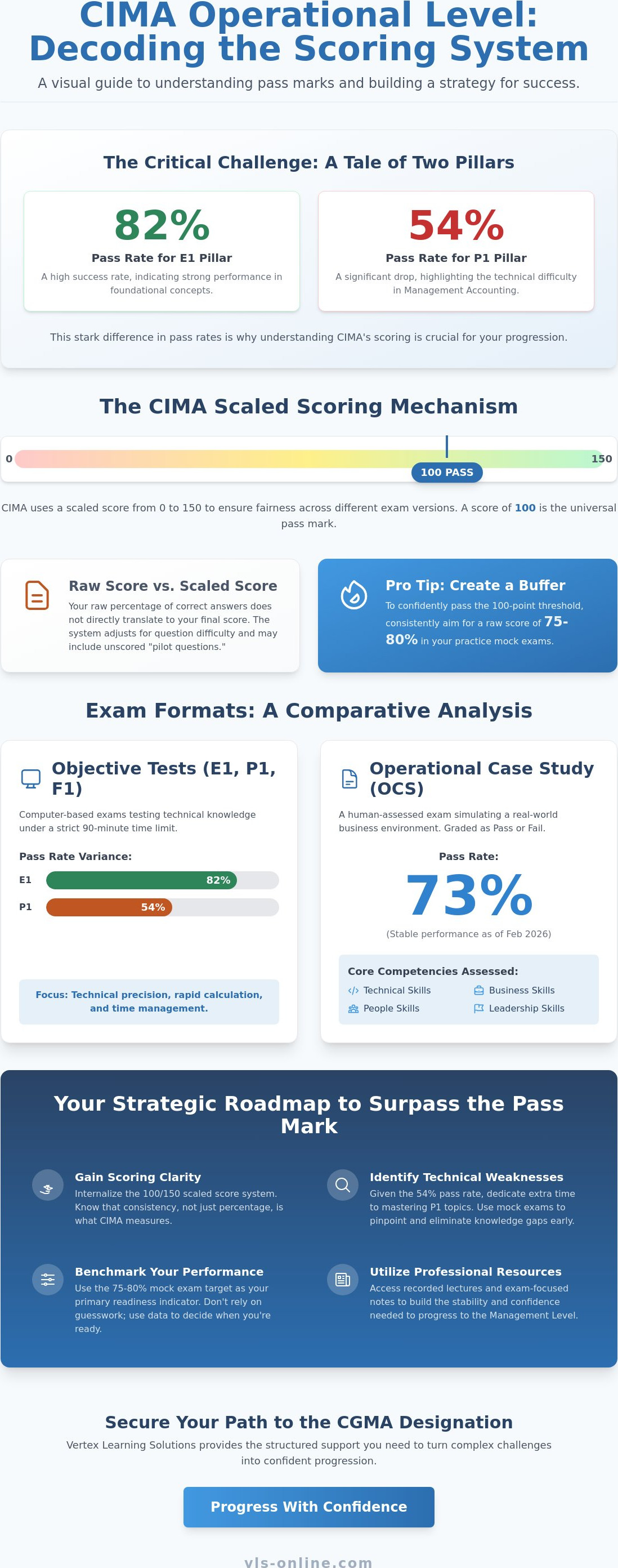
Understanding the mechanics behind CIMA operational level pass marks is essential for any student aiming for first-time success. The Chartered Institute of Management Accountants (CIMA) utilizes a sophisticated methodology to ensure every candidate is evaluated fairly. Since Objective Tests like E1, P1, and F1 are pulled from a dynamic question bank, the difficulty of one exam session might differ slightly from another. To maintain a level playing field, the institute employs a scaled scoring system rooted in Item Response Theory. This mathematical approach doesn't simply tally correct answers; it adjusts your score based on the statistical difficulty of the specific questions you encountered.
The CIMA scaled score is a psychometric measure ranging from 0 to 150 that reflects a candidate's performance relative to the exam's difficulty.
The 100-Point Threshold: What It Really Means
The number 100 represents the universal passing standard across all professional levels. Securing the CIMA operational level pass marks requires demonstrating a consistent level of competency across the entire syllabus. CIMA weights questions differently based on their complexity. A challenging calculation in P1 might be statistically "worth" more in the scaling process than a basic definition in E1. This ensures your result is a true reflection of professional capability rather than a stroke of luck regarding the questions you were assigned.
Raw Marks vs. Scaled Scores
Many students mistakenly assume that a 70% raw score automatically equates to a scaled score of 105. This isn't the case. The conversion isn't a simple percentage. Your exam might include "pilot questions" which are unscored items used by CIMA for future test development. Since you won't know which questions are unscored, your perceived performance can feel higher or lower than your final result. To ensure you clear the 100-point bar, it's prudent to consistently achieve 75-80% in your practice mocks. This provides a necessary buffer for the statistical adjustments made during the final calculation.
Comparing Pass Marks: Objective Tests vs. Operational Case Study
Success at this level requires a dual mastery of technical precision and practical application. While the three Objective Tests focus on specific pillars, the Case Study evaluates your ability to function as a junior management accountant in a simulated business environment. Understanding how CIMA operational level pass marks vary between these formats is the first step in building a resilient study plan. For a broader perspective on the entire journey, you'll find our CIMA Professional Qualification guide to be an invaluable resource for long-term planning.
Objective Test (OT) Passing Criteria
The computer-based Objective Tests for E1, P1, and F1 demand rapid, accurate decision-making within a strict 90-minute window. Recent data highlights a significant variance in difficulty across these subjects. For the period ending November 2025, E1 saw a strong 82% pass rate, whereas P1 dropped significantly to 54%. This suggests that many students struggle with the management accounting pillar, likely due to the depth of technical calculation required under pressure. Achieving the necessary CIMA operational level pass marks in P1 requires more than just memorization; it necessitates a disciplined approach to time management and a deep understanding of cost-volume-profit analysis.
Operational Case Study (OCS) Grading
The OCS represents a shift from automated scoring to human assessment. Unlike the OTs, where a scaled score of 100 is the goal, the OCS result is reported as a pass or fail based on your demonstration of four core competencies: technical, business, people, and leadership skills. Examiners aren't merely looking for correct arithmetic. They seek an integrated response that shows you understand the strategic implications of your work. Interestingly, OCS pass rates have remained robust, climbing to 73% in February 2026. This stability indicates that once the technical hurdles of the OTs are cleared, students generally find the transition to the case study manageable with the right guidance. If you're looking to bridge the gap between theory and exam-room performance, our CIMA Professional Qualification - Operational Level resources provide the structured support you need to progress with confidence.
Strategic Preparation: How to Surpass the Pass Mark
Securing your professional progression requires a shift from passive reading to active, data-driven preparation. To reliably clear the CIMA operational level pass marks, you must identify your "weak pillars" within the first three weeks of your study cycle. Waiting until the final revision phase to address technical gaps in P1 or F1 often leads to narrow failures that could've been avoided with early intervention. We've observed that achieving consistent 110+ scores in time-boxed mock exams is the most reliable predictor of actual exam success in the 2026 testing environment.
Simulating the 90-minute pressure of an Objective Test is non-negotiable. This discipline helps you manage the cognitive load of switching between theoretical definitions and complex calculations. If a specific concept remains elusive, professional tutor support can provide the clarity needed to turn a potential failure into a confident pass. Stability in your preparation leads to stability in your results.
Mastering the P1 Hurdle
The P1 Management Accounting paper remains a significant obstacle for many. Success here hinges on your command of variance analysis and modern costing techniques, such as Activity-Based Costing. These areas require precise calculation and an understanding of their operational utility. For those seeking additional conceptual depth, reviewing ACCA Management Accounting insights can offer a fresh perspective on these shared principles, reinforcing your technical foundation before you sit the CIMA exam.
OCS Success: Beyond the Numbers
The Operational Case Study requires a different strategic lens. You should treat the pre-seen material as a live business case rather than a static document. Use it to predict potential "triggers" or exam tasks that examiners frequently use to test your ability to integrate knowledge. High-scoring candidates focus on the "so what?" factor. They don't just state financial data; they explain its specific business impact on the company's operational stability. To build this level of professional competence, consider the structured pathways available at Vertex Learning Solutions, where our experts help you bridge the gap between technical knowledge and practical application.
Your Path to CGMA Success with Vertex Learning Solutions
Achieving the necessary CIMA operational level pass marks is merely the first milestone in a broader strategic journey toward the CGMA designation. At Vertex Learning Solutions, we provide a professional framework designed to simplify the inherent complexities of the scaled scoring system. Our recorded lectures and meticulously structured exam-focused notes don't just present information; they distill the syllabus into actionable insights that target the 100-point threshold with precision. By utilizing our interactive practice questions, which mirror the official CIMA testing interface, you'll develop the technical fluency and psychological stability required for the actual exam environment.
Personalized Support for Every Student
We recognize that professional growth requires more than static materials. Our students benefit from direct WhatsApp tutor support, offering a discrete channel for immediate clarification on challenging topics like variance analysis or financial reporting standards. This proactive thinking is supplemented by weekly live sessions. These gatherings serve as a critical bridge between theoretical frameworks and practical exam application, ensuring no student feels isolated in their preparation. It's this combination of elite expertise and accessible support that creates a secure professional protective net for our candidates.
Building a Long-term Professional Roadmap
Progression shouldn't stall once you receive your OCS results. We encourage our students to adopt a systems-level view by planning their transition to the Management Level immediately. Maintaining momentum is essential for long-term success in the professional qualification landscape. For those committed to a comprehensive career trajectory, our professional certification packages provide a structured pathway through all professional levels. We invite you to explore VLS CIMA Operational Level courses and partner with a consultant who understands the nuances of CIMA operational level pass marks and the strategic requirements of your future career.
Securing Your Professional Advancement
Navigating the transition to the Management Level requires a sophisticated understanding of the benchmarks that define success. You now possess the clarity needed to interpret the 100-point scaled scoring system and the strategic insight to overcome the specific hurdles presented by the P1 pillar. Success in securing the CIMA operational level pass marks isn't merely about passing a test; it's about demonstrating the technical and business acumen required of a modern management accountant. By focusing on consistent mock performance and integrated Case Study responses, you've already begun to build the resilience needed for a long-term career.
We're here to provide the professional safety net and expert guidance essential for this journey. Our updated 2026 study notes, weekly live interactive sessions, and direct WhatsApp tutor support are designed to turn complex regulations into manageable milestones. This structured environment ensures your preparation is both efficient and effective, giving you the security to focus on your professional growth. Start your CIMA Operational Level journey with VLS today and approach your exams with the calm confidence of a prepared professional. Your path to the CGMA designation is clear, and we're ready to help you walk it.
Frequently Asked Questions
What is the difference between a raw mark and a scaled score in CIMA exams?
A raw mark is the simple tally of questions you answered correctly during your session, whereas a scaled score is a weighted result that accounts for the statistical difficulty of those specific questions. Because every candidate receives a unique combination of items from the question bank, CIMA uses scaling to ensure that a score of 100 represents a consistent level of professional competency regardless of which exam variant you sat.
Can I see my actual percentage score after a CIMA Objective Test?
No, the institute doesn't disclose raw percentage scores or the exact number of correct answers for Objective Tests. Instead, you'll receive a final scaled score between 0 and 150 and a descriptive performance profile. This profile indicates whether you were "Proficient" or "Not Proficient" in specific syllabus areas, allowing you to identify technical gaps without focusing on misleading raw percentages.
What happens if I score exactly 100 on my CIMA Operational exam?
Scoring exactly 100 results in a "Pass" because this figure represents the minimum threshold for CIMA operational level pass marks. There's no professional disadvantage to passing with the minimum score; the institute views any result of 100 or higher as a valid demonstration of the skills required to progress to the Management Level. Your transcript will simply record the successful completion of the pillar.
How long do I have to wait for my CIMA Operational Case Study (OCS) results?
Results for the Operational Case Study are typically released six to eight weeks after the close of the exam window. This duration is necessary because the OCS is a human-marked exam where examiners must carefully evaluate your ability to integrate technical, business, and people skills. You'll receive a notification via email once your result is available on the MyCIMA portal.
Is it possible to fail a CIMA exam even if I get more than 50% of the questions right?
Yes, it's possible to fail with more than half of the questions correct if the items you answered right were statistically weighted as "easier" questions. Under the Item Response Theory model, easier questions contribute less to your final scaled score than more complex ones. This is why we advise students to aim for a 75-80% success rate in practice sessions to safely secure the CIMA operational level pass marks in the real testing environment.