Vertex Learning Solutions


While the overall global success rate remains a steady 50%, the March 2026 results reveal a sobering reality: papers like Advanced Performance Management (APM) saw success for only 40% of candidates. It's natural to feel a sense of trepidation when analyzing the latest ACCA pass rates by paper, especially when you're balancing a demanding career with the rigorous requirements of professional qualification. The jump in complexity between the Applied Skills and Strategic Professional levels often feels like a chasm rather than a step, leaving many students questioning if their current study methods are sufficient to survive the next sitting.
We understand that you don't just want to pass; you want the security of a well-executed plan that minimizes risk and respects your limited time. This strategic analysis provides a meticulous breakdown of the latest benchmarks and introduces the structured framework you need to exceed them in 2026. You'll gain a clear understanding of difficulty levels across the entire syllabus, discover the most effective order for taking your exams, and acquire the confidence to beat the global averages through disciplined, expert-led preparation that turns complexity into a manageable path toward your membership.
Key Takeaways
- Understand how the latest 2026 performance trends and the CBE Practice Platform influence global success benchmarks.
- Identify the specific "bottleneck" papers within the ACCA pass rates by paper data where candidates frequently encounter increased technical difficulty.
- Learn to bridge the "Application Gap" by evolving your study method from rote memorisation to the strategic interpretation of complex business scenarios.
- Discover how expert mentorship and the analysis of examiner reports provide a professional safety net against common pitfalls in high-risk papers.
- Gain a structured roadmap for sequencing your exams to maintain momentum and exceed global average pass rates in 2026.
Table of Contents
Analysing the 2026 ACCA Pass Rate Landscape
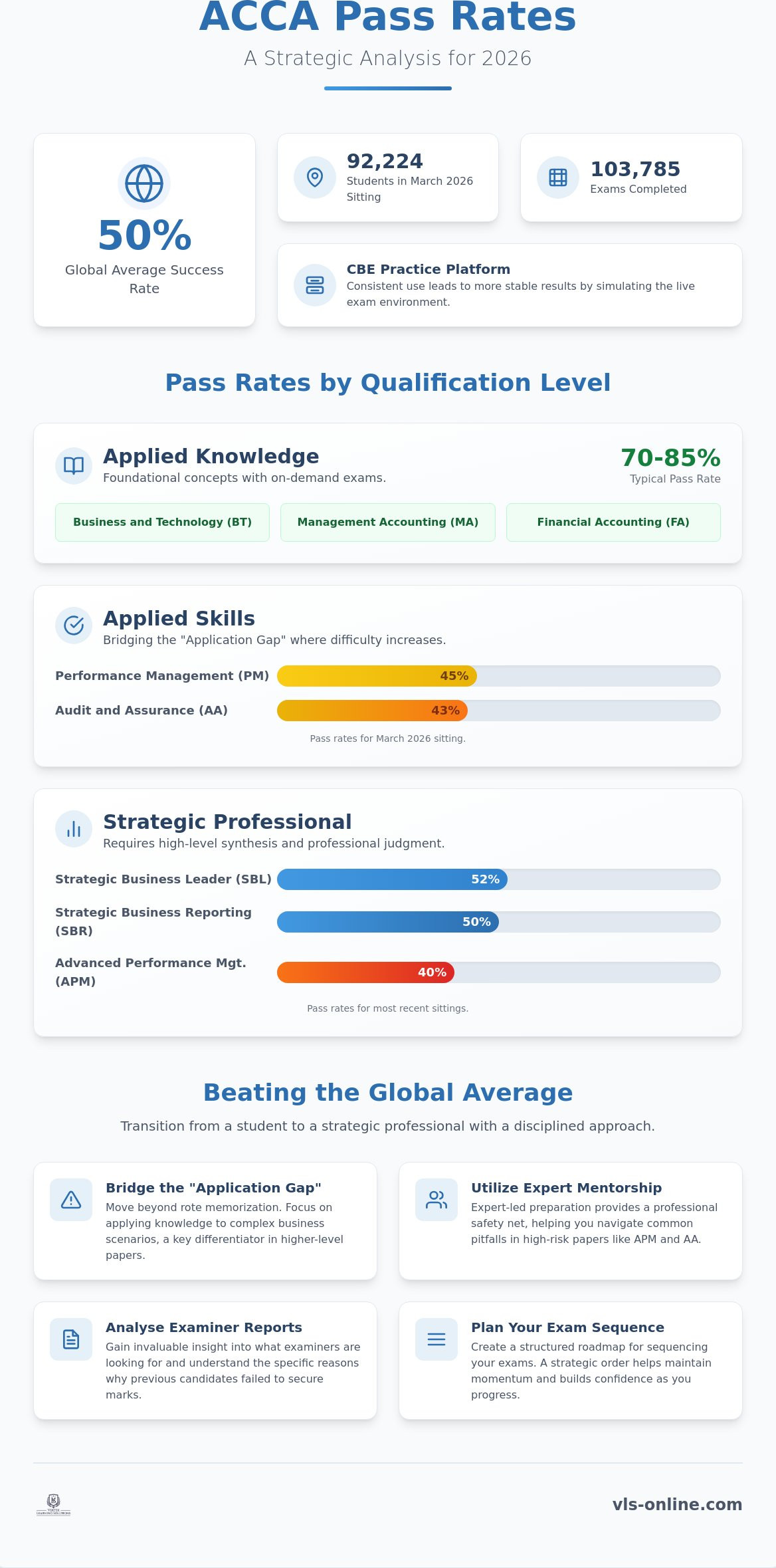
Understanding the ACCA pass rates by paper requires a clear definition of what these percentages signify. A pass rate represents the proportion of candidates who achieved a score of 50% or higher during a specific examination window. In the March 2026 sitting, for instance, 103,785 exams were completed by 92,224 students. These figures aren't just abstract data; they provide a diagnostic view of how the global student body is adapting to increasingly sophisticated assessment methods. The 2026 trend indicates that students who consistently utilize the CBE Practice Platform are achieving more stable results. This platform simulates the live environment, reducing technical friction and allowing candidates to focus purely on the application of knowledge.
Exam performance often fluctuates between the March, June, September, and December sessions. These variations can stem from seasonal study habits or the specific mix of optional papers taken during a particular window. When planning your 2026 journey, the December 2025 results serve as a critical baseline. They highlight the steady state of the qualification before the latest syllabus updates took full effect. Analyzing these trends helps you identify which sittings might offer a more focused environment for your specific exam goals.
The Significance of Global Benchmarks
The Association of Chartered Certified Accountants (ACCA) maintains its reputation as a global gold standard by ensuring that pass rates reflect rigorous professional standards. These benchmarks aren't static; they evolve to incorporate emerging ethical complexities and digital transformation trends. Success here signifies that you've met a high-level criterion recognized by employers in 180 countries. It's a testament to your ability to operate within a complex, regulated environment.
On-Demand vs. Session-Based Pass Rates
Applied Knowledge papers like Business and Technology (BT), Management Accounting (MA), and Financial Accounting (FA) typically see pass rates between 70% and 85%. These are on-demand exams, offering instant results that provide immediate momentum. This differs significantly from session-based Applied Skills or Strategic Professional papers. The psychological advantage of on-demand exams helps students progress quickly through the foundational stages before they encounter the more analytical hurdles of the higher levels where pass rates naturally tighten.
ACCA Pass Rates by Paper: A Detailed Level Breakdown
Analysing the ACCA pass rates by paper across different levels reveals a distinct escalation in complexity. While the Applied Knowledge papers maintain a high degree of stability, the transition to later stages requires a fundamental shift in your preparation strategy. Success at the foundational level doesn't always guarantee a smooth journey through the professional tiers without a change in tactical approach.
Applied Knowledge exams, specifically Business and Technology (BT) and Financial Accounting (FA), consistently see global pass rates between 70% and 85%. These papers assess your foundational understanding of business environments and accounting techniques. Their objective nature and on-demand availability contribute to these higher success metrics, making them an ideal starting point for building academic confidence. It's the first step in a long-term professional commitment.
Applied Knowledge and Skills Performance
The landscape changes significantly at the Applied Skills level. Papers such as Performance Management (PM) and Audit and Assurance (AA) often act as bottlenecks. In the March 2026 sitting, PM saw a pass rate of 45%, while AA remained one of the most challenging at 43%. These subjects demand more than technical knowledge; they require the ability to apply concepts to specific, often ambiguous, scenarios. For a deeper dive into navigating these hurdles, consult our ACCA Applied Skills: The Ultimate Educational Guide for 2026.
Strategic Professional Success Metrics
At the Strategic Professional level, the focus shifts toward high-level synthesis and professional judgment. Strategic Business Leader (SBL) typically enjoys a higher pass rate, reaching 52% in the most recent sitting, as it rewards commercial acumen and communication skills. Conversely, technical papers like ACCA Strategic Business Reporting (SBR) demand a sophisticated grasp of complex reporting standards, reflected in its 50% pass rate. Success here requires a transition from being a student to thinking like a consultant.
The optional papers present the final challenge. Advanced Performance Management (APM) saw the lowest success rates in March 2026, recorded at 40%. This compares to Advanced Taxation (ATX) at 50% and Advanced Audit and Assurance (AAA) at 42%. Choosing your options requires an honest assessment of your technical strengths and career aspirations. If you're struggling to decide, our tutors can help you evaluate your performance data through our specialized ACCA courses to ensure your final choices align with your professional goals.
Beyond the Numbers: Why Certain Papers Challenge Students
Raw data provides a benchmark, but it doesn't explain the structural hurdles that cause ACCA pass rates by paper to fluctuate so significantly. The primary obstacle for many is the "Application Gap." This is the difficult transition from performing rote calculations to interpreting complex business scenarios. In papers like Financial Management (FM), students often master the formulas but struggle to explain the strategic implications of their results. Success in 2026 requires you to move beyond the role of a calculator and adopt the mindset of a strategic advisor who understands the "why" behind the numbers.
Audit and Assurance (AA) remains a consistent challenge, often seeing pass rates as low as 43%. The pitfall here isn't a lack of technical knowledge; it's a failure to apply professional skepticism. Candidates frequently provide generic answers rather than tailoring their audit risks to the specific case study provided. Similarly, in high-stakes papers like FM, poor time management often results in unfinished discussion questions, which carry significant marks. It's a common misconception that these exams are designed to make students fail. In reality, they are rigorous filters designed to ensure that only those with true professional competence enter the global workforce.
The Technical vs. Strategic Hurdle
The 2026 exam sittings place an even greater emphasis on professional marks and ethical skepticism. This shift explains why Advanced Audit and Assurance (AAA) remains a significant hurdle, with a 42% pass rate. You aren't just tested on what you know, but on how you communicate that knowledge. Demonstrating commercial acumen and clarity is now as vital as getting the technical accounting treatment correct.
The Impact of Professional Experience
Working in a finance department can be a double-edged sword. While practical experience provides context, it can also lead to "tunnel vision" where a student relies on their company's specific (and sometimes non-standard) practices rather than the IFRS or ISA standards. Balancing workplace habits with exam requirements is essential. For a structured approach to this balance, see our Accounting Exam Study Tips: The Strategic Guide to Passing Professional Certifications in 2026.
To bridge these gaps effectively, you need a partner who can translate examiner feedback into actionable study goals. Our tutors at Vertex specialize in helping you navigate these nuances, ensuring you don't just study hard, but study with strategic precision. Explore our Full Access study models to secure your professional safety net today.
Beating the Average: Strategic Preparation with Vertex
Exceeding the global ACCA pass rates by paper requires more than just high-quality materials; it demands a structured environment where technical queries are resolved with professional precision. The Vertex "Full Access" model is designed to ensure you never study in isolation. By providing a professional safety net, we help you navigate the chasm between basic knowledge and the strategic application required at the professional level. Our tutors act as your strategic partners, helping you interpret complex examiner reports and avoid the pitfalls that often lead to marginal failures.
One of the most significant advantages of our approach is the integration of real-time support. Leveraging WhatsApp tutor support allows you to clarify complex IAS and IFRS standards instantly, preventing small misunderstandings from becoming systemic errors. This is complemented by our weekly live sessions, which simulate the high-pressure exam environment. These sessions are crucial for mastering time management and refining your professional tone before you ever step into the exam hall. Combining these interactions with VLS mock exams on the CBE Practice Platform ensures your preparation is both rigorous and relevant.
The Vertex Methodology for 2026
Our methodology focuses on efficiency and clarity. We provide exam-focused study notes that distill thousands of pages of syllabus into actionable, high-impact insights. This approach is particularly effective for papers like ACCA Advanced Financial Management (AFM), where understanding the strategic implications of financial data is the key to career growth. We don't just teach you the content; we teach you how to pass.
Your Strategic Path to Membership
Planning your 2026 exam calendar is a delicate balance of ambition and pragmatism. To avoid burnout and maximise your probability of success, it's essential to sequence your papers in a way that builds on your existing technical strengths. Our mentors assist you in creating a stable, long-term roadmap that respects your professional commitments while maintaining steady progress toward your membership goals. Success is a result of disciplined planning and expert-led execution. Explore our comprehensive ACCA online courses and start your journey today to secure your professional future.
Securing Your Professional Future in 2026
Navigating the path to membership requires more than technical diligence; it demands a sophisticated understanding of how to bridge the application gap. While the latest ACCA pass rates by paper highlight the inherent challenges of the professional level, they also provide a clear roadmap for those who approach their studies with strategic intent. Success in 2026 is reserved for candidates who move beyond foundational theory to master the art of professional judgment. It's about evolving from a student into a proactive business advisor who understands the nuances of global standards.
By integrating exam-focused study materials with active tutor support via WhatsApp, you can transform global benchmarks into personal milestones. Our weekly live interactive sessions provide the stability and professional protection you need to navigate complex syllabi with confidence. You don't have to face these rigours alone; expert mentorship ensures your efforts are always aligned with examiner expectations. This structured approach provides the safety net required for consistent, high-level performance across all levels of the qualification.
Take the definitive step toward your qualification today. View our 2026 ACCA Course Packages and Tutor Support Options to align your preparation with global standards of excellence. Your commitment, supported by our expert framework, will ensure you don't just meet the average, but exceed it. We're ready to partner with you on your journey to professional success.
Frequently Asked Questions
What is the hardest ACCA paper to pass based on 2026 data?
Advanced Performance Management (APM) recorded the lowest pass rate of 40% in the March 2026 sitting, making it the statistically most challenging paper. Advanced Audit and Assurance (AAA) followed closely with a 42% success rate. These results indicate that papers requiring professional judgment and high-level synthesis remain the most difficult hurdles for students to overcome during their final professional stages.
How often does ACCA update the global pass rates?
ACCA updates its global pass rate statistics four times per year, coinciding with the quarterly exam cycles in March, June, September, and December. These figures are generally released to the public shortly after candidates receive their individual results. This regular cadence allows students to monitor performance trends and adjust their study strategies based on the latest global benchmarks provided by the association.
Do higher pass rates mean the exam is easier?
Higher pass rates, such as those seen in foundational papers, don't necessarily imply the exams are simple. Instead, they reflect a focus on foundational technical concepts and objective testing formats that allow for clearer success metrics. As you progress to the Strategic Professional level, the shift toward subjective analysis and professional marks naturally results in tighter success margins, requiring a more sophisticated approach to preparation.
Can I pass difficult papers like AAA or PM with online self-study?
Passing challenging papers like AAA or PM through online study is highly effective when the platform includes expert-led support. Success in these subjects depends on understanding examiner nuances that isolated study might miss. Utilizing resources like tutor interaction and live sessions helps candidates navigate the ACCA pass rates by paper landscape by providing immediate clarification on complex standards and reporting requirements that often challenge self-taught students.
What is the average pass rate for the ACCA Strategic Professional level?
The average pass rate for the Strategic Professional level typically fluctuates between 40% and 52% depending on the specific paper and session. While Strategic Business Leader (SBL) reached 52% in March 2026, optional papers like Advanced Performance Management (APM) often see success rates closer to 40%. This variance highlights the importance of choosing optional papers that align with your technical strengths and professional experience to maximize your probability of success.