Vertex Learning Solutions


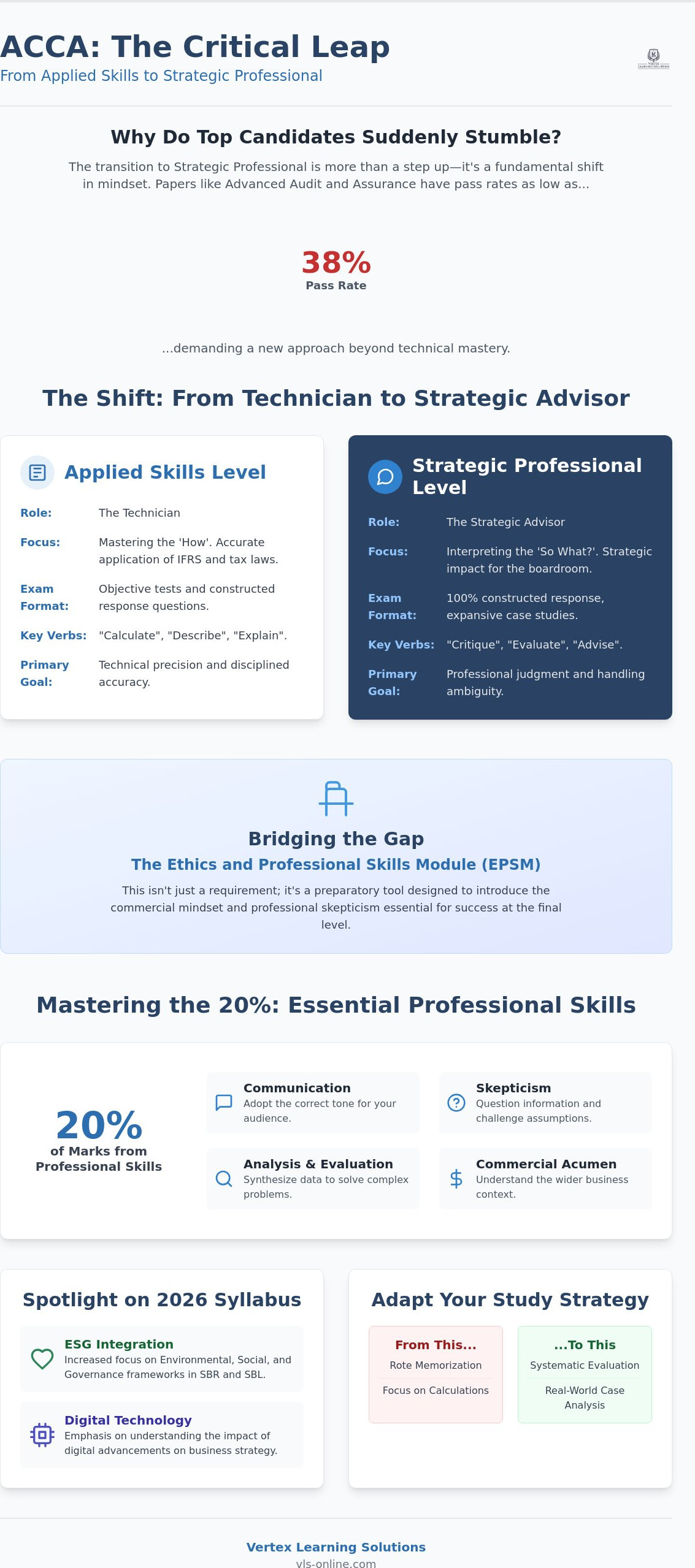
Why do nearly half of the candidates who successfully cleared their earlier exams suddenly struggle to cross the finish line? With pass rates for papers like Advanced Audit and Assurance often sitting as low as 38 percent, the transition from ACCA Applied Skills vs Strategic Professional represents a fundamental shift in the rules of the game. It is no longer enough to operate as a technician; the 2026 syllabus demands that you step into the role of a strategic advisor.
You've likely spent years perfecting your calculation speed and memorizing financial standards, so it's natural to feel anxious when those proven methods no longer guarantee a pass. We recognize that the move from calculation to written analysis is one of the most significant hurdles in your professional journey. This article provides a structured roadmap to help you master this transition. You'll discover how to secure critical professional marks, understand the systemic differences between these levels, and gain the clarity needed to select the optional papers that best protect your career interests.
Key Takeaways
- Recognize the critical transition between ACCA Applied Skills vs Strategic Professional as a fundamental shift from technical execution to high-level strategic advisory.
- Learn how to secure the essential 20% of your marks by mastering professional skills such as commercial acumen, skepticism, and structured communication.
- Transition your study strategy from rote memorization to a systematic evaluation of real-world corporate governance and sustainability reporting.
- Establish a clear roadmap for selecting optional papers by aligning your previous technical proficiencies with their advanced strategic counterparts.
- Understand the impact of the 2026 syllabus changes, specifically the increased integration of ESG frameworks and digital technology within SBR and SBL.
Table of Contents
Defining the ACCA Journey: Applied Skills vs Strategic Professional
The progression through the ACCA Qualification Overview is designed to mirror the career trajectory of a modern finance leader. However, many candidates in 2026 encounter a significant psychological and academic barrier when transitioning from ACCA Applied Skills vs Strategic Professional. While the earlier levels focus on building a robust technical toolkit, the final stage demands a radical shift in perspective. You're moving from a role where you prepare the numbers to one where you interpret their strategic impact for the boardroom.
This "wall" exists because the exam environment changes fundamentally. At the Skills level, success is often synonymous with technical precision. By contrast, the Strategic Professional level evaluates your ability to handle ambiguity and exercise professional judgment. The Ethics and Professional Skills Module (EPSM) serves as the critical bridge here. It's not just a requirement; it's a preparatory tool that introduces the commercial mindset and skepticism necessary to survive the final papers.
The Applied Skills Foundation
This stage represents the technical engine room of your qualification. Here, you master the mechanics of Performance Management (PM), Taxation (TX), Financial Reporting (FR), Audit and Assurance (AA), and Financial Management (FM). The focus remains on the accurate application of IFRS and local tax laws through a combination of objective test questions and constructed response questions. Success at this level proves you can perform the "how" of accounting with disciplined accuracy. You can explore our ACCA Applied Skills courses to ensure your foundation is resilient enough for the challenges ahead.
The Strategic Professional Pinnacle
At this level, the curriculum shifts toward leadership and high-level reporting through mandatory papers like Strategic Business Leader (SBL) and Strategic Business Reporting (SBR). You won't find simple multiple-choice questions here. Instead, you'll face 100% constructed response questions and expansive case studies that simulate real-world corporate scenarios. The examiner is no longer checking if you can calculate a ratio. They're asking "so what?" and "what should the board do next?" You can master SBR with VLS expert tuition to bridge this gap between theory and executive-level application.
The Core Differences: From Technician to Strategic Advisor
The transition between ACCA Applied Skills vs Strategic Professional is often described as a shift from performing the work to reviewing it. In the earlier stages, you're the technician ensuring the ledger balances. Once you reach the Strategic level, you become the advisor explaining why the balance matters to the CEO. This evolution is clearly outlined in the Official ACCA Qualification Structure, where the focus moves from technical competence to professional capability.
One of the most visible changes involves the command verbs used in exam questions. While Applied Skills papers frequently ask you to "calculate" or "describe," Strategic Professional papers demand that you "critique," "evaluate," or "advise." This isn't a mere semantic change. It requires a deeper level of cognitive processing. You aren't just processing data; you're synthesizing it to solve complex organizational problems. For instance, in the SBL exam, you'll navigate 10 to 15 pages of exhibits, including board minutes and market data. The challenge isn't finding a single right answer. It's managing your time to construct a coherent, strategic response within the four-hour window.
The Calculation vs. Analysis Split
In the Applied Skills tier, producing an accurate calculation is often the primary objective. In the Strategic Professional tier, the calculation serves merely as the evidence for a boardroom recommendation. Professional skepticism is the critical requirement for 2026 SP exams, demanding that you question information and challenge management's assumptions. If you find the move from numbers to narrative challenging, our SBR tuition provides the structured support needed to refine your professional tone.
Understanding Professional Skills Marks
The 2026 syllabus allocates 20% of marks to professional skills in SBL and all optional papers. These marks evaluate your communication, analysis, evaluation, skepticism, and commercial acumen. You must adopt the correct tone for your audience, whether it's a formal report for the Board or a briefing note for the CFO. Mastering this shift is essential for success, as we discuss in our guide on Mastering the ACCA Strategic Professional Level. You don't just need to know the right answer; you need to know how to present it with professional authority.
Bridging the Gap: How to Adapt Your Study Strategy
Success in the final stage of your qualification requires an immediate abandonment of rote memorization. While Applied Skills rewards technical recall, the Strategic level penalizes it if you fail to apply the theory to the specific scenario presented. You must start contextualizing every standard you encounter. For example, when studying SBR, don't just learn the rules of IFRS 18; understand how these presentation changes impact stakeholder perception in a volatile market. This shift is a core component of the ACCA Qualification Structure, which demands a higher level of intellectual agility than the previous levels.
Broadening your perspective is essential because you're no longer just a student; you're a business professional in training. Regularly reading international business news helps you develop the commercial acumen required for SBL. To bridge the transition from ACCA Applied Skills vs Strategic Professional, consider these disciplined study habits:
- Analyze real-world corporate failures to understand governance and ethical risks.
- Use the Active Recall method to test your understanding of complex reporting standards rather than just re-reading notes.
- Practice on the ACCA Practice Platform from your first week to ensure the digital workspace becomes second nature.
Case Study Mastery Techniques
Managing 15-page exhibits requires a disciplined approach to annotation. You must learn to highlight key triggers without losing the overarching narrative of the business. Unlike the siloed nature of earlier papers, Strategic Professional exams are integrated. A financial reporting issue in SBR often has deep ethical or performance management implications. To help you navigate these complexities, you can get full access to all ACCA modules and tutor support to ensure no area of your syllabus remains isolated.
Utilizing Tutor Support for Analysis
Writing with an evaluative tone is a skill that requires consistent feedback. Our WhatsApp tutor support allows you to refine your writing style through immediate query resolution. Observing how an expert deconstructs a 50-mark question during live sessions provides the mental blueprint you need for the actual sitting. For more detailed techniques, read our Accounting Exam Study Tips. This proactive approach turns the daunting shift from ACCA Applied Skills vs Strategic Professional into a manageable, structured progression. To begin your journey with expert guidance, visit vls-online.com and explore our comprehensive study packages.
Strategic Pathfinding: Choosing Your Options for 2026 Success
Selecting your optional papers is perhaps the most consequential decision in the final phase of the ACCA Applied Skills vs Strategic Professional transition. It requires a cold, analytical look at your previous performance and your long-term career trajectory. In 2026, the trend of the "Double Pass" strategy has gained significant traction. Many successful candidates choose to sit Strategic Business Reporting (SBR) and Advanced Audit and Assurance (AAA) in close proximity. This isn't a coincidence; the reporting standards mastered in SBR form the backbone of the audit judgments required in AAA.
Choosing between Advanced Financial Management (AFM) and AAA often defines a student's path. If you prefer the precision of valuation and risk management, AFM is your natural home. Conversely, if you enjoy the ethical complexities and systemic evaluation of financial statements, AAA offers a more suitable challenge. Your choice should also reflect the 2026 professional landscape. With the integration of IFRS 18 and increased sustainability reporting, your ability to align your technical strengths with these evolving standards is vital for a first-time pass.
Option Paper Decision Matrix
To optimize your chances of success, align your options with the papers where you demonstrated the highest technical proficiency during the Skills level. This alignment reduces the cognitive load of learning entirely new concepts at a higher level of complexity. Consider the following pairings:
- If you loved Financial Management (FM), you should prepare for AFM with Vertex Learning.
- If you excelled in Audit and Assurance (AA), then Advanced Audit and Assurance (AAA) is your logical target.
- For those who found Taxation (TX) or Performance Management (PM) rewarding, the advanced versions of these papers offer a clear path to specialization.
The Final Countdown to Membership
Passing your final exam is a momentous achievement, but it's only one part of the journey. You must also finalize your Practical Experience Requirement (PER) alongside your studies to ensure a seamless transition to membership. Once you cross this threshold, you move from the role of a student to that of a recognized professional with elite expert status. The shift from ACCA Applied Skills vs Strategic Professional is demanding, but with the right strategic partner, it's entirely manageable. Join Vertex Learning Solutions today and bridge the gap to ACCA success.
Mastering the Strategic Shift for 2026 Success
The transition to the leadership tier is a deliberate evolution of your professional identity. You've moved past the technical mechanics of accounting and must now embrace the strategic responsibilities of a business advisor. Success in the 2026 sittings depends on your ability to integrate professional skepticism with commercial acumen, ensuring that every recommendation you make is grounded in corporate reality. By focusing on evaluative writing and selecting optional papers that align with your established technical strengths, you effectively protect your path to membership.
While the jump from ACCA Applied Skills vs Strategic Professional is significant, it's a manageable progression when supported by a structured methodology. We provide the professional protective net you need during this critical phase. Our expert led tuition offers weekly live interactive sessions and exam focused 2026 study materials. Our active tutor support via WhatsApp ensures that no complex reporting standard or strategic framework remains a barrier to your progress. Start your Strategic Professional journey with Vertex Learning Solutions and gain the confidence to reach affiliate status with precision. Your career as a future finance leader begins with this final, decisive step.
Frequently Asked Questions
Is Strategic Professional significantly harder than Applied Skills?
The difficulty increases because the focus shifts from technical execution to professional judgment. Pass rates for the Strategic Professional level typically range between 30% and 52%, which is lower than the 40% to 55% range seen in the Applied Skills tier. While the calculations aren't necessarily more complex, the requirement to evaluate data from multiple perspectives makes the ACCA Applied Skills vs Strategic Professional transition a significant academic challenge.
How many Professional Marks are there in the Strategic Professional exams?
In the 2026 syllabus, there are exactly 20 professional marks available in the Strategic Business Leader (SBL) exam and all four optional papers. These marks are awarded for demonstrating skills such as communication, commercial acumen, and professional skepticism. You must treat these marks as a core part of your preparation, as they represent a substantial portion of the 50 marks required to pass.
Which Strategic Professional paper should I take first?
Most candidates find it beneficial to start with Strategic Business Reporting (SBR) or Strategic Business Leader (SBL). SBR provides a rigorous technical foundation that supports several optional papers, while SBL introduces the high-level strategic thinking required for the entire level. Your choice should depend on whether you prefer to tackle technical reporting standards or broad business strategy at the start of your final journey.
Can I take Strategic Professional exams before finishing Applied Skills?
You cannot move to the Strategic Professional level until you've completed the Applied Skills module. However, ACCA allows you to book Strategic Professional exams if you're also sitting the remaining papers of your Applied Skills level in the same exam session. This ensures a logical progression while allowing you to maintain momentum toward your final qualification.
How much study time is required for an ACCA Strategic Professional paper in 2026?
You should allocate approximately 150 to 200 hours of focused study for each Strategic Professional paper. This time is necessary to navigate the increased volume of data, such as the 15-page exhibits in SBL, and to practice the evaluative writing style required for 50-mark questions. Consistent practice on the official platform is essential to manage the four-hour exam duration effectively.