Vertex Learning Solutions


Could you realistically secure the CGMA designation in under twenty-four months without compromising your professional performance or personal stability? Many ambitious finance professionals ask how long does it take to complete CIMA professional qualification when they first evaluate the strategic requirements of the industry. While the global average for part-time students remains between three and five years, the 2026 syllabus update and optimized exemption pathways have redefined the timeline for the disciplined candidate.
We recognize that balancing twelve or more exams with high-level corporate responsibilities creates a complex environment where the risk of burnout is a legitimate concern. It's vital to approach this qualification not just as a series of tests, but as a structured strategic project. This analysis provides a definitive roadmap for the 2026 landscape, offering a level-by-level timeline that incorporates the latest requirements for generative AI and sustainability. You'll learn how to leverage exemptions and methodical study sequences to minimize delays, ensuring your journey is both efficient and professionally secure.
Key Takeaways
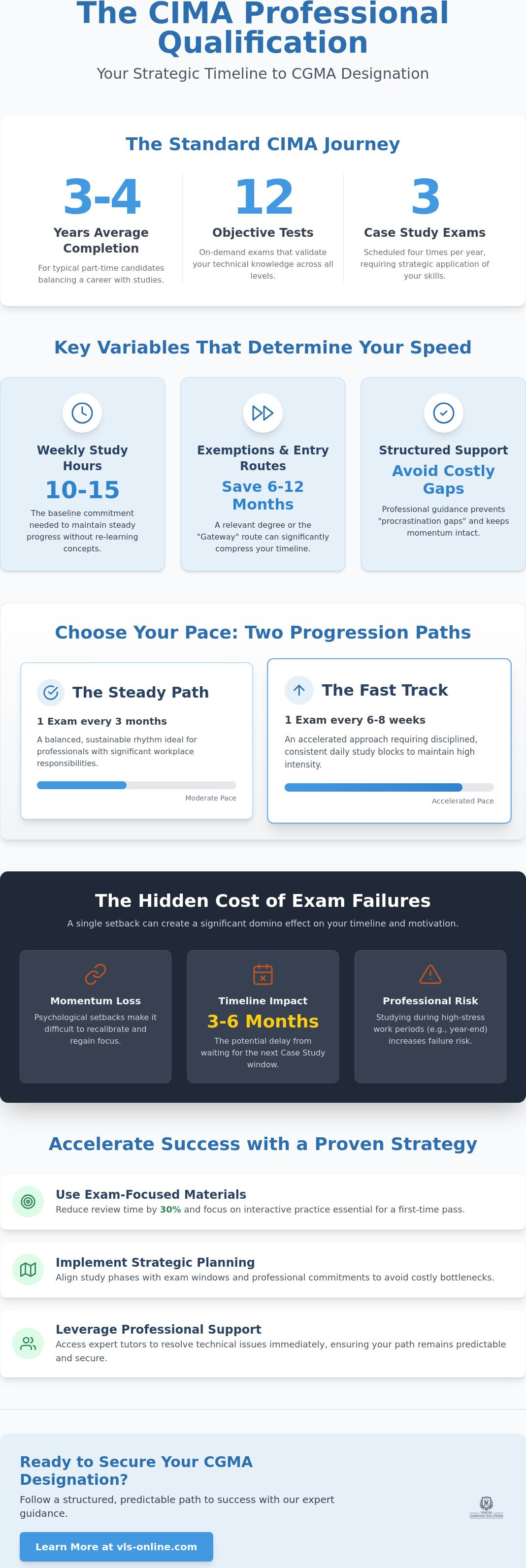
- A standard progression through the twelve Objective Tests and three Case Study exams typically requires a commitment of three to four years for most part-time candidates.
- The primary factor in determining how long does it take to complete CIMA professional qualification is the balance between your weekly study hours and the choice of a structured study environment.
- Strategic level-by-level planning ensures a more predictable transition from Operational foundations to advanced Management and Strategic decision-making.
- Utilizing exam-focused study materials can reduce content review time by 30%, allowing more capacity for the interactive practice essential for first-time pass rates.
Table of Contents
The Standard Timeline: Defining the CIMA Qualification Journey
Key Variables: What Determines Your Individual Completion Speed?
Minimizing Retakes: The Vertex Strategy for Accelerated CGMA Success
The Standard Timeline: Defining the CIMA Qualification Journey
Securing the CGMA designation requires a methodical approach to the curriculum established by the Chartered Institute of Management Accountants (CIMA). For most candidates, the typical duration ranges between three to four years. This timeframe encompasses twelve Objective Tests and three Case Study exams, which validate your technical and strategic proficiency. While the CIMA Certificate in Business Accounting serves as the foundational entry point, the professional levels demand a more rigorous, structured commitment.
It's vital to recognize that your progression won't always be linear. While Objective Tests are available on-demand, Case Study exams are scheduled only four times per year. This creates natural checkpoints in your schedule. When evaluating how long does it take to complete CIMA professional qualification, you must synchronize your study phases with these specific windows to prevent administrative delays. A misaligned schedule can easily add months to your journey.
The Impact of Professional Exemptions
Strategic planning begins with a thorough audit of your existing credentials. Holding a relevant university degree or a recognized accounting qualification can significantly compress your timeline, often shaving six to twelve months off the total journey. Senior professionals might qualify for the specialized "Gateway" route. This pathway allows direct entry into the Strategic Level, bypassing the Operational and Management tiers and providing a streamlined transition for experienced leaders.
Average vs. Accelerated Progression Paths
Candidates typically choose between two distinct velocities based on their professional capacity. The "Steady Path" involves completing one exam every three months, which provides a balanced rhythm for those with significant workplace responsibilities. In contrast, the "Fast Track" aims for an exam every six to eight weeks. An accelerated path is a commitment to consistent, daily study blocks. Maintaining this intensity requires a disciplined framework to ensure that speed doesn't compromise your first-time pass rate.
Key Variables: What Determines Your Individual Completion Speed?
The question of how long does it take to complete CIMA professional qualification is rarely answered by academic ability alone. Instead, your velocity is determined by how effectively you manage external variables like work-life balance and available study hours. For most professionals, dedicating 10 to 15 hours per week is the baseline required to maintain steady progress through the official CIMA Professional Qualification. Without this consistency, the timeline often stretches as complex concepts require repeated review due to lack of reinforcement.
Strategic alignment with your professional calendar is equally critical. Attempting a Case Study exam during a fiscal year-end or a major audit period introduces unnecessary risk. High-stress periods at work often lead to fragmented study sessions, which inevitably diminishes retention. A single exam failure doesn't just impact your budget; it results in a significant "momentum loss." This psychological setback can delay your qualification by three to six months as you wait for the next available Case Study window or struggle to recalibrate your study plan.
Structured Support vs. Independent Study
Choosing between self-study and structured online tuition is perhaps the most influential decision you'll make regarding your total timeline. Independent study frequently leads to "procrastination gaps," where the lack of a fixed schedule allows weeks to slip by without meaningful progress. These gaps can easily extend your total journey by several months. In contrast, having access to professional tutor support allows you to resolve technical bottlenecks immediately, keeping your momentum intact. Implementing proven Accounting Exam Study Tips helps bridge the gap between theory and exam-day performance. By opting for structured professional guidance , you ensure that your path to the CGMA designation remains predictable, stable, and secure.
Level-by-Level Strategic Planning for Faster Completion
Navigating the professional levels requires more than just academic diligence; it demands a tactical understanding of the exam cycle. When calculating how long does it take to complete CIMA professional qualification, you should view each level as a distinct project with its own milestones. The journey begins with the Operational Level. You'll master E1, P1, and F1 before tackling your first Case Study. This stage builds the technical foundation necessary for all subsequent strategic decisions.
The Operational and Management Hurdles
For most candidates, allocating six to nine months per level represents a sustainable target that respects both professional and personal boundaries. The Management Level shifts the focus toward advanced management accounting. Success at this stage depends on your ability to synthesize complex data into actionable business insights. If you're looking to establish a secure foundation, starting with a structured CIMA Professional Qualification - Operational Level course ensures you don't lose time to inefficient study habits.
The Strategic Level and Practical Experience Requirements
The Strategic Level represents the final academic summit. Examiners here expect a transition from technical calculation to high-level advisory thinking. You're no longer just an accountant; you're a strategic partner evaluating risk and organizational performance. You must also account for the three years of verified practical experience (PER) required to secure your letters. Aligning your exam sittings with the February, May, August, or November windows allows you to maintain a predictable rhythm. To ensure your progression remains on track, consider integrating your study plan with a professional education platform that prioritizes logical structure and strategic depth.
Minimizing Retakes: The Vertex Strategy for Accelerated CGMA Success
The single most significant variable in determining how long does it take to complete CIMA professional qualification is your first-time pass rate. Every unsuccessful attempt doesn't just add months to your timeline; it erodes professional confidence and disrupts your career trajectory. To mitigate this risk, we've developed a systematic approach that prioritizes high-impact material over exhaustive, low-value reading. By utilizing exam-focused study notes, candidates can eliminate unnecessary "fluff" and reduce their total reading time by 30%. This efficiency allows for a more concentrated focus on the application of knowledge, which is where the majority of marks are secured.
Speed is the primary barrier in Objective Tests. Developing the required pace demands more than just understanding the theory; it requires consistent exposure to interactive practice questions that mirror the actual exam environment. We supplement this technical practice with weekly live sessions designed to simulate exam conditions and reduce performance anxiety. Additionally, our WhatsApp tutor support provides instant clarity on complex topics. This prevents the "stalled study session" trap, where a single misunderstood concept halts your progress for days while you wait for a response through traditional channels.
Strategic Revision for Case Study Success
Success in the Case Study exams requires a fundamental shift from technical recall to strategic business partnering. Mock exams are the most effective tool for ensuring you complete the qualification on your original schedule. Our methodology focuses on a deep, analytical dissection of the pre-seen material, ensuring you can anticipate examiner requirements with professional precision. To secure your progression and minimize the risk of avoidable delays, explore our full access CIMA preparation packages and start your journey with a structured professional safety net today.
Securing Your Professional Future with Strategic Precision
The path to becoming a CGMA in 2026 is defined by more than just academic persistence; it requires a calculated approach to exam sequencing and resource management. When considering how long does it take to complete CIMA professional qualification, remember that the standard three to four year window is a baseline, not a fixed constraint. By leveraging exemptions and maintaining a disciplined study rhythm, you can navigate the twelve objective tests and three case studies with greater efficiency. Your speed is largely a function of your preparation strategy.
Minimizing retakes is the most effective way to protect your timeline and maintain professional momentum. Accessing structured support ensures that technical bottlenecks don't become months of lost progress. Through exam-focused study notes, weekly live interactive sessions, and direct tutor support via WhatsApp, you gain the professional safety net required for first-time success. These tools replace uncertainty with methodical progress and technical clarity.
Begin your CIMA journey with expert-led online courses at Vertex Learning Solutions and transform your career aspirations into a structured, achievable reality. Your commitment to excellence deserves a professional partner that values precision and operational stability as much as you do.
Frequently Asked Questions
Can I finish the CIMA qualification in 2 years?
Yes, completing the journey in twenty-four months is achievable for candidates who possess relevant exemptions or follow an intensive schedule of one exam every six to eight weeks. This accelerated pace requires a high first-time pass rate and a disciplined commitment to daily study blocks. When evaluating how long does it take to complete CIMA professional qualification, you must consider that your starting point and the consistency of your preparation are the primary drivers of this timeline.
How many exams are there in the CIMA professional qualification?
The professional qualification consists of twelve Objective Tests and three Case Study exams divided across the Operational, Management, and Strategic levels. If you're entering the program without a relevant degree or prior accounting experience, you'll also need to complete the four exams within the CIMA Certificate in Business Accounting. This structured framework ensures that you master the technical, management, and strategic pillars required for the CGMA designation.
What happens if I fail a CIMA Case Study exam?
Failing a Case Study exam requires you to wait for the next available sitting, as these exams are only scheduled four times per year in February, May, August, and November. This result typically adds a minimum of three months to your total completion time. To avoid this delay, it's vital to use mock exams and pre-seen analysis tools that simulate the actual exam environment, ensuring you're prepared for the specific strategic requirements of the sitting.
Is it possible to study for CIMA while working full-time?
Most candidates successfully balance their CIMA studies with full-time professional responsibilities by utilizing on-demand objective tests and flexible online tuition. The qualification is specifically designed for working professionals, allowing you to align your exam sittings with periods of lower activity at your workplace. Success in this environment depends on maintaining a steady rhythm of ten to fifteen study hours per week and using structured resources to resolve technical queries efficiently.
Do I need a degree to start CIMA?
You don't need a university degree to begin your CIMA journey. Ambitious professionals without prior qualifications can start with the Certificate in Business Accounting, which provides the necessary foundation for the professional levels. While a relevant degree can provide exemptions and shorten the answer to how long does it take to complete CIMA professional qualification, the pathway is open to anyone committed to the rigorous standards of management accounting.