CIMA Strategic Level Case Study Tips: The 2026 Masterclass for CGMA Success
Unlock CGMA success with expert CIMA Strategic Level case study tips. Our 2026 masterclass covers pre-seen analysis, time management & AI to help you pass.
In this article
Ready to qualify online?
Get full access to expert-led ACCA & CIMA exam preparation with live tutor support.
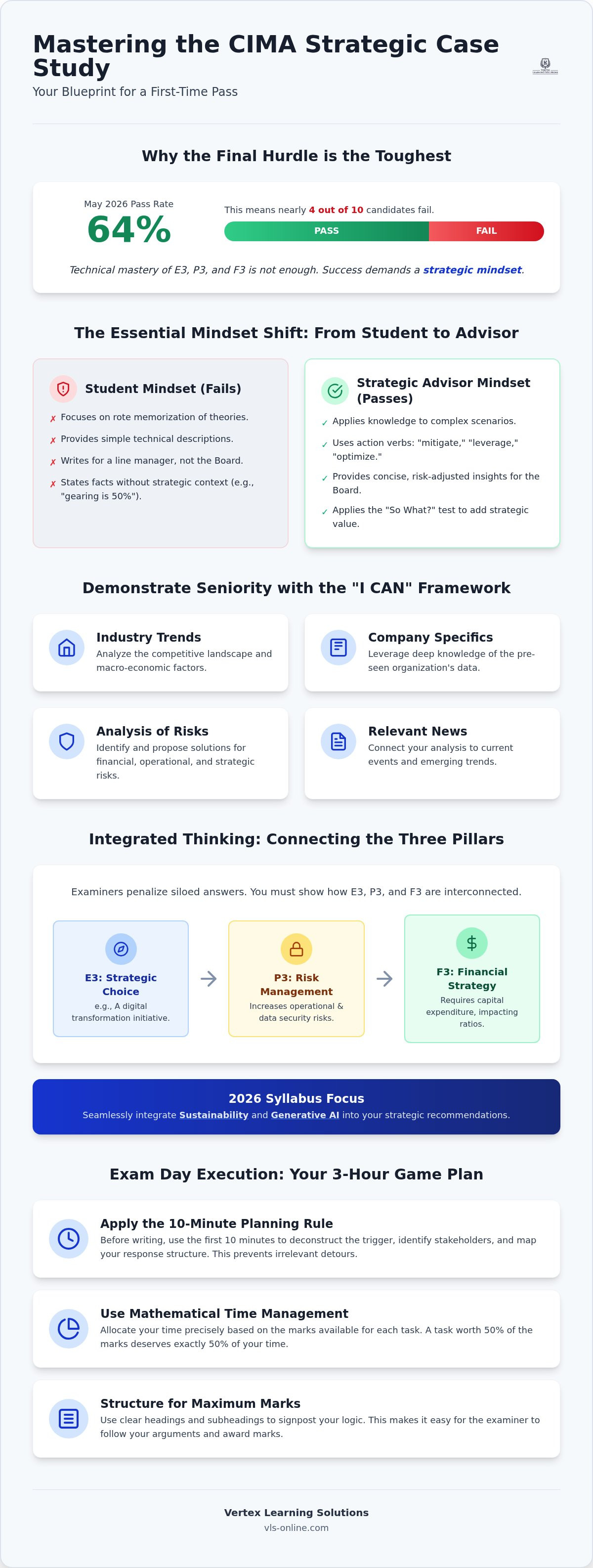
Explore Full AccessWith the May 2026 Strategic Case Study pass rate at 64%, nearly four out of ten candidates fail at the final hurdle. Technical mastery of E3, P3, and F3 isn't enough in a simulated boardroom; success requires specific CIMA Strategic Level case study tips to navigate unpredictable triggers. You likely feel the pressure of the three-hour window and the difficulty of applying pre-seen data to complex scenarios. These hurdles are significant, but they aren't insurmountable with a structured, professional protection net.
This masterclass provides the framework required to transition from a student to a senior advisor. We'll provide a disciplined approach to pre-seen analysis and show you how to address stakeholders with calm confidence. You'll gain a clear roadmap to integrate sustainability and generative AI into your responses, ensuring you approach your 2026 exam with the precision needed to pass on your first attempt.
Key takeaways
- Transition from technical memorization to a boardroom-level mindset by applying the "I CAN" framework to demonstrate senior management capabilities.
- Implement high-impact CIMA Strategic Level case study tips to transform pre-seen data into actionable insights through rigorous SWOT and financial ratio analysis.
- Master exam-day time management by adopting the 10-minute planning rule, ensuring every response is structured with logical precision for maximum marks.
- Learn how to seamlessly integrate E3, P3, and F3 pillars while addressing critical 2026 syllabus requirements like sustainability and generative AI disclosures.
Mastering the Strategic Mindset: Moving Beyond Technical Knowledge
Success at the final level requires a fundamental psychological shift. You're no longer a management accountant; you're a strategic advisor. While the Chartered Institute of Management Accountants (CIMA) provides the technical foundation through E3, P3, and F3, the Case Study demands application over rote memorization. Examiners expect you to use the "I CAN" framework: Industry trends, Company specifics, Analysis of risks, and relevant News. If you only recite theory, you'll fail to demonstrate the seniority required for CGMA status. Technical accuracy is merely the entry fee; strategic insight is the currency of success.
The 2026 syllabus places immense weight on "Value Creation" and sustainability. Every recommendation you make must consider long-term viability and stakeholder impact. You aren't writing for a line manager who wants a simple reconciliation; you're writing for the Board of Directors. They require concise, risk-adjusted insights that align with the organization's overarching strategy. Understanding this distinction is one of the most vital CIMA Strategic Level case study tips for those aiming for a first-time pass. Your answers must be holistic, addressing how a single financial decision ripples through the entire corporate structure.
Adopting the Boardroom Persona
To sound like a senior advisor, replace passive descriptions with professional, action-oriented verbs like "mitigate," "leverage," or "optimize." Use the "So What?" test for every point you raise. If you identify a high gearing ratio, don't just state the figure. Explain why it restricts future investment or increases default risk. Your role is to simplify complexity and provide a clear path forward for the board. This structured approach ensures your arguments remain logically closed, professionally persuasive, and focused on strategic outcomes rather than technical definitions.
Strategic Pre-seen Analysis: Turning Data into Actionable Insights
Analyzing the pre-seen for the Strategic level of CIMA's CGMA Professional Qualification requires a methodical, two-stage approach. First, perform a SWOT and PESTEL analysis that mirrors the 2026 business environment, specifically focusing on sustainability disclosures and generative AI integration. Second, translate the financial statements into strategic health indicators. If the company's current ratio is declining while its debt-to-equity ratio climbs, don't just report the numbers; connect these trends to the company's ability to fund the strategic initiatives outlined in the text.
Anticipating "unseen" triggers is where you secure a pass. Map every weakness in the pre-seen to a potential exam threat. If the board lacks digital expertise, expect an unseen trigger regarding a cybersecurity breach or a failed AI implementation. Condense these insights into a one-page "Strategic Cheat Sheet" for rapid recall. This disciplined preparation is among the most effective CIMA Strategic Level case study tips for maintaining composure under pressure.
Integrating E3, P3, and F3 Pillars
Examiners penalize candidates who treat the three pillars as silos. You must map P3 risk management directly to F3 financial strategy and E3 strategic choice. A digital transformation initiative (E3) inherently increases operational and data security risks (P3), which may require significant capital expenditure and impact interest cover (F3). This holistic view is vital for senior advisors. For those looking to expand their expertise beyond CIMA, exploring ACCA Strategic Business Reporting can provide a complementary perspective on complex financial reporting. Our personalized tutor support helps you synthesize these complex relationships with precision.
Exam Day Execution: Scoring High on Integration and Logic
Precision during the three-hour exam window separates successful candidates from those who must resit. One of the most critical CIMA Strategic Level case study tips is the 10-minute planning rule. Don't start typing immediately. Use the first ten minutes to deconstruct the trigger, identify the stakeholders, and map your response to the specific requirements. This disciplined approach prevents the common pitfall of drifting into irrelevant technical descriptions that fail to answer the board's core concerns. It ensures your logic remains closed and your arguments stay relevant to the 2026 business context.
Structure your response to aid the marker's evaluation. Use clear headings and sub-headings to signpost your logic. Time management must be mathematical; if a task is worth 50% of the marks, it deserves exactly half of your available time. These practical CIMA Strategic Level case study tips ensure you maximize your scoring potential across all competencies. When a trigger introduces an unseen threat, pivot your pre-seen knowledge to address the new reality. You can find detailed examples of successful answer structures within the Official CIMA Strategic Case Study Resources provided by the institute.
Vertex’s Proven Case Study Methodology
Our approach provides a professional safety net for your final exam. Through weekly live sessions, you'll practice under timed pressure and receive instant, expert feedback on your writing style. This helps you refine your strategic voice, ensuring you sound like a senior advisor rather than a student. Our WhatsApp tutor support offers real-time query resolution, helping you navigate complex syllabus changes like generative AI and sustainability reporting. For a broader perspective on your journey, explore our CIMA Professional Qualification guide to master every level with confidence.
Securing Your Professional Future as a CGMA
The transition from a technical student to a strategic board advisor requires more than memorization. It demands a holistic integration of the E3, P3, and F3 pillars combined with a disciplined 10-minute planning phase on exam day. By weaponizing the pre-seen data and addressing the specific 2026 syllabus triggers, you transform from a candidate into a senior advisor. These CIMA Strategic Level case study tips provide the framework for success, but consistent practice remains the final variable.
Vertex Learning Solutions serves as your strategic partner, offering expert-led recorded lectures, interactive practice questions, and direct WhatsApp tutor support to ensure you don't face this challenge alone. Enroll in the Vertex CIMA Strategic Case Study Course for 2026 Success and take the final step toward your professional qualification with absolute confidence. Your journey to the boardroom starts today.