CIMA Operational Level Case Study Tips: Your 2026 Guide to OCS Success
Get expert CIMA Operational Level case study tips for 2026. Learn to structure answers, manage time, and apply E1, P1 & F1 to pass your OCS first time.
In this article
Ready to qualify online?
Get full access to expert-led ACCA & CIMA exam preparation with live tutor support.
Explore Full AccessWhy do candidates who excel in objective tests often struggle when they reach the Operational Case Study? It's a common frustration to feel overwhelmed by the shift from multiple-choice questions to a three-hour written simulation, especially when you're tasked with integrating E1, P1, and F1 into a single response. Finding the right CIMA Operational Level case study tips is the first step in moving beyond theory and into professional application.
This guide provides the expert strategies you need to master this transition, ensuring you can apply technical theory to the 2026 pre-seen material with professional precision. We'll explore how to structure your answers for maximum marks, manage your time effectively within 60-minute blocks, and approach the exam with the mindset of a Finance Officer. By the end of this guide, you'll have a clear plan to pass your OCS on the first attempt.
Key takeaways
- Shift your perspective from academic recall to professional simulation by mastering the specific responsibilities of the Finance Officer role.
- Learn to interrogate the pre-seen material with a strategic lens to identify the financial health and stakeholder risks inherent in the business scenario.
- Apply expert CIMA Operational Level case study tips to maintain focus and precision during the rigorous 60-minute exam blocks.
- Develop a structured approach to professional communication by utilizing the exam software's planning tools for logically closed, high-scoring answers.
Mastering the Role: Transitioning to the CIMA Operational Case Study (OCS) Mechanics
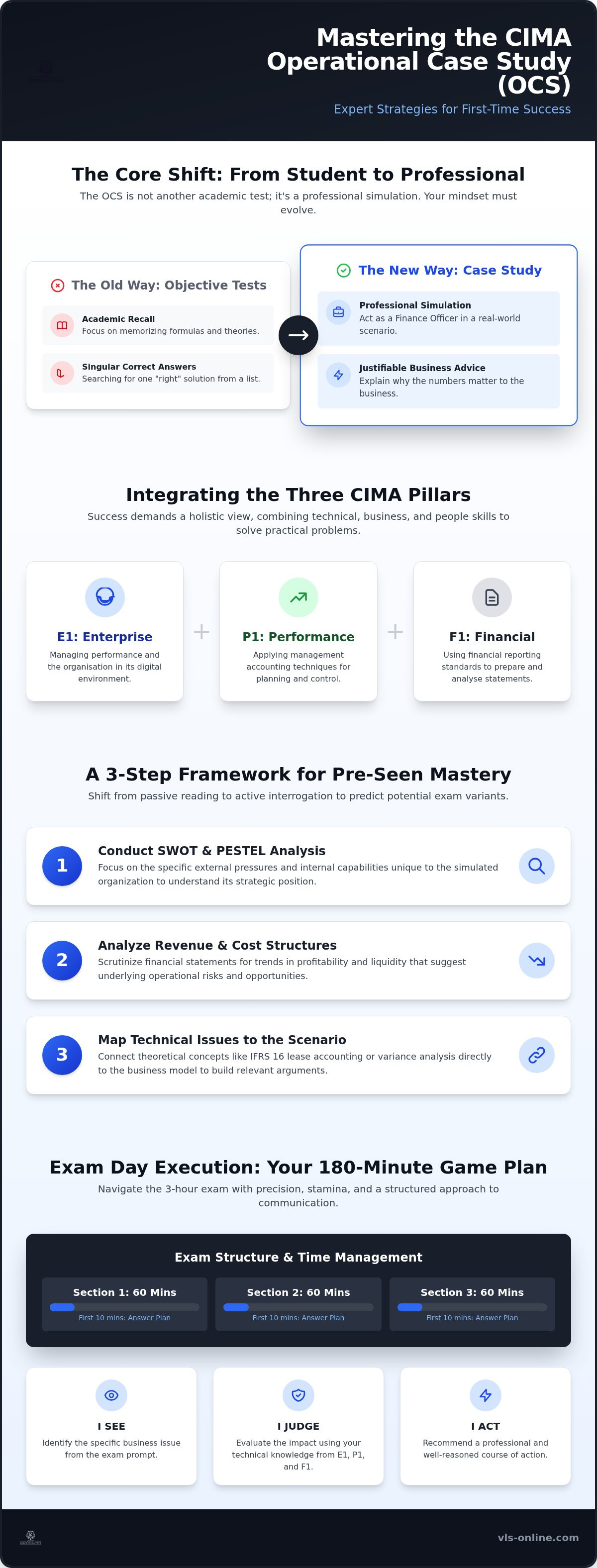
The Chartered Institute of Management Accountants (CIMA) designs the OCS not as an academic test, but as a professional simulation. Unlike Objective Tests (OTs) where you select a single correct answer, the Case Study demands professional judgment. You're no longer just a student; you're stepping into the role of a Finance Officer within a simulated business environment. This shift is critical. One of the most effective CIMA Operational Level case study tips is to stop looking for "right" or "wrong" answers and start looking for "appropriate" or "justifiable" ones.
In the 2026 syllabus, your responsibilities focus on the operational core of the organization. While you've spent months mastering complex formulas, the OCS requires minimal manual calculation. The examiner assumes you know the math. Your task is to explain why those figures matter to the business. If a variance is adverse, don't just state the number; explain the operational cause and the potential impact on the company's stability. This transition from "Finance Function Candidate" to "Finance Officer" requires a high level of professional maturity.
The Three Pillars: Integrating E1, P1, and F1 in a Single Scenario
Success requires a holistic view of the CIMA Professional Qualification. In any given task, you must combine P1 management accounting techniques with F1 financial reporting standards, all while considering the E1 digital environment. The OCS is a multi-disciplinary assessment of technical, business, and people skills. You'll need to demonstrate how these subjects overlap to solve practical problems. Practical CIMA Operational Level case study tips often emphasize this integration; a Finance Officer who only understands one department is a risk to the business. Logical clarity and technical accuracy must work in tandem to secure a passing grade.
Strategic Preparation: Active Analysis of the Pre-seen Material
Many candidates treat the pre-seen material like a textbook. They read it repeatedly without extracting actionable intelligence. To succeed, you must shift your mindset from passive consumption to active interrogation. This involves identifying key stakeholders, analyzing industry trends, and scrutinizing the financial health of the simulated company. By building a Technical Mapping Document, you can link theoretical concepts from the three pillars directly to the business scenario. This proactive approach allows you to predict potential exam variants before you even enter the room.
Effective preparation requires more than just high-level summaries. You need a structured methodology to dissect the 2026 pre-seen document. Integrating these CIMA Operational Level case study tips into your daily routine ensures you aren't caught off guard by unexpected requirements. If you're looking for broader guidance, our Accounting Exam Study Tips offer a strategic foundation for professional certifications.
A 5-Step Framework for Pre-seen Mastery
A systematic analysis prevents information overload. Follow these initial steps to anchor your knowledge:
Step 1: Conduct a comprehensive SWOT and PESTEL analysis. Focus on the specific external pressures and internal capabilities unique to the simulated organization.
Step 2: Identify the company's revenue drivers and cost structures based on the provided financial statements. Look for trends in profitability and liquidity that suggest operational risks.
Step 3: Map at least five technical issues to the scenario. Consider how IFRS 16 lease accounting, variance analysis, or digital ecosystems might impact this specific business model.
Developing this level of detail requires discipline and a mentor's perspective. Our CIMA Professional Qualification courses provide the expert guidance needed to bridge the gap between theory and application.
Exam Day Execution: Professional Communication and Time Management
The 180-minute OCS window is a test of stamina and precision. You'll typically navigate three distinct 60-minute blocks, each requiring a fresh mental reset. One of the most vital CIMA Operational Level case study tips is to dedicate the first 10 minutes of each section to a robust Answer Plan. This prevents you from missing hidden requirements in complex prompts. To build well-rounded arguments, utilize the "I see, I judge, I act" framework. Identify the specific business issue (I see), evaluate its impact using your technical knowledge (I judge), and recommend a professional course of action (I act). Applying these CIMA Operational Level case study tips during the exam will help you stay composed under pressure.
Professional marks are awarded for your ability to communicate as a Finance Officer. This means maintaining a tone that's calm, logical, and objective. Clarity is essential; markers value answers that are easy to navigate and free from unnecessary jargon. If you find the transition from multiple-choice to essay writing difficult, our tutor support via WhatsApp offers the direct guidance needed to polish your professional tone and ensure your logic is closed and defensible.
Structuring Your Response Like a Finance Professional
Always adopt the specific format requested in the task, whether it's a memo, email, or report. If the prompt asks for an email, include formal headers: "To:", "From:", and "Subject:". Use short, impactful paragraphs and clear sub-headings to make your response scannable for the examiner. Crucially, link every technical point back to the specific company name and context from the pre-seen material. This demonstrates that you're providing a tailored, strategic solution rather than a generic theoretical answer. High-scoring candidates don't just state facts; they provide context that matters to the stakeholders involved.
Securing Your Path to OCS Success in 2026
Mastering the Operational Case Study requires a fundamental shift from theoretical recall to professional application. By adopting the persona of a Finance Officer and conducting an active, strategic analysis of the pre-seen material, you transform the exam from a hurdle into a showcase of your expertise. Implementing these CIMA Operational Level case study tips ensures your responses are structured, logical, and tailored to the organizational risks identified in the business scenario. Precision in time management and professional communication will be your greatest assets on exam day.
You don't have to navigate this complex transition alone. Master your CIMA OCS with expert tutor support and exam-focused notes at Vertex Learning Solutions. Our platform provides personalized WhatsApp tutor support, recorded lectures for flexible learning, and live weekly sessions designed for interactive practice. With the right strategic partner, you can approach the 2026 exam windows with absolute confidence. Your professional advancement is within reach.