Vertex Learning Solutions


Investing over $260,000 in an elite MBA might seem like the ultimate career insurance, but for the strategic finance leader, the most expensive path isn't always the most secure. You're likely balancing the prestige of a global business school against the technical rigor of a specialized professional qualification. It's a high-stakes choice where the risk of a generic degree losing its value is just as concerning as the uncertainty surrounding the time commitment for professional certifications. This definitive 2026 comparison of CIMA vs MBA provides the structural clarity you need to determine which path maximizes your global ROI and career mobility.
We'll analyze the critical differences in cost, where CIMA's structured fees represent a fraction of the MBA's six-figure tuition, and explore the 2026 syllabus updates that now prioritize Generative AI and IFRS sustainability standards. You'll find a precise decision framework based on regional recognition, pass rate comparisons, and the flexibility of modern exam structures. This analysis ensures your next professional step is grounded in logic and strategic foresight, protecting your career trajectory in a complex global market.
Key Takeaways
- Identify the fundamental distinction between a specialized strategic finance qualification and a broad general management degree to align your credentials with your professional identity.
- Analyze the 2026 structural requirements, comparing the rigorous 16-exam CIMA progression and digital proctoring nuances with the intensive curriculum of a traditional MBA.
- Evaluate the 2026 global ROI of CIMA vs MBA by examining regional dominance in the UK and Asia versus the varying institutional prestige of business schools.
- Utilize a structured decision matrix to determine if your career trajectory requires technical mastery in management accounting or the networking focus of an academic master's.
- Gain clarity on how the 2026 syllabus updates, specifically regarding Generative AI and sustainability, provide a protective professional shield in a volatile economic environment.
Table of Contents
- CIMA vs. MBA: Defining Professional Identity in 2026
- Structural Comparison: Syllabus, Cost, and Time to Completion
- Global Recognition and Career ROI in the 2026 Market
- The Decision Matrix: Which Path Should You Choose in 2026?
CIMA vs. MBA: Defining Professional Identity in 2026
Choosing between CIMA vs MBA isn't just about selecting a curriculum; it's about defining your professional persona for the next decade. In the 2026 market, the distinction between these paths has sharpened. CIMA represents a rigorous professional qualification focused on management accounting and high-level business strategy. Conversely, an MBA remains an academic master’s degree designed to provide a panoramic view of general management, from organizational behavior to marketing. The choice you make now determines whether you're seen as a "Strategic Specialist" or a "Generalist Leader."
The 2026 recruitment landscape shows a definitive shift. Employers no longer value broad, non-specific degrees as they once did. They're seeking specialized technical depth. They want professionals who can navigate complex regulatory environments and leverage advanced data analytics. The CIMA professional provides this precision, acting as a strategic partner who understands the financial implications of every operational move.
The CIMA Philosophy: Beyond the Balance Sheet
The Chartered Institute of Management Accountants (CIMA) grants the prestigious CGMA (Chartered Global Management Accountant) designation. This title signals a unique mastery of finance integrated with business operations and digital strategy. By 2026, the CIMA framework has evolved to prioritize finance business partnering. It's not just about reporting numbers; it's about influencing the direction of the enterprise through data-driven insights and risk management.
The MBA Spectrum: Elite vs. Generic Programs
It's vital to recognize that the MBA market is highly bifurcated in 2026. There's a massive gap between elite M7 programs and generic offerings. While a top-tier MBA provides unparalleled prestige and networking, the ROI of mid-tier, non-specialized programs is diminishing rapidly. Consider these factors:
Institutional Prestige: Top-tier programs can cost over $260,000 for two years, but they offer access to exclusive global C-suite networks.
Generic Saturation: Local, generic MBAs often lack the technical rigor found in the CIMA Professional Qualification levels, making them less attractive to finance-heavy recruiters.
Skill Application: MBA programs focus on "how to manage," while CIMA focuses on "how to drive value" through financial strategy.
If your goal is a career pivot into a different industry, the MBA's broad canvas might serve you. However, for those committed to the summit of strategic finance, the technical and strategic depth of CIMA offers a more resilient professional shield.
Structural Comparison: Syllabus, Cost, and Time to Completion
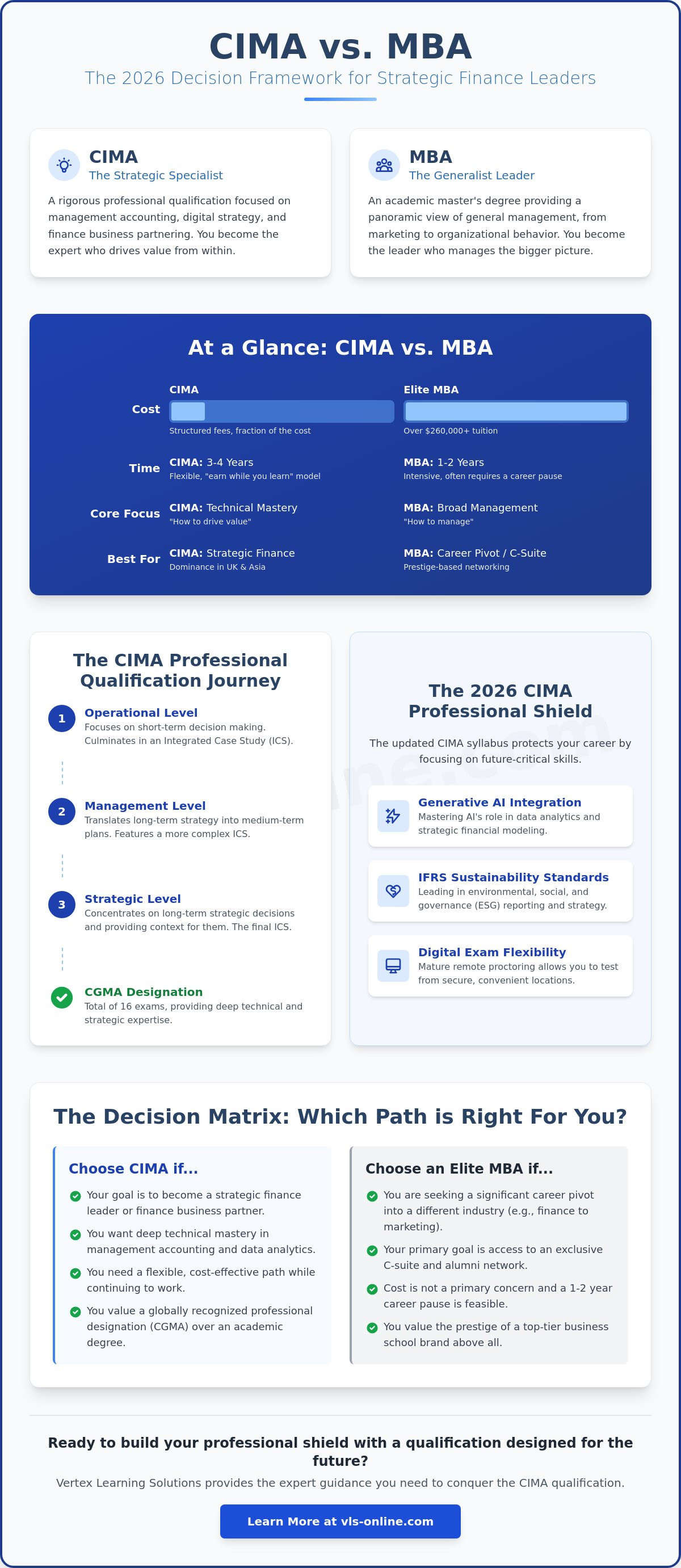
The structural commitment required for CIMA vs MBA represents two fundamentally different investment philosophies. A standard MBA typically demands a one to two year intensive academic focus. In contrast, the CIMA journey involves a 16-exam structure that usually spans three to four years. While the MBA offers a faster completion timeline, it often requires a total career pause. CIMA's "earn while you learn" model allows you to maintain your professional trajectory while applying new concepts in real time.
In 2026, the CIMA digital exam environment has reached full maturity. Remote proctoring allows candidates to sit for objective tests and case studies from secure environments, provided they adhere to strict technical and room compliance standards. This flexibility is a significant advantage over many traditional MBA programs that still prioritize on-campus attendance. Cost also remains a primary differentiator. While the total cost of attendance for elite M7 MBA programs can exceed $260,000, CIMA professional fees are structured around registration, annual subscriptions, and individual exam costs, making it a far more accessible route for cost-conscious leaders.
CIMA Exam Levels and Case Studies
The CIMA Professional Qualification is divided into three distinct levels: Operational, Management, and Strategic. Each level culminates in an Integrated Case Study (ICS). These exams act as a bridge to real-world business leadership by simulating boardroom decisions. You aren't just tested on theory; you're required to provide strategic recommendations based on a complex business scenario. For those seeking to master these technical pillars efficiently, exploring comprehensive online study resources can significantly reduce the time to completion.
The MBA Academic Approach
What is an MBA? At its core, it's an academic journey focusing on broad business modules like HR, Marketing, and Operations. Unlike CIMA’s competency-based exams, MBA assessments often rely on group projects and diverse business modules. The focus is heavily weighted toward networking and institutional prestige. While CIMA ensures technical mastery in management accounting, the MBA provides a wider, albeit less specialized, view of the corporate ecosystem. This academic breadth is valuable for career pivots, but it lacks the forensic financial depth that defines a CIMA professional.
Global Recognition and Career ROI in the 2026 Market
In the 2026 global market, the CIMA vs MBA decision dictates your geographic and industrial mobility. CIMA maintains a commanding presence across the UK, Commonwealth nations, and major Asian financial hubs. While the MBA carries universal name recognition, its prestige is often tied to the specific institution's ranking, which can vary significantly by region. The CGMA designation, born from the partnership between CIMA and the AICPA, has effectively bridged the recognition gap in North America, offering a level of technical authority that rivaled traditional academic paths.
Industry preferences have become more pronounced. FMCG, Tech, and Consulting firms increasingly seek strategic management accountants who can bridge the gap between complex data and actionable business strategy. This technical depth often results in a faster path to leadership roles compared to the broad, sometimes generic, trajectory of a non-elite MBA. Both qualifications offer significant salary uplifts, but CIMA's lower entry cost and the ability to remain in full-time employment provide a superior net ROI for many finance professionals.
The CFO and CEO Track
The journey to the C-suite in 2026 requires more than general management skills; it demands a mastery of risk management and financial strategy. CIMA's curriculum is explicitly designed to prepare you for the CFO role by integrating financial precision with strategic foresight. For those exploring how this fits into the wider professional landscape, understanding the role of Specialist Accounting Qualifications is essential for long-term career planning. If you're aiming for a specialized leadership role, enrolling in a structured CIMA program ensures you possess the technical shield required for the C-suite.
Networking vs. Technical Mastery
An elite MBA offers a powerful directory of high-level contacts and peers, while CIMA membership provides the technical authority and ethical framework to lead any boardroom discussion. Both paths require a commitment to continuous professional development (CPD) to maintain their value. In a volatile economic environment, the technical mastery of a CIMA member often provides a more stable professional protective net than the networking-heavy focus of an academic degree.
The Decision Matrix: Which Path Should You Choose in 2026?
Deciding between CIMA vs MBA requires a cold, analytical assessment of your current professional standing and your ten year trajectory. Your choice should reflect the specific type of authority you wish to command in the boardroom. If your goal is to be the architect of financial strategy, CIMA provides the technical scaffolding. If you seek a broader, more social route into general leadership, an MBA might be your preferred vehicle. Use the following criteria to evaluate your next move.
Checklist for CIMA: You possess a high technical interest in strategic finance, you're cost-conscious about your educational investment, and you seek a long-term focus on management accounting.
Checklist for MBA: You require an immediate career pivot into a different industry, you prioritize high-level networking, and you have the capital to invest in top-tier institutional prestige.
Many professionals choose a hybrid approach to maximize their mobility. It's a common strategy for MBA holders to utilize the CIMA Master's Gateway route, which provides significant exemptions. This allows them to supplement their broad academic knowledge with the specialized technical depth that modern employers demand. Vertex Learning Solutions supports this progression through expert-led modules designed to bridge any existing knowledge gaps.
Succeeding in Professional Exams
Passing rigorous professional exams in 2026 requires a structured support system that goes beyond static textbooks. Active tutor support via WhatsApp has become a critical differentiator, providing real-time problem solving when you encounter complex case study scenarios. Weekly live sessions further reinforce this by bridging the gap between theoretical frameworks and exam day success. For those beginning their preparation, reviewing these Accounting Exam Study Tips will provide the strategic edge needed to pass on your first attempt.
Final Verdict: Your Professional Shield
The CIMA vs MBA debate ultimately centers on whether you value technical depth or general breadth. In an increasingly volatile global economy, specialized depth often acts as a more resilient professional shield. If you feel you need a stronger foundation in core accounting principles before advancing, consider starting with ACCA Applied Skills. However, for those ready to master the art of strategic finance, you can explore VLS CIMA Courses to begin your journey toward the CGMA designation today.
Securing Your Strategic Future in 2026
The choice between technical mastery and general leadership defines your professional ceiling. We've analyzed how the 2026 market increasingly rewards those who can act as strategic partners rather than generalist managers. While an MBA offers broad networking, CIMA provides the forensic financial depth required for the modern C-suite. Deciding on CIMA vs MBA is a commitment to a specific professional identity, ensuring your credentials align with the specialized demands of global finance.
You don't have to navigate this complex path alone. You can master your CIMA or ACCA journey with Vertex Learning Solutions through a system built for your success. Our framework includes active tutor support via WhatsApp for instant query resolution and weekly live interactive sessions that simulate a true classroom environment. You'll also receive exam-focused study notes and comprehensive recorded lectures to ensure your preparation is mathematically precise. Take the first step toward your global designation today. Your career stability depends on the strategic choices you make right now.
Frequently Asked Questions
Is CIMA equivalent to an MBA in 2026?
CIMA is a professional qualification focusing on technical and strategic mastery, whereas an MBA is an academic master's degree providing a broad management overview. While they are structurally different, recruiters in the finance sector often view them as equivalent in terms of professional seniority. The choice depends on whether you seek the specialized depth of a chartered professional or the generalist approach of an academic program.
Which has a higher starting salary: CIMA or MBA?
Graduates from elite, top-tier MBA programs often command higher initial starting salaries due to the prestige of their institution. However, the CIMA vs MBA comparison highlights that CIMA members often reach specialized leadership roles with significant earning potential much faster. This path avoids the high tuition debt associated with business schools, often leading to a superior net ROI over a five year period.
Can I get CIMA exemptions if I already have an MBA?
Yes, MBA holders from accredited institutions are typically eligible for the CIMA Master's Gateway route. This accelerated path allows you to bypass the Certificate, Operational, and Management levels by passing a single gateway exam. It's a highly efficient method for academic graduates to secure the technical authority required for high-level strategic finance roles without repeating foundational material.
How much does it cost to complete CIMA compared to an MBA?
CIMA is a significantly more cost-effective investment than a traditional MBA. Elite M7 MBA programs can exceed $260,000 in total costs, including tuition and living expenses. In contrast, CIMA costs are focused on registration, annual subscriptions, and individual exam fees. This allows you to maintain your full-time salary while studying, effectively eliminating the massive opportunity cost of a two year career break.
Is CIMA recognized in the USA for 2026 career paths?
Recognition in the United States has reached a historic high due to the partnership between CIMA and the AICPA. This collaboration created the CGMA designation, which is now a standard for management accounting excellence across North America. It provides a protective professional shield for finance leaders seeking mobility between European, Asian, and American markets in 2026.