Vertex Learning Solutions


Achieving Affiliate status is a monumental milestone, yet many professionals find that the final transition to full membership is where the most significant pressure resides. You’ve mastered the technical syllabus, but now you face the administrative rigor of the Practical Experience Requirement (PER). It's common to feel a sense of anxiety regarding the shelf-life of your Affiliate status or to feel stuck when supervisors hesitate to sign off on your hard-earned progress. This ACCA practical experience requirement guide is designed to remove that uncertainty, providing a structured path to navigate the 2026 landscape with absolute clarity.
We understand that the distinction between time-based requirements and performance objectives can be confusing, particularly with recent updates to supervisor verification and sustainability mandates. This guide offers a definitive roadmap to mastering the application portal and securing your professional recognition. We'll examine the mandatory supervisor IFAC membership proof, the updated "Strategy, innovation and sustainable value creation" objective, and the strategic steps required to transition to full Chartered status. By the end of this article, you'll have the tools to complete your journey and unlock the salary advancement you've worked so hard to achieve.
Key Takeaways
- Identify the strategic transition from Affiliate status to full membership by leveraging the three-year rule for documenting professional experience.
- Master the complex calculation of your 36-month requirement and the specific documentation of the 5 Essential and 4 Technical Performance Objectives.
- Follow this ACCA practical experience requirement guide to navigate the 2026 supervisor verification mandates and the updated sustainability-focused criteria.
- Conduct a comprehensive audit of your MyACCA dashboard to ensure all modules are complete before initiating the final membership application.
- Establish a long-term plan for Continuing Professional Development (CPD) compliance to maintain your status and progress toward becoming a Fellow (FCCA).
Navigating the Transition: From ACCA Affiliate to Chartered Member
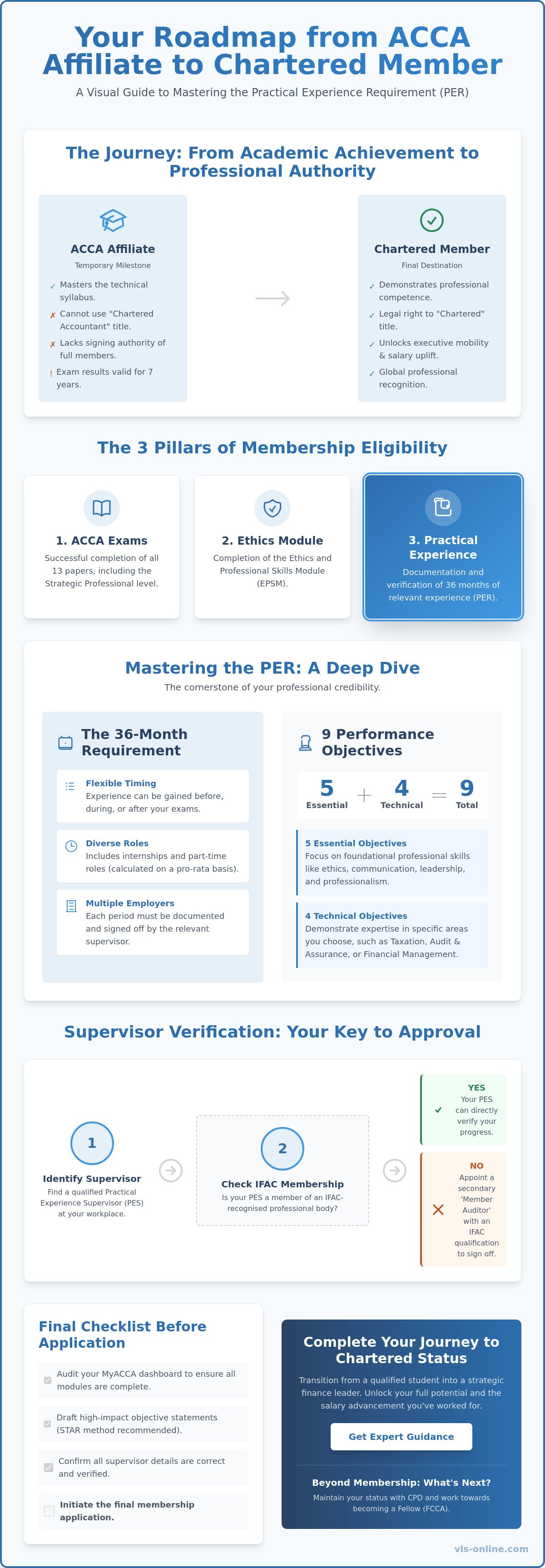
Passing your final exams elevates you to the status of an ACCA Affiliate. This title represents a significant academic achievement, yet it remains a temporary milestone rather than a final destination. The Association of Chartered Certified Accountants (ACCA) maintains a clear distinction between those who have mastered the syllabus and those who have demonstrated professional competence in a live environment. As an Affiliate, you don't yet possess the legal right to describe yourself as a "Chartered Certified Accountant" or exercise the signing authority reserved for full members. It's a phase defined by potential, but it's also one with a shelf-life; your Strategic Professional exam results are subject to a seven-year limit, making a swift transition to membership a matter of professional security.
The Three Pillars of Membership Eligibility
Securing your place in the global membership registry requires a structured approach to three specific criteria. This ACCA practical experience requirement guide serves as your framework for ensuring no administrative detail is overlooked during this final stage. To qualify for admission, you must satisfy the following requirements:
- Successful completion of all 13 ACCA exams, including the Strategic Professional papers, or the attainment of relevant exemptions.
- Completion of the Ethics and Professional Skills Module (EPSM), which provides the behavioral foundation for your future career.
- The documentation and verification of 36 months of relevant practical experience through the PER portal.
Why Timing Matters for Your Career
The leap to full membership often triggers an immediate shift in professional standing and global salary benchmarks. Employers in 2026 view the "Chartered" status as a definitive audit of your ethical and practical reliability. Avoiding "Affiliate inertia" is critical. Many professionals lose momentum after the intensity of the ACCA Strategic Professional level, yet delaying your PER documentation only complicates the verification process later. By finalizing your membership now, you transition from a qualified student into a strategic finance leader, gaining the executive mobility required to operate at the highest levels of corporate governance.
Mastering the PER: Documenting Your 36 Months of Experience
The 36-month practical experience requirement is the cornerstone of your professional credibility. It isn't merely a chronological countdown; it's a strategic record of your evolution from a trainee to a competent professional. When calculating this duration, you can include experience gained before, during, or after your exams. This includes internships and part-time roles, provided they're calculated on a pro-rata basis against a standard 35-hour work week. If you've held multiple positions across different organisations, you must ensure each period is documented and signed off by the relevant supervisor at that time. This ACCA practical experience requirement guide emphasizes that accuracy in these calculations is vital to avoid delays during the final audit of your application.
To satisfy the PER, you must achieve nine performance objectives, consisting of five "Essentials" and four "Technical" objectives. The Essentials focus on foundational professional skills such as ethics, communication, and leadership. The Technical objectives allow you to demonstrate expertise in specific areas like Taxation, Audit, or Financial Management. For a complete technical breakdown of these standards, consult the official ACCA's Practical Experience Requirement portal. Identifying a qualified Practical Experience Supervisor (PES) within your organisation is your first priority. This individual must be a member of an IFAC-recognised professional body to verify your progress. If your direct supervisor is not a member of an IFAC body, a secondary "Member Auditor" who holds such a qualification must be appointed to verify the supervisor's professional standing and the validity of your experience.
Drafting High-Impact Objective Statements
Success in the PER portal depends on the quality of your narrative evidence. We recommend using the STAR method (Situation, Task, Action, Result) to structure your statements. Avoid vague descriptions like "I helped with the month-end close." Instead, specify your individual contribution: "I implemented a new reconciliation workflow that reduced discrepancy resolution time by 15%." Mapping your daily tasks to technical objectives requires a proactive mindset. Refining your technical skills through structured ACCA courses can provide the necessary evidence for these performance objectives by aligning your theoretical knowledge with practical application.
Navigating Supervisor Challenges
Securing sign-offs can become complex if your direct manager lacks the required professional credentials. In such instances, you must proactively seek a higher-level manager or an external consultant who meets the IFAC membership criteria to act as your PES. If you've changed roles during your 36 months, don't wait until the end of your journey to seek verification. Request sign-offs as you leave each role to ensure your records remain current and your previous supervisors are still available to validate your achievements.
The 2026 ACCA Membership Application: A Step-by-Step Portal Guide
Transitioning to full membership requires a methodical audit of your MyACCA portal. Before initiating the process, ensure your dashboard displays the requisite "green ticks" across all exam modules and professional ethics requirements. This ACCA practical experience requirement guide emphasizes that missing a single sign-off can halt the entire application. Once your dashboard confirms eligibility, the "Apply for Membership" link will become active under the "My Qualification" section. Navigating this portal with precision ensures that your record is transmitted to the admissions committee without administrative friction.
The 2026 fee structure involves several specific commitments. Upon approval, you'll be required to pay a one-time admission fee of £326. Distinguishing this from annual subscription fees is essential for accurate financial planning. For 2026, the annual member subscription is £326, which represents a step up from the £163 affiliate rate. Budgeting for these professional investments is a key part of your strategic career progression. Most successful applicants report a processing window of 10 to 12 working days. This benchmark is critical if you're timing your membership to coincide with a performance review or a specific executive job application.
The EPSM Final Verification
It's vital to ensure your Ethics and Professional Skills Module (EPSM) completion is fully synchronised with your membership record. This module isn't just a hurdle; it informs the professional declaration you must sign during the final submission. If you're still in the earlier stages of your journey, you can bridge your knowledge with ACCA Applied Skills prep to ensure a seamless progression toward these final ethics requirements.
Final Submission and Declaration
The final stage involves a rigorous cross-reference of your employment history. You must double-check that the dates on your uploaded CV align perfectly with your PER records. Discrepancies here can trigger manual reviews and extend your waiting period. The process concludes with a formal declaration of professional standing and ethical conduct. This statement is your commitment to the integrity of the profession. To ensure you're fully prepared for these technical requirements, consider accessing comprehensive ACCA resources to verify your standing before the final click.
Beyond Membership: CPD Compliance and Strategic Specialisation
Admission to membership is a transformative milestone, but it initiates a lifelong commitment to professional excellence. To maintain your standing, you must adhere to the Continuing Professional Development (CPD) policy. This requires 40 units of relevant learning annually, ensuring your skills remain sharp in an evolving regulatory environment. While this ACCA practical experience requirement guide has focused on the path to entry, your long-term success depends on documenting these CPD activities with the same precision you applied to your PER. It's a structured safeguard that protects your professional reputation and the integrity of the designation.
After five years of continuous membership and compliance, you'll achieve the prestigious Fellow status (FCCA). This designation signals to the global market that you possess not just technical knowledge, but a sustained track record of professional integrity and senior-level experience. It's the ultimate badge of seniority within the global finance community. Leveraging these letters effectively involves updating your global professional profiles and engaging with the ACCA’s vast networking resources to command the higher consulting fees associated with elite expertise.
Maintaining Global Mobility
ACCA membership serves as a passport for international mobility. Through Mutual Recognition Agreements with various global bodies, your credentials allow you to practice in numerous jurisdictions without repeating foundational exams. Your annual CPD declaration is the mechanism that keeps this license active and recognized worldwide. To prepare for leadership in multinational corporations, you should explore specialist accounting qualifications that complement your Chartered status and target senior roles.
Advanced Specialisation for Senior Roles
Many new members choose to deepen their expertise immediately after qualification to master niche areas of the market. Mastering complex global reporting standards is a common priority in the 2026 economic landscape. This is why many professionals pursue a Diploma in IFRS to master global reporting and refine their technical edge for group-level management. Transitioning from technical accounting to strategic advisory and CFO-track roles requires a proactive approach to learning. If you're ready to lead, explore our full access professional courses to build the strategic toolkit required for the next phase of your career.
Executing Your Final Step to Professional Membership
Transitioning from an Affiliate to a Chartered Certified Accountant is a strategic process that requires meticulous attention to detail. This ACCA practical experience requirement guide has outlined the necessity of documenting your 36 months of experience and navigating the 2026 portal updates with precision. Success isn't just about passing exams; it's about validating your ethical and technical standing through verified performance objectives. Once you've secured your letters, the focus shifts to maintaining your standing through CPD compliance and pursuing advanced specialisations that command respect in the global market.
Vertex Learning Solutions has supported a global community of finance professionals since 2016, providing the professional protection you need during this transition. We offer expert tutor support via WhatsApp to ensure you're never navigating complex requirements alone. Our exam-focused study notes are designed to help you master post-membership specialisations with ease. When you're ready to solidify your career trajectory, upgrade your professional profile with Vertex Learning Solutions. Your journey to the top of the profession is a marathon, not a sprint, and having a strategic partner ensures you cross the finish line with confidence.
Frequently Asked Questions
How long does it take for ACCA membership to be approved in 2026?
The standard processing time for a membership application is between 10 and 12 working days. This window allows the admissions team to conduct a thorough audit of your submitted performance objectives and verify your supervisor's professional standing. You should ensure your contact details and employment history are current to avoid administrative delays during this final review phase.
Can I apply for ACCA membership if my supervisor is not an ACCA member?
Yes, you can apply as long as your supervisor is a member of a professional body that belongs to the International Federation of Accountants (IFAC). If your manager doesn't hold such a qualification, you'll need to appoint a "Member Auditor" who is an IFAC member to oversee the verification process. This ACCA practical experience requirement guide highlights that digital verification of these credentials is now a mandatory requirement in the 2026 portal.
What is the difference between an ACCA Affiliate and a Full Member?
An ACCA Affiliate has completed the examination syllabus but hasn't yet fulfilled the practical experience or ethics requirements. A Full Member has successfully documented 36 months of experience, completed the EPSM, and been formally admitted to the registry. Only Full Members have the legal authority to use the "Chartered Certified Accountant" designation and sign off on official financial documents.
Do I need to pay a separate fee for the ACCA membership application?
Yes, there's a one-time admission fee of £326 required upon approval of your membership in 2026. Once admitted, your annual commitment also shifts from the affiliate subscription rate to the full member rate of £326. These fees cover the cost of maintaining your professional license and provide access to the global network and resources available only to chartered professionals.
Can I use the ACCA letters after my name as soon as I pass my final exam?
You shouldn't use the ACCA letters until you receive official confirmation of your membership admission. Claiming the designation while still in Affiliate status is considered a breach of professional ethics and can lead to disciplinary action. It's vital to wait for the formal approval of your application to ensure your professional integrity remains beyond reproach.
What happens if I don’t complete my PER within the three-year window?
While the 36-month requirement is fixed, there isn't a strict three-year deadline for completion, provided your exam results remain valid. However, Strategic Professional exam results expire after seven years. If you don't achieve membership within this timeframe, you may be required to re-sit those papers, so maintaining momentum in your PER documentation is a critical career safeguard.