
Latest Updates to IFRS Standards 2026: A Strategic Guide for Finance Professionals
Master the latest updates to IFRS standards 2026. Our guide covers IFRS 18, 9, 7 & sustainability disclosures for finance pros & ACCA candidates.

In this article
Ready to qualify online?
Get full access to expert-led ACCA & CIMA exam preparation with live tutor support.
Explore Full AccessThe year 2026 represents a fundamental pivot where financial reporting evolves from a retrospective compliance exercise into a tool for integrated strategic transparency. Mastering the latest updates to IFRS standards 2026 is no longer just about maintaining your CPD requirements; it's about safeguarding the integrity of your organization’s financial narrative in an increasingly scrutinized environment. We recognize that the simultaneous implementation of sustainability disclosures and the structural demands of IFRS 18 can feel like a regulatory maze that threatens to overwhelm even the most diligent finance leaders.
This guide provides the clarity and professional security you need to manage these complex shifts with absolute confidence. You'll gain a definitive roadmap of the mandatory 2026 amendments to IFRS 9 and IFRS 7, alongside a strategic breakdown of how IFRS 18 will reshape your income statement presentation. We'll also examine the specific implications for ACCA Strategic Business Reporting (SBR) and DipIFR candidates, ensuring you have the actionable steps required for both corporate compliance and exam excellence.
Key takeaways
- Identify the specific amendments to IFRS 9 and IFRS 7 that become mandatory in 2026 to ensure your financial instruments' classification remains compliant.
- Gain a strategic advantage by understanding how IFRS 18 introduces new defined subtotals to improve comparability across global financial statements.
- Align your climate-related disclosures with IFRS S1 and S2 to provide a transparent view of how sustainability risks impact traditional asset valuations.
- Secure your professional standing by mastering the latest updates to IFRS standards 2026 , a critical requirement for navigating the ACCA SBR and DipIFR curricula.
- Develop a proactive compliance roadmap that simplifies complex transition rules into manageable, structured operational steps for your finance team.
The 2026 IFRS Landscape: Key Standards and Effective Dates
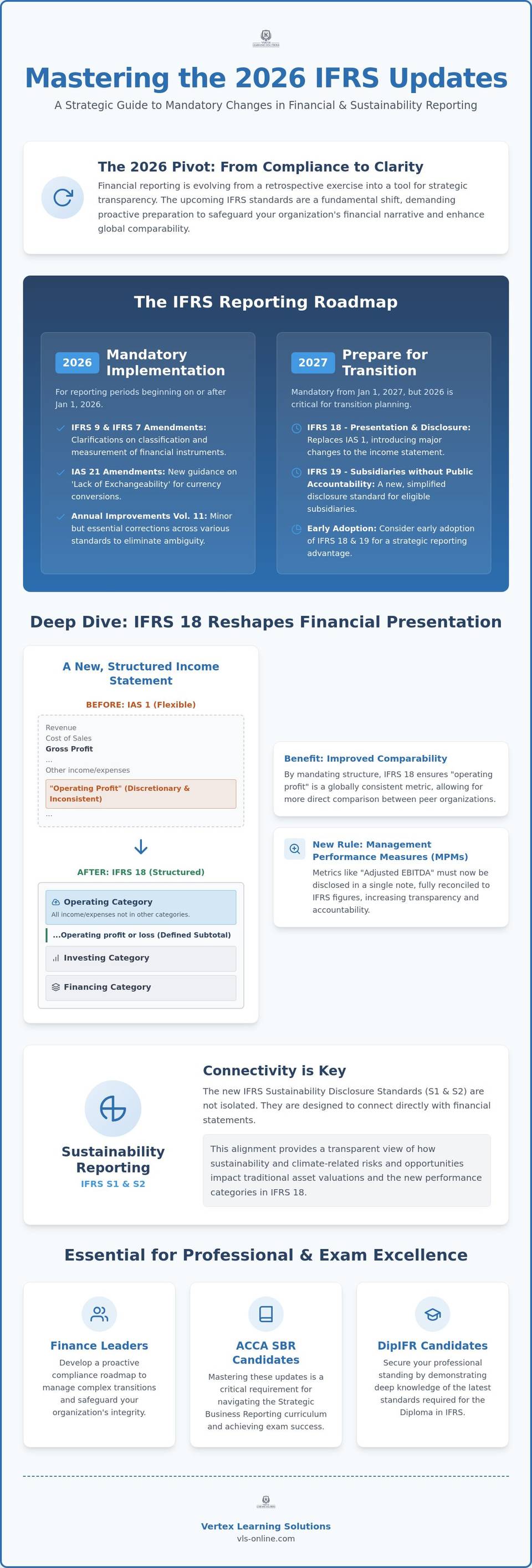
The International Accounting Standards Board (IASB) has finalized several strategic projects that come to fruition during the 2026 reporting cycle. This period is not merely another year of incremental changes. Instead, the 2026 reporting period serves as a vital bridge toward enhanced global transparency through structured disclosure and rigorous connectivity. Organizations must distinguish between the latest updates to IFRS standards 2026 that are mandatory and those where early adoption provides a strategic advantage.
Under the framework of International Financial Reporting Standards (IFRS), the application of IAS 8 remains a critical safeguard. It requires entities to disclose the potential impact of standards that have been issued but are not yet effective. This means that even if you aren't adopting IFRS 18 early, your 2026 financial statements must provide a structured assessment of how these future rules will alter your reported performance. Proactive disclosure isn't just a compliance task; it's an opportunity to manage stakeholder expectations ahead of significant structural shifts.
Mandatory Standards for 2026 Year-Ends
For reporting periods beginning on or after January 1, 2026, several key amendments become compulsory. The amendments to IFRS 9 and IFRS 7 clarify the classification and measurement of financial instruments, particularly concerning contractual cash flow characteristics and equity instruments. Additionally, the Annual Improvements to IFRS Accounting Standards—Volume 11 introduces minor yet essential corrections across the standard suite to eliminate ambiguity. For entities with year-ends in March or June 2026, these requirements must be integrated into the interim and annual reporting processes to maintain compliance.
The amendments to IAS 21 regarding the Lack of Exchangeability also demand attention. These rules provide a systematic approach for determining whether a currency can be exchanged into another and how to estimate the exchange rate when exchangeability is absent. Mastering these nuances is essential for success in professional qualifications like the ACCA Strategic Business Reporting (SBR) or the Diploma in IFRS (DipIFR).
Standards Issued but Not Yet Effective
While the focus remains on immediate compliance, the roadmap for IFRS 18, Presentation and Disclosure in Financial Statements, dominates the horizon. Although mandatory from January 1, 2027, the latest updates to IFRS standards 2026 include the necessary groundwork for this transition. Similarly, IFRS 19, Subsidiaries without Public Accountability: Disclosures, offers a streamlined disclosure framework for eligible subsidiaries. Professionals should evaluate whether early adoption of these standards would simplify their reporting structure or provide better information to stakeholders ahead of the mandatory deadlines.
Deep Dive into IFRS 18: Redefining Financial Presentation
IFRS 18 represents the most significant shift in financial presentation in decades. It moves beyond the flexibility of IAS 1 to mandate a structured income statement that prioritizes comparability. The latest updates to IFRS standards 2026 emphasize that while the mandatory effective date is January 1, 2027, the groundwork for comparative data and transition planning must begin immediately. The core objective is to eliminate the ambiguity that currently exists between how different companies report their core performance metrics.
The new standard introduces three distinct categories for income and expenses: operating, investing, and financing. This classification ensures that "operating profit" is no longer a discretionary subtotal but a strictly defined metric. By standardizing these tiers, the IASB facilitates a more direct comparison between peer organizations. This structured approach also improves connectivity with the IFRS Sustainability Disclosure Standards, as users can more easily trace how climate-related risks impact specific functional areas of the business. Management-defined Performance Measures (MPMs) will also enter the audited scope. If a company uses "adjusted EBITDA" in its communications, these metrics must now be disclosed in a single note, ensuring management's view of performance is transparent and reconciled to statutory figures.
The End of IAS 1: What Changes for Preparers?
Preparers will find that the traditional income statement is replaced by a more rigorous framework. Aggregation and disaggregation rules are tightened to prevent essential information from being obscured in "other" categories. While the Statement of Financial Position remains largely stable, the Statement of Cash Flows will see adjustments to align with the new P&L categories. This ensures a logical flow across the entire financial package.
Exam Focus: Why SBR and DipIFR Students Must Master IFRS 18
For those pursuing professional certification, IFRS 18 is a high-probability topic for 2026 and 2027 sittings. Examiners for the SBR and DipIFR papers will likely require candidates to justify the classification of interest and dividends within the new categories. You'll need to demonstrate a deep understanding of why an item belongs in operating versus financing. To stay ahead of these requirements, you can explore our Mastering ACCA Strategic Professional Level guide for deeper exam insights. If these changes feel daunting, our ACCA Strategic Business Reporting (SBR) course provides the structured support needed to master these presentation rules through practical application.
Sustainability and Connectivity: The Impact of IFRS S1 and S2
The shift toward sustainability-related financial disclosures represents a structural evolution in the reporting ecosystem. For many jurisdictions, the mandatory adoption of IFRS S1 and IFRS S2 marks the end of fragmented ESG reporting. This transition ensures that the latest updates to IFRS standards 2026 are not viewed in isolation but as part of a connected reporting framework. 2026 is the pivotal year where sustainability data must be assurance-ready, requiring the same level of internal control and rigor as traditional financial figures.
The International Sustainability Standards Board (ISSB) has successfully harmonized global reporting through these standards, creating a common language for investors. A critical aspect of this connectivity is the impact on asset impairment under IAS 36. If a business identifies climate-related transition risks, such as declining demand for carbon-intensive products, these must be reflected in the cash flow projections used for impairment testing. Ignoring these links poses a significant risk to the integrity of the Statement of Financial Position.
IFRS S1: General Requirements for Disclosure
IFRS S1 establishes a structured framework based on four pillars: governance, strategy, risk management, and metrics and targets. This standard requires entities to disclose information about all sustainability-related risks and opportunities that could reasonably be expected to affect the entity’s prospects. The objective is to provide a clear line of sight between sustainability factors and the financial statements, ensuring that disclosures are relevant and material to the primary users.
IFRS S2: Climate-related Financial Disclosures
Focusing specifically on climate, IFRS S2 mandates the reporting of Scope 1, 2, and 3 greenhouse gas emissions. This granular level of transparency helps stakeholders evaluate an entity’s exposure to both physical risks, such as extreme weather events, and transition risks, such as regulatory changes or market shifts. In the 2026 reporting cycle, the ability to quantify these risks becomes a measure of professional competence and organizational resilience.
To navigate these complex requirements and secure your professional future, consider enrolling in our Diploma in IFRS (DipIFR) program, where we break down these connectivity rules into practical, actionable insights.
Strategic Preparation: Navigating 2026 Compliance and Exams
Navigating the transition toward the 2026 reporting cycle requires a structured audit of your organization's current reporting practices. It's no longer sufficient to merely observe these shifts from a distance. Instead, finance leaders must perform a rigorous gap analysis, comparing existing income statement structures against the new mandatory categories defined in the latest updates to IFRS standards 2026. Bridging the gap between theoretical knowledge and practical execution is best achieved through simulation. By applying these new rules to your 2025 data, you can identify potential friction points in your systems before the mandatory deadlines arrive.
For many, the complexity of IFRS 18 and the new connectivity requirements makes self-study a high-risk strategy. Professional tutor support provides a necessary safety net, offering a space to resolve technical queries through direct interaction. This structured guidance ensures that your preparation is both efficient and aligned with the highest professional standards, protecting you from the risks of misinterpretation.
Study Plan for ACCA SBR and DipIFR Candidates
Success in professional exams requires a disciplined integration of the 2026 updates into your routine. If you're preparing for ACCA Strategic Business Reporting, your focus should shift toward the justification of subtotals and the disclosure of management-defined performance measures. Our students benefit from dedicated WhatsApp tutor support, allowing for real-time resolution of complex technical questions as they arise during study sessions. This ensures that no conceptual ambiguity remains unresolved before you enter the exam hall.
CPD for Qualified Accountants: Staying Relevant in 2026
Maintaining your professional integrity in a changing regulatory environment involves more than just meeting minimum requirements. It’s about proactivity. Pursuing Specialist Accounting Qualifications is a proven method for staying relevant and securing a strategic advantage in the labor market. For those seeking comprehensive professional mastery, our Diploma in IFRS (DipIFR) program offers the structured, expert-led environment necessary to navigate the latest updates to IFRS standards 2026 with absolute confidence.
Securing Your Professional Future Amid Regulatory Change
The 2026 reporting cycle marks a definitive transition from traditional disclosure toward a more disciplined, integrated financial narrative. Success in this environment requires a deep mastery of the latest updates to IFRS standards 2026, particularly the structural shifts mandated by IFRS 18 and the rigorous connectivity of sustainability reporting. By proactively auditing your current practices and simulating the impact of these new requirements, you protect both your organization and your professional standing from the risks of non-compliance. These changes are not merely technical hurdles; they're opportunities to demonstrate strategic leadership through transparent and comparable financial reporting.
We provide the expert guidance and structured support necessary to navigate these complexities with absolute confidence. Our approach ensures you aren't just reacting to changes but leading them with precision. You can master the latest IFRS standards with our comprehensive DipIFR course, which features exam-focused study notes specifically updated for the 2026 requirements. Our students benefit from weekly live interactive sessions and dedicated expert tutor support via WhatsApp to resolve technical queries in real time. Take the next step in your professional journey with a partner committed to your strategic success. We look forward to supporting your advancement.