
IFRS vs UK GAAP: 2026 Comparison of Key Accounting Differences
Master the IFRS vs UK GAAP key differences for 2026. Our guide simplifies FRS 102 updates on leases & revenue to help you excel in ACCA SBR exams.

In this article
Ready to qualify online?
Get full access to expert-led ACCA & CIMA exam preparation with live tutor support.
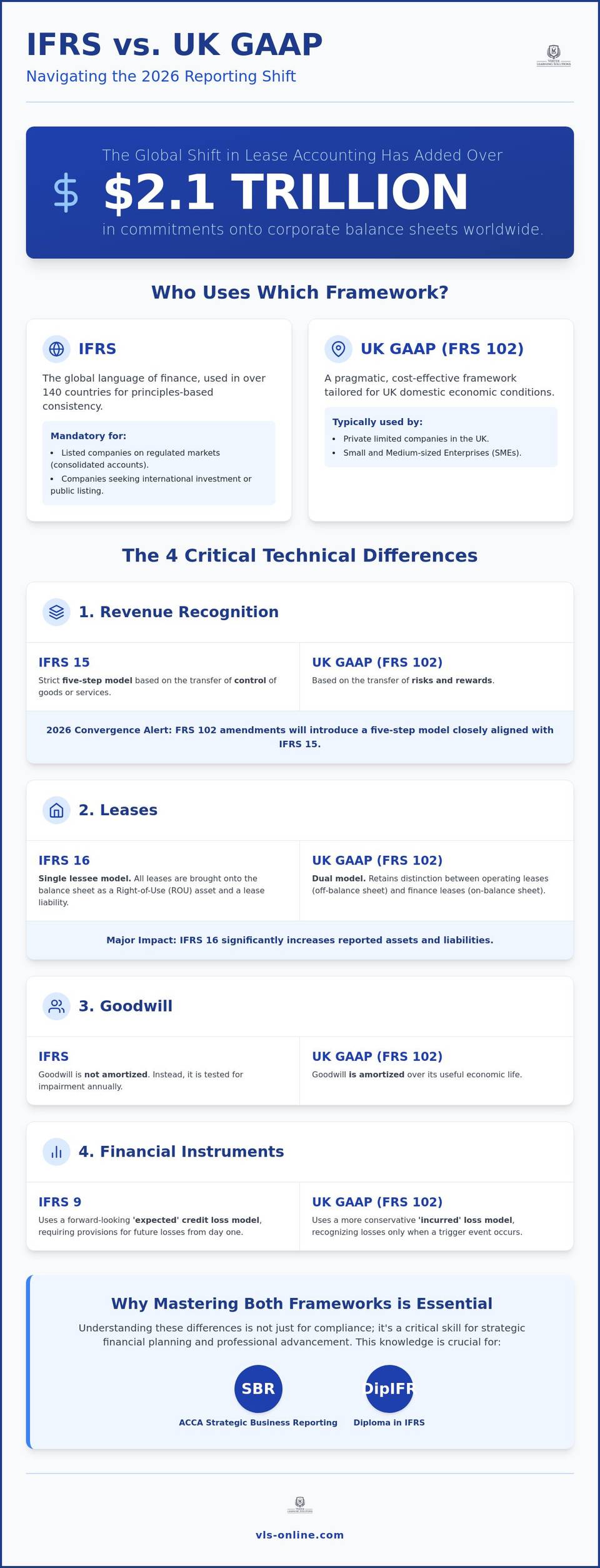
Explore Full AccessThe global shift in lease accounting has already brought over US$2.1 trillion in commitments onto corporate balance sheets, fundamentally altering the financial profile of major industries. As the 2026 amendments to FRS 102 take effect, mastering the IFRS vs UK GAAP key differences is no longer an elective skill; it's a requirement for professional survival. We understand that the convergence of these frameworks can feel like a moving target, particularly when you're preparing for rigorous modules like ACCA SBR or the DipIFR. The pressure to reconcile conflicting treatments for revenue and leases can be daunting, but it's a challenge we can help you navigate with precision.
This guide provides the strategic protection you need by simplifying the most complex reporting hurdles. You'll gain a clear understanding of the divergence in recognition and measurement, ensuring you aren't caught off guard by conflicting standards. We'll examine the specific 2026 updates alongside enduring differences in goodwill and financial instruments. By the end of this analysis, you'll have the technical depth required to excel in your professional exams and the confidence to manage complex reporting environments with ease.
Key takeaways
- Understand the 2026 evolution of FRS 102 and its alignment with the global IFRS framework to maintain reporting integrity.
- Identify the IFRS vs UK GAAP key differences regarding lease accounting and revenue recognition to ensure precise financial statement preparation.
- Learn to navigate the technical hurdles of first-time adoption, including the restatement of comparative figures and opening balances.
- Master the specific reporting requirements for the ACCA Strategic Business Reporting (SBR) module to secure your professional certification.
- Recognize why the divergence in goodwill treatment and financial instruments remains a critical area for strategic financial planning.
The Reporting Landscape: Defining IFRS and UK GAAP (FRS 102) in 2026
The landscape of financial reporting in the United Kingdom has undergone a sophisticated transformation. Gone are the fragmented legacy standards of the past. Today, the UK Generally Accepted Accounting Practice (UK GAAP) operates as a cohesive ecosystem, primarily governed by FRS 102. This framework, alongside the FRS 101 reduced disclosure option, provides a structured protective net for entities that don't require the full complexity of International Financial Reporting Standards (IFRS). While IFRS serves as the global language of finance for over 140 countries, the UK's domestic standards offer a tailored approach for local economic conditions. IFRS focuses on principles-based global consistency, while UK GAAP (FRS 102) offers a pragmatic, cost-effective alternative for UK-centric entities.
Who Must Use Which Framework?
Listed companies on regulated markets must use UK-adopted IFRS for their consolidated accounts. This isn't optional. However, private limited companies and SMEs enjoy significant flexibility. Many choose FRS 102 to balance compliance with operational efficiency. A transition to IFRS often occurs when a company seeks international investment or prepares for a public listing. Understanding the IFRS vs UK GAAP key differences is vital during these strategic shifts. For those preparing for professional milestones, mastering these frameworks through specialized training, such as an ACCA Strategic Business Reporting (SBR) course, provides the necessary expertise to navigate these transitions safely.
The Role of the Financial Reporting Council (FRC)
The Financial Reporting Council (FRC) acts as the guardian of domestic standards. It ensures that financial statements provide a true and fair view of an entity's health. The FRC's 2026 outlook emphasizes convergence. It's moving UK GAAP closer to international standards, particularly regarding revenue and leasing. This proactive alignment reduces friction for businesses operating across borders. It maintains the stability of the UK's professional environment while simplifying the IFRS vs UK GAAP key differences for practitioners. Our role is to ensure you remain ahead of these regulatory shifts, turning complexity into a clear professional advantage.
The 4 Most Critical Technical Differences in Financial Reporting
Identifying the IFRS vs UK GAAP key differences requires a meticulous examination of recognition and measurement criteria. While both frameworks aim to provide a true and fair view, their methodologies often diverge at the foundational level. This divergence is most visible in how they handle revenue and financial instruments. Under IFRS 15, revenue recognition follows a strict five-step model centered on the transfer of control. In contrast, UK GAAP currently relies on the transfer of risks and rewards. Although the 2026 amendments to FRS 102 will introduce a similar five-step model, the current gap creates significant variance in the timing of revenue for complex, long-term contracts.
Financial instruments also present a stark contrast. IFRS 9 utilizes an expected credit loss model, which requires entities to account for potential future losses from the moment a financial asset is recognized. UK GAAP remains more conservative and simplified, generally employing an incurred loss model. This makes FRS 102 less administratively burdensome for smaller entities but offers less predictive value for international investors who prioritize forward-looking data. Professionals aiming to master these nuances often find the Diploma in IFRS (DipIFR) provides the technical protective net required for global reporting.
Leases: The Balance Sheet Impact
IFRS 16 eliminated the distinction between operating and finance leases for lessees. This shift brought approximately US$2.18 trillion in lease commitments onto balance sheets globally. By recognizing a Right-of-Use (ROU) asset and a corresponding lease liability, a company's debt-to-equity ratio can increase significantly. FRS 102 still maintains the dual model for now. This allows many UK entities to keep operating leases off the balance sheet, maintaining a leaner appearance that might not reflect their actual long-term commitments.
Goodwill and Business Combinations
The treatment of goodwill is a definitive point of departure between the two systems:
IFRS: Goodwill is not amortized. It must undergo rigorous annual impairment testing.
UK GAAP: Goodwill is amortized over its useful life. If the life cannot be reliably estimated, a 10-year limit is typically applied.
This difference fundamentally alters the P&L statement. UK GAAP entities record a steady, predictable expense. IFRS entities avoid this annual charge but face the risk of sudden, substantial impairment hits that can erode investor confidence overnight.
Navigating the Transition: Practical Challenges for UK Accountants
Transitioning between reporting frameworks is a strategic maneuver, not a clerical task. The IFRS 1 'First-time Adoption' hurdle requires restating comparative figures and opening balances, a process that often reveals hidden complexities in data collection. Moving from simplified UK records to the granular disclosure requirements of IFRS demands a robust internal reporting structure. Accountants must be prepared to manage stakeholders meticulously. Explaining why "paper" profits have shifted due to IFRS vs UK GAAP key differences is essential to maintain director and investor confidence during the transition year.
Impact on Financial Ratios and Covenants
Moving to IFRS can inadvertently trigger technical breaches in bank covenants. Changes in asset recognition or liability measurement alter key financial ratios overnight, potentially affecting borrowing capacity. Earnings volatility often increases because IFRS favors fair value measurements over historical cost. This fluctuation doesn't necessarily reflect operational performance, yet it can alarm lenders. Understanding how specialist accounting qualifications prepare you for these shifts is a critical step in risk mitigation for any senior finance professional.
The Importance of Tutor-Led Support During Transition
Self-study frequently falls short when navigating standard divergence. The nuances of IFRS vs UK GAAP key differences require more than a textbook; they require expert interpretation and a professional protective net. Access to live sessions and WhatsApp support allows for the immediate resolution of specific reporting dilemmas that arise during a live transition. This guided approach ensures that professional judgment is applied correctly, protecting the integrity of the financial statements. To secure your technical expertise and lead your organization through these changes, explore our Diploma in IFRS (DipIFR) for expert-led transition training.
Strategic Career Impact: Why Mastering Both Frameworks is Essential
Mastering the IFRS vs UK GAAP key differences isn't merely a technical exercise; it's a strategic investment in your global mobility. Proficiency in IFRS acts as a professional passport, opening doors in more than 140 countries where the IASB framework is the standard. For a finance leader, the ability to interpret and reconcile accounts across different jurisdictions is a hallmark of elite expertise. This dual-framework knowledge often correlates with a significant salary premium. Senior roles require the foresight to manage international reporting risks and the technical depth to oversee complex consolidations.
Vertex's approach focuses on bridging the gap between knowing the rules and applying the strategy. We provide a professional protective net that allows you to move beyond rote memorization. By understanding the underlying logic of both systems, you gain the confidence to advise directors on how framework choices affect the bottom line. We don't just help you pass exams; we prepare you to lead in a sophisticated global economy.
Exam Focus: ACCA SBR and DipIFR
The ACCA SBR exam specifically tests your ability to critique accounting treatments under IFRS. It's not enough to state a rule. You must evaluate its impact on the stakeholder's perception of the business. Before your next sitting, review this essential comparison checklist:
Revenue: Transfer of control (IFRS 15) vs. risks and rewards (UK GAAP).
Leases: On-balance sheet ROU assets (IFRS 16) vs. the dual model (FRS 102).
Goodwill: Impairment only (IFRS) vs. mandatory amortization (UK GAAP).
Prepare for excellence with our ACCA Strategic Business Reporting (SBR) course to master these nuances.
Future-Proofing Your Finance Career
The rise of ESG reporting and its integration into the IFRS framework through the ISSB signals a shift toward holistic transparency. Even if you currently work within a UK-centric entity, staying "IFRS-adjacent" is vital as standards continue to converge. Understanding the IFRS vs UK GAAP key differences ensures you remain relevant as the regulatory environment evolves. Read our guide on Mastering the ACCA Strategic Professional Level for more insights into securing your future in senior finance.
Securing Your Position in the 2026 Global Finance Landscape
The 2026 updates to FRS 102 represent a significant step toward international alignment, yet the remaining divergence in goodwill treatment and financial instrument measurement continues to define the reporting landscape. Navigating these complexities requires a proactive approach that moves beyond simple compliance. You must be prepared to manage the volatile impact on financial ratios while ensuring that every disclosure meets the highest standards of transparency and professional integrity.
Mastering the IFRS vs UK GAAP key differences is the definitive step toward professional autonomy in an increasingly integrated global economy. We provide the expert guidance and the professional protective net you need to succeed. Advance your reporting expertise with our Diploma in IFRS course to benefit from expert tutor support via WhatsApp and weekly live interactive sessions. Our exam-focused study notes and recorded lectures are designed to ensure you don't just learn the rules; you master the strategic application. Your path to reporting excellence starts here.