Vertex Learning Solutions


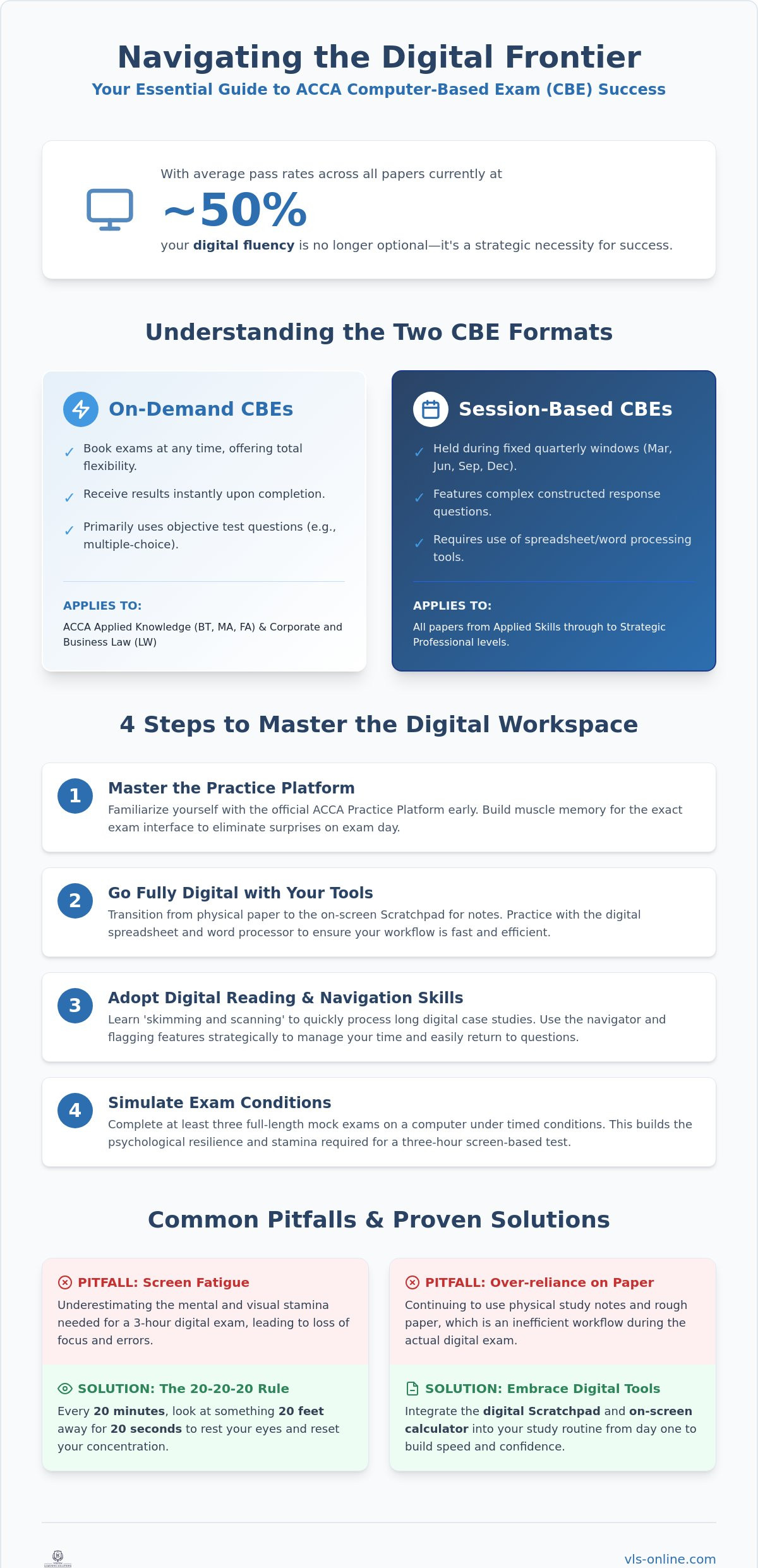
Your ability to pass the ACCA is now as much about your digital fluency as it is about your accounting expertise. Many candidates find that the traditional study methods they've relied on for years don't quite translate to the rigors of a screen-based assessment. Learning how to prepare for computer-based ACCA exams is now a dual challenge of mastering the syllabus while simultaneously developing fluency in the CBE interface. With overall pass rates across all papers currently averaging around 50%, technical proficiency is no longer optional; it's a strategic necessity.
It's understandable to feel anxious about navigating complex spreadsheets or managing long case studies on a monitor while the clock is ticking. You've likely worried about the risk of losing work or simply failing to keep pace with the digital format. This guide will provide you with the exact techniques needed to master the 2026 exam interface with precision and composure. We'll explore how to effectively utilize the scratchpad, optimize the on-screen calculator, and implement time management strategies specifically designed for the digital workspace.
Key Takeaways
- Understand the critical distinctions between on-demand and session-based formats to align your preparation with the specific requirements of each digital assessment.
- Master the official Practice Platform early in your study cycle to learn how to prepare for computer-based ACCA exams using the exact interface you'll face on exam day.
- Transition from physical note-taking to the digital scratchpad and on-screen tools to ensure your workflow remains efficient and compliant with exam regulations.
- Adopt specialized 'skimming and scanning' techniques to navigate long digital scenarios and manage your time effectively using the navigator and flagging features.
- Leverage structured support and real-time tutor guidance to resolve technical complexities and integrate CBE-specific skills into your core accounting knowledge.
Table of Contents
- What are Computer-Based ACCA Exams (CBEs)?
- Strategic Preparation for the Digital Workspace
- Overcoming Common CBE Challenges and Pitfalls
- The Vertex Advantage: Expert Support for Digital Success
What are Computer-Based ACCA Exams (CBEs)?
The Association of Chartered Certified Accountants (ACCA) has fully transitioned its assessment model to reflect the digital reality of the modern finance profession. Computer-Based Exams (CBEs) are not merely digital versions of paper tests; they're sophisticated assessments administered via a secure, specialized platform designed to evaluate your ability to perform in high-stakes business environments. Understanding the architecture of these assessments is the first step in learning how to prepare for computer-based ACCA exams effectively. Essentially, a CBE serves as a direct simulation of the digital tools and analytical workspaces you'll use throughout your career as a qualified accountant.
By 2026, the digital format has become the global benchmark for professional certifications. This shift ensures that candidates possess the technical agility required to handle complex data and evolving reporting standards. While the underlying accounting principles remain constant, the method of delivery varies depending on your stage in the qualification journey. This structure provides a professional safety net, ensuring you're tested in conditions that mirror the expectations of top-tier employers.
On-Demand vs. Session-Based: Key Differences
The distinction between exam types significantly influences your study strategy. On-demand CBEs, covering the ACCA Applied Knowledge level (BT, MA, FA) and the Corporate and Business Law (LW) paper, offer total flexibility. You can book these at any time and receive your results instantly upon completion. These exams primarily utilize objective test questions, such as multiple-choice and drag-and-drop formats, which demand rapid recall and precision.
Session-based CBEs apply to all papers from the Applied Skills level through to Strategic Professional. These are held during fixed quarterly windows in March, June, September, and December. These assessments are more complex, featuring constructed response questions where you must build financial statements or draft reports using word processing and spreadsheet tools. They also incorporate professional marks, rewarding your ability to communicate with the skepticism and commercial acumen expected of a senior advisor. When you consider how to prepare for computer-based ACCA exams at this level, you must focus on the integration of technical knowledge with digital presentation skills.
Strategic Preparation for the Digital Workspace
Developing a structured approach to your digital environment is the cornerstone of exam success. You must move beyond passive reading and engage with the interface from day one. When considering how to prepare for computer-based ACCA exams, your priority should be the ACCA Practice Platform. This tool mimics the live environment; it allows you to build muscle memory long before the pressure of the actual sitting. You should also consult the official ACCA guide to on-demand CBEs for specific insights into the earlier stages of the qualification.
One common pitfall is the over-reliance on physical paper. While you receive a physical booklet for rough notes, the digital 'Scratchpad' is often more efficient for structuring your thoughts within the software. Transitioning your study habits from physical textbooks to digital notes is equally vital. If you're reading on a screen during your revision, your eyes will be better conditioned for the three-hour duration of a professional sitting. This alignment of study habits with exam conditions removes a significant layer of digital friction.
Mastering the Digital Spreadsheet and Word Tools
At the ACCA Applied Skills level, spreadsheet and word processing tools become your primary means of communication. You must master essential formulas such as SUM, IF, and VLOOKUP. These aren't just shortcuts; they're essential components of papers like Management Accounting (MA) and Financial Management (FM). Use the 'Highlight' and 'Copy/Paste' functions to extract key data points from long case studies without losing your place. If you're looking for a structured path to mastering these tools, exploring specialized ACCA courses can provide the necessary technical edge.
The Psychology of Screen-Based Testing
The mental stamina required for screen-based testing is often underestimated. To prevent fatigue, implement the 20-20-20 rule: every 20 minutes, look at something 20 feet away for 20 seconds. Finally, never attempt the real exam without completing at least three full-length mocks under timed conditions on a computer. This simulation builds the psychological resilience needed to handle the digital interface with precision and prevents the cognitive overload that often occurs during the first hour of the assessment.
Overcoming Common CBE Challenges and Pitfalls
Technical mastery of the software is just as critical as your grasp of accounting standards. One of the most significant tactical errors candidates make when learning how to prepare for computer-based ACCA exams is the misuse of the 'Flag for Review' feature. While the Navigator tool is designed to assist with time management, excessive flagging creates a psychological and operational backlog. You should only flag a question if you're confident that a brief second look will resolve a specific doubt. Otherwise, you risk facing a mountain of difficult tasks in the final, high-pressure minutes of the session.
Digital reading fatigue is a verified challenge during three-hour assessments. Navigating long, complex scenarios on a 15-inch screen requires a shift from linear reading to 'skimming and scanning' for key financial triggers and regulatory requirements. This technique preserves your cognitive energy and ensures you don't miss vital data points buried in the text. To maintain your focus, ensure your physical workspace meets the 2026 remote proctoring standards, which emphasize a strictly controlled, quiet environment to uphold exam integrity and minimize external distractions.
Markers frequently report the 'Formula Trap' as a reason for lost marks in spreadsheet-based papers. If your cell logic is over-complicated or uses deeply nested formulas, the marker may be unable to follow your thought process. It's far better to use simple, transparent calculations that clearly demonstrate your methodology. If you're looking to bridge the gap between technical knowledge and digital execution, our structured ACCA preparation courses provide the expert guidance needed to master these interface-specific nuances.
Construction Response Questions (CRQs) Strategy
Your presentation in CRQs directly impacts your professional marks. You should use the word processor's formatting tools, such as bold headings and structured lists, to ensure your arguments are distinct and easy to audit. A highly effective time-saving technique is to copy the specific requirements directly from the exam scenario into your answer template. This provides an immediate framework for your response and ensures you address every sub-requirement without having to toggle back and forth between screens repeatedly.
The Vertex Advantage: Expert Support for Digital Success
Mastering the digital interface requires more than just self-study; it demands a structured pedagogical approach that bridges the gap between accounting theory and digital application. At Vertex Learning Solutions, we recognize that learning how to prepare for computer-based ACCA exams is a multidimensional process. We've integrated CBE-specific training into every module of our curriculum. This ensures that you aren't just memorizing standards, but are actively practicing their execution within a simulated digital workspace. This method provides the professional safety net necessary to navigate the 2026 exam landscape with absolute certainty.
Our students benefit from real-time support through dedicated WhatsApp tutor groups. This resource is particularly valuable when you encounter complex spreadsheet formulas or technical interface queries that require immediate clarity. Rather than struggling in isolation when you hit a conceptual wall, you have direct access to experienced mentors who provide the precise guidance needed to maintain your study momentum. Our ACCA Business and Technology resources are specifically designed for digital-first learners, ensuring that your primary study materials align perfectly with the final assessment format.
Why Tutor Support is Essential for CBEs
The transition from understanding a concept to applying it within the ACCA platform is where many candidates falter. Professional guidance is essential to ensure your digital presentation meets the rigorous standards of the markers. Our weekly live interactive sessions simulate the pressure of a live CBE environment, allowing you to receive expert feedback on your technique and time management. This proactive approach is vital as you progress toward the Strategic Professional Level, where professional marks are awarded for the quality and clarity of your digital communication.
Effective preparation requires a partner who understands the complexities of the modern regulatory environment and the nuances of the digital workspace. If you're ready to master the interface with confidence and precision, explore our Full Access Courses today. We provide the strategic protection and expert insight necessary to ensure your hard work translates into definitive exam success.
Securing Your Professional Future in a Digital Era
Mastering the transition to digital assessments is a defining step in your professional journey. We've explored how early engagement with the Practice Platform and the strategic use of on-screen tools are essential components of success. Understanding how to prepare for computer-based ACCA exams involves more than just a syllabus review; it requires a disciplined approach to the digital workspace and the psychological resilience to handle high-stakes scenarios on screen. By focusing on spreadsheet transparency and effective time management through the navigator, you'll eliminate the technical risks that often hinder otherwise qualified candidates.
Success in the 2026 sittings depends on having a reliable professional safety net. Our approach combines exam-focused digital study notes with active WhatsApp tutor support and interactive weekly live sessions to ensure you're never navigating this complex environment alone. Your path to qualification is a strategic partnership, and we're committed to ensuring your transition to the digital format is seamless and secure.
Enroll in VLS ACCA Courses for Expert Tutor Support
Frequently Asked Questions
Can I use my own calculator during a computer-based ACCA exam?
Yes, you're permitted to bring your own physical, non-programmable calculator into the exam room. While the software includes a built-in scientific calculator, many students prefer the tactile efficiency of their own device. You must ensure your model complies with official regulations; programmable devices with communication capabilities are strictly prohibited to maintain exam integrity. This physical tool remains a reliable backup to the on-screen resources.
What happens if the computer crashes or the internet fails during my CBE?
The system is designed with a professional safety net that automatically saves your progress to the last completed action. If a technical failure occurs in a center, you must alert the invigilator immediately to restore your session. For remote exams, you should contact the technical proctor through the chat function. Understanding these protocols is a vital part of learning how to prepare for computer-based ACCA exams and helps reduce technical anxiety.
How many times can I take an on-demand CBE if I fail?
There is no official limit on the number of attempts for on-demand assessments such as Business and Technology or Management Accounting. You can re-book the exam as soon as you feel ready, though you'll need to pay the applicable fee for each new sitting. We recommend a structured review of your previous performance to ensure any conceptual gaps are closed before your next attempt to maintain your professional momentum.
Is the CBE format harder than the old paper-based exams?
The technical difficulty of the syllabus remains unchanged; however, the digital format requires a higher level of operational agility. Success depends on your ability to manipulate data within spreadsheets and draft reports in a word processor. Learning how to prepare for computer-based ACCA exams effectively means training for these digital requirements so the interface doesn't become a barrier to demonstrating your accounting knowledge and strategic insight.
Do I get a physical scratchpad for rough work in the exam center?
Yes, the exam center staff will provide you with a physical booklet or scrap paper for rough calculations and notes. You're also given a pen or pencil, which must be returned at the end of the session. While this physical resource is available, we encourage you to practice using the digital scratchpad within the software. This ensures your final answers are structured efficiently for the markers to follow your logic.