
Fast Track ACCA Qualification: The Strategic 2026 Guide to Rapid Success
Ready to fast track your ACCA qualification? Our 2026 guide shows you how to pass all 13 exams in 12-24 months with smart strategies and exemptions.

In this article
Ready to qualify online?
Get full access to expert-led ACCA & CIMA exam preparation with live tutor support.
Explore Full AccessDid you know that while the average ACCA pass rate hovers around 50%, the most successful candidates aren't necessarily studying harder; they're studying smarter? The daunting prospect of 13 exams and a 10-year time limit often paralyzes ambitious professionals who are already balancing demanding full-time roles. You don't have to be one of them. Achieving a fast track ACCA qualification is not about cutting corners. It's about a disciplined, strategic approach to the 2026 syllabus that maximizes your existing academic background and professional experience.
We understand the complexity of navigating exemption rules and the pressure of the upcoming 2027 qualification redesign. This guide provides the precise roadmap you need to accelerate your journey, potentially reaching membership within 12 to 24 months. You'll discover how to optimize the March, June, and September 2026 exam cycles, leverage every possible exemption to skip redundant papers, and implement study techniques designed for high-pass-rate success. It's time to transform your professional trajectory with a structured, expert-led plan that provides the security and clarity you deserve.
Key takeaways
- Learn how to condense the traditional three-year timeline into a 12-24 month strategic roadmap by increasing exam frequency and optimizing your preparation.
- Identify your eligibility for exemptions using professional benchmarks to ensure you never sit for a paper you have already mastered through previous academic or vocational achievements.
- Discover the "Vertex Method" for achieving a fast track ACCA qualification, utilizing recorded lecture videos that provide the 24/7 flexibility required by working professionals.
- Master the transition to the Strategic Professional level by integrating advanced IFRS knowledge early, shifting your focus from technical calculation to high-level corporate analysis.
- Align your study schedule with the quarterly 2026 exam cycles to maintain consistent momentum without compromising your professional or personal commitments.
What Does it Mean to Fast Track the ACCA Qualification?
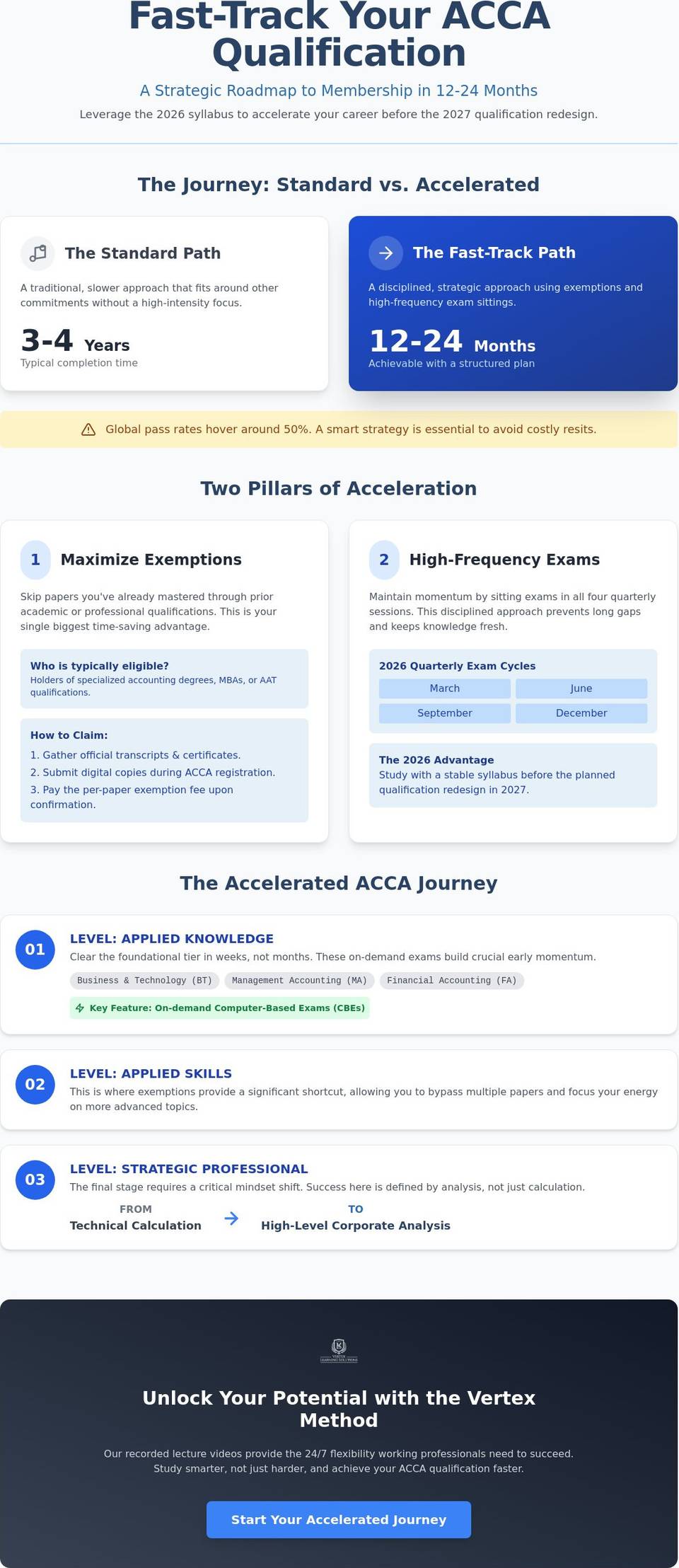
The standard journey to becoming a member of the Association of Chartered Certified Accountants (ACCA) typically spans three to four years. However, a fast track ACCA qualification compresses this timeline into a rigorous 12 to 24 month period. This acceleration isn't achieved through shortcuts; it's a result of a structured, proactive strategy that leverages every available regulatory advantage. Achieving this requires a shift from a passive student mindset to that of a strategic professional who manages time as a finite resource.
Two primary pillars support this rapid progression. First, you must maximize prior learning exemptions to bypass redundant foundational papers. Second, you must maintain a disciplined exam frequency by utilizing all four quarterly sessions. Starting in 2026 offers a unique advantage. The continued refinement of on-demand Computer-Based Exams (CBEs) and the stability of the current syllabus provide a predictable environment for intensive study before the planned 2027 redesign. It's a window of opportunity for those ready to commit to a high-density learning schedule.
Speed must never compromise precision. With a global pass mark of 50%, the margin for error is slim. Failing a paper doesn't just incur additional fees; it disrupts your entire momentum. A successful fast-track candidate views each exam as a strategic milestone that requires a high-intensity, exam-focused approach. Balancing speed with the quality of your preparation is the only way to avoid the trap of costly and time-consuming resits.
The 1-Year Fast-Track: Myth vs. Reality
While ACCA regulations permit students to take up to four exams per session, attempting 13 papers in a single year is a logistical and intellectual extreme that few can sustain. Realistically, a one-year path is only viable for those starting with significant exemptions at the Applied Skills level. The fast-track path is a calculated synergy of maximizing academic exemptions and consistently utilizing quarterly exam sittings.
Accelerating through Applied Knowledge
The Applied Knowledge level, comprising ACCA Business and Technology (BT) , Management Accounting (MA), and Financial Accounting (FA), is the most flexible phase. Since these are on-demand CBEs, you don't have to wait for the quarterly cycles. You can sit these exams as soon as you're ready, allowing you to clear the foundational tier in weeks rather than months. This creates the early momentum necessary to tackle the more complex Applied Skills papers later in the year.
Maximizing Exemptions: Your Shortcut to Applied Skills
Maximizing exemptions represents the most significant tactical advantage for any professional seeking a fast track ACCA qualification. By skipping foundational papers, you don't just save time; you align your study efforts with your existing expertise. The official ACCA Exemption Calculator is the essential first tool for this assessment. It provides a definitive list of papers you can bypass based on your previous academic history, ensuring you don't repeat content you've already mastered.
Common entry points for significant exemptions include specialized accounting degrees, MBA holders, and AAT qualified technicians. For instance, the University of Hull ACCA Accreditation highlights how accredited programs are specifically mapped to ACCA requirements to streamline this transition. While exemption fees are required for each paper you skip, the investment is almost always justified by the months of study time recovered. It's a strategic trade-off where you exchange a one-time administrative cost for an accelerated career trajectory.
How to Claim Your ACCA Exemptions in 2026
Securing your credits is a formal administrative process that requires precision. Follow these steps during your registration for ACCA courses online to ensure a smooth transition:
Gather documentation: Obtain official, stamped transcripts and degree certificates from your prior institutions.
Submit during registration: Upload these digital copies when you first create your ACCA student account.
Settle the fees: Once ACCA confirms your eligibility, pay the required per-paper fee to officially apply the credits to your record.
When to Decline an Exemption
Speed is vital, but structural integrity is paramount. You might choose to sit a paper even if you're exempt if your previous study was several years ago. For example, if you lack a firm grasp of Financial Accounting, you'll struggle significantly with Strategic Business Reporting later. Similarly, ensure your Management Accounting foundation is robust before attempting Performance Management. A strategic pause now prevents a total collapse at the Strategic Professional level, ensuring your fast track ACCA qualification remains on schedule. If you're unsure of your current knowledge level, our expert consultants can help you evaluate the best path forward.
Strategic Study Planning for High-Frequency Exams
Maintaining the momentum required for a fast track ACCA qualification demands a shift from traditional academic habits to a high-frequency exam strategy. The ACCA calendar provides four distinct windows each year: March, June, September, and December. Successful candidates don't just pick dates; they map out their entire 12 to 24 month journey in advance to ensure each session builds logically upon the previous one. This structured foresight eliminates the decision fatigue that often leads to skipped sittings, keeping your professional goals firmly within reach.
Speed is often hindered by passive learning. Textbooks are exhaustive, but they aren't always efficient. The "Vertex Method" prioritizes recorded lecture videos for 24/7 flexibility, allowing you to master complex topics during your most productive hours. We've found that interactive practice questions are vastly superior to passive reading, as they immediately highlight knowledge gaps. To maintain this pace, our students leverage real-time tutor support via WhatsApp, clearing technical roadblocks before they become significant delays.
Leveraging Professional Certification Packages
Consistency is the primary driver of success. Bundling your modules creates a stable study rhythm and ensures you have all the necessary resources at your fingertips. Explore our ACCA Applied Skills exam prep for comprehensive module access. These packages include weekly live sessions that simulate the accountability of a physical classroom, keeping you on track for the next sitting. Ready to commit? Select your next module and start your accelerated path today.
Exam Technique: The Secret to First-Time Passes
A first-time pass is the only way to stay on a fast-track schedule. This requires focusing on exam-focused study notes that prioritize mark-earning points over theoretical fluff. The final 14 days before an exam should be reserved for rigorous mock exams under timed conditions. For a deeper dive into these specific methodologies, see our Accounting Exam Study Tips.
Conquering the Strategic Professional Level
The final phase of a fast track ACCA qualification involves the Strategic Professional level. This is often where even the most disciplined candidates face their greatest challenge. Unlike the Applied Knowledge and Skills levels, no exemptions are available here. The curriculum shifts from technical calculation to high-level strategic analysis, requiring a sophisticated understanding of corporate governance, risk management, and financial reporting. Maintaining your momentum at this stage requires a transition from a student mindset to that of a senior advisor.
Mastering Strategic Business Reporting (SBR) involves more than just memorizing standards; it requires the ability to apply complex IFRS knowledge to multifaceted corporate scenarios. Similarly, the Strategic Business Leader (SBL) exam utilizes a four-hour case study format that tests your professional judgment and communication skills. Detailed guidance can be found in our Mastering the ACCA Strategic Professional Level guide. Because SBL evaluates your ability to act as a consultant, tutor-led case study analysis is non-negotiable for success.
Succeeding in SBR and SBL
Success in these high-stakes exams depends on your ability to synthesize information quickly. We provide specific preparation for ACCA SBR and ACCA AFM to ensure you're equipped for these rigorous assessments. Choosing your two optional papers is a critical career decision. You should align Advanced Financial Management (AFM), Advanced Performance Management (APM), Advanced Taxation (ATX), or Advanced Audit and Assurance (AAA) with your long-term professional objectives. If your goal is a leadership role in corporate finance, AFM and APM are often the most logical choices.
Finalizing Membership: PER and Ethics
Completing the Ethics and Professional Skills Module (EPSM) early in your journey is a proven way to boost your pass rates at the professional level. It provides the contextual framework needed for the complex ethical dilemmas presented in the exams. Simultaneously, you should record your Practical Experience Requirement (PER) milestones as you progress. Documenting your professional development while you study ensures that once your final exam results are released, your path to full membership is clear and immediate. This integrated approach is the final step in securing your fast track ACCA qualification.
Accelerate Your Journey to Professional Membership
Achieving a fast track ACCA qualification is a goal defined by precision and strategic foresight. By maximizing your prior learning exemptions and maintaining a disciplined rhythm through the quarterly exam cycles, you can significantly reduce the time required to reach full membership. This journey demands more than just effort; it requires a structured environment where technical knowledge meets professional application. You've seen how a proactive approach to the Strategic Professional level can prevent common delays, ensuring that your transition from candidate to member is seamless and predictable.
We provide the professional safety net necessary to navigate this intensive path with absolute confidence. Our approach prioritizes efficiency through exam-focused study materials and weekly live interactive sessions that maintain your momentum. With expert tutor support available via WhatsApp, you'll never face technical roadblocks alone. View our ACCA Professional Certification Packages and start your fast-track journey today. The 2026 syllabus offers a stable window for rapid advancement. Take the definitive step toward your career goals with a partner that values your time as much as your success.