
CIMA Certificate in Business Accounting: The Ultimate 2026 Guide to Starting Your Finance Career
Your ultimate 2026 guide to the CIMA Certificate in Business Accounting. Pass all four exams in 6-12 months with expert strategies and syllabus updates.

In this article
Ready to qualify online?
Get full access to expert-led ACCA & CIMA exam preparation with live tutor support.
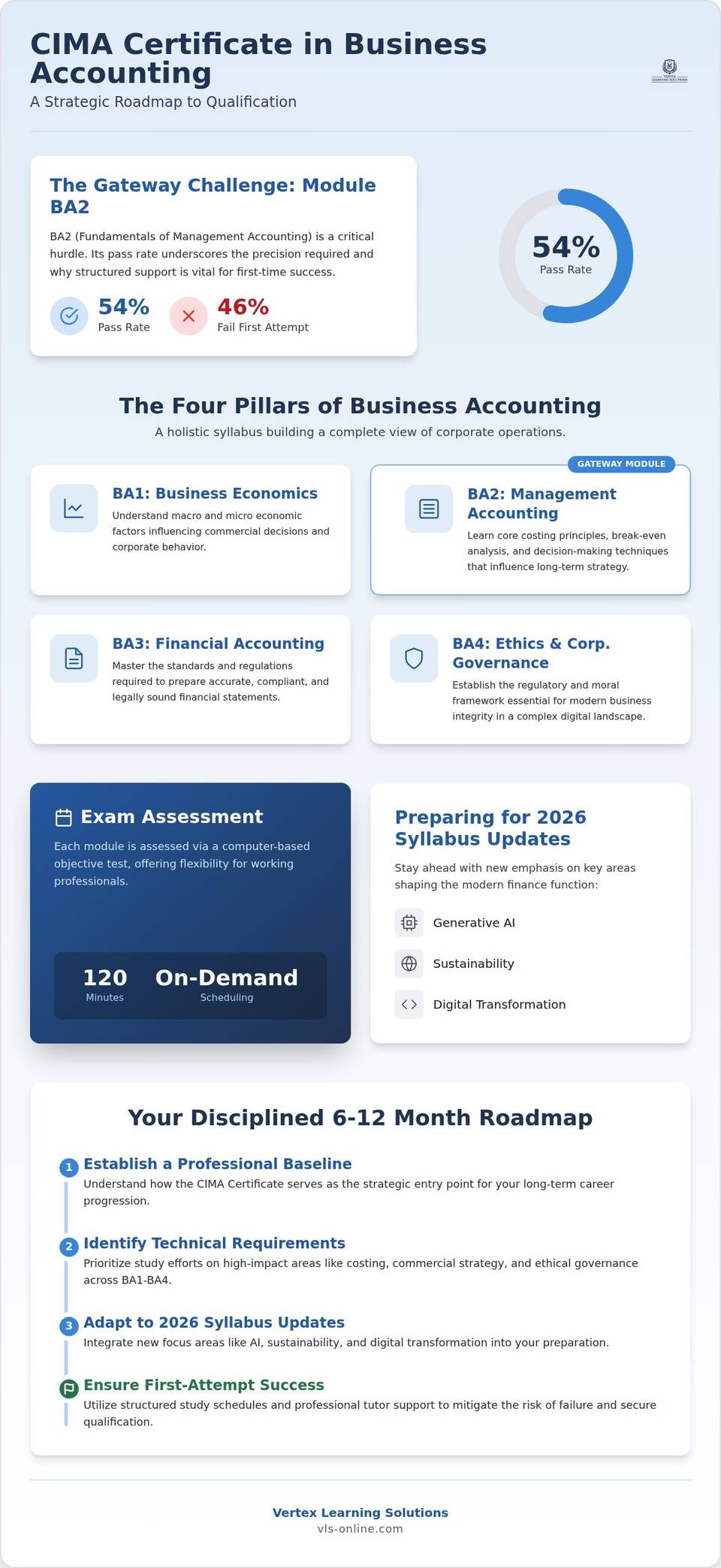
Explore Full AccessDid you know that nearly 46% of candidates fail the BA2 module of the CIMA Certificate in Business Accounting on their first attempt? While a 54% pass rate for management accounting might seem intimidating, it underscores the high level of precision required in today's financial environment. You're likely managing a full-time job while attempting to master complex BA3 accounting standards, all while facing the pressure of strict two-hour objective tests. It's a challenging path, but you don't have to navigate these technical complexities without a professional safety net.
We believe that with the right structural support, your path to qualification should be predictable and secure. This guide offers a comprehensive roadmap to passing all four exams within six to twelve months, providing the stability you need to advance your career. We'll examine the 2026 syllabus updates regarding generative AI and sustainability, clarify the tiered fee structure, and detail the exact strategies required to transition successfully to the CIMA Professional Qualification. Your journey toward increased salary potential and professional integrity starts with a disciplined, expert-backed plan.
Key takeaways
- Establish a definitive professional baseline by understanding how the CIMA Certificate in Business Accounting serves as the strategic entry point for your long-term career progression.
- Identify the specific technical requirements of the BA1 through BA4 modules to prioritize study efforts on high-impact areas like costing, commercial strategy, and ethical governance.
- Adapt your preparation to the 2026 syllabus updates, which place a heightened emphasis on generative AI, sustainability, and digital transformation within the modern finance function.
- Develop a disciplined 6-12 month roadmap that utilizes structured study schedules and professional tutor support to mitigate the risk of failure and ensure a successful first-attempt result.
What is the CIMA Certificate in Business Accounting?
The CIMA Certificate in Business Accounting represents the foundational entry-level qualification for the Chartered Institute of Management Accountants (CIMA). It serves as a rigorous introduction to the commercial world, designed for individuals regardless of their educational background or prior exposure to financial reporting. In an era where generative AI and automation redefine routine tasks, this qualification equips you with the analytical mindset necessary to interpret data rather than just process it. Business accounting isn't merely a technical skill; it's the language of management. It provides a professional safety net by ensuring you possess the fundamental competencies required to transition into the more advanced CIMA Professional Qualification.
Structure of the Qualification
Four strategic pillars form the foundation of the syllabus, providing a holistic view of corporate operations. These modules ensure that you understand how various business functions intersect with financial objectives:
BA1 (Fundamentals of Business Economics): This module focuses on the macro and micro economic factors that influence commercial decision-making.
BA2 (Fundamentals of Management Accounting): You'll learn the core principles of costing and how these influence long-term strategy.
BA3 (Fundamentals of Financial Accounting): This section simplifies complex accounting standards, focusing on the preparation of financial statements.
BA4 (Fundamentals of Ethics, Corporate Governance and Business Law): This establishes the regulatory and moral framework essential for modern business integrity.
Each module is assessed via a 120-minute computer-based objective test. These exams are available on-demand, offering the operational flexibility required by working professionals to study at their own pace.
Entry Requirements and Registration
There are no formal prerequisites for enrollment, which makes the CIMA Certificate in Business Accounting an ideal starting point for career changers seeking a structured transition into finance. The registration process begins through the AICPA & CIMA portal, where new students establish their professional profile. Once registered, you gain access to a global network of expertise and a clear path toward becoming a Chartered Global Management Accountant (CGMA). This accessibility ensures that talent and discipline are the only true barriers to entry in the profession.
Mastering the Syllabus: A Strategic Breakdown of BA1 to BA4
Approaching the CIMA Certificate in Business Accounting requires a methodical understanding of its four constituent pillars. Each module is designed to build a specific layer of commercial intelligence, moving from the broad external environment to the internal mechanics of a firm. Success isn't merely about passing; it's about internalizing the strategic alignment between these subjects to create a professional safety net for your future career. You'll find that the official CIMA Certificate in Business Accounting qualification syllabus balances technical precision with high-level business partnering skills.
BA1 Fundamentals of Business Economics: This module places commerce within its macro and micro contexts. It examines how global economic shifts and market competition dictate corporate behavior.
BA2 Fundamentals of Management Accounting: As the core of the CIMA journey, this subject teaches you how costing influences long-term strategy. It's the technical engine of the qualification.
BA3 Fundamentals of Financial Accounting: You'll master the standards and regulations required for compliant statements. This ensures your financial reporting is accurate and legally sound.
BA4 Fundamentals of Ethics, Corporate Governance, and Business Law: This defines the ethical framework of the profession, emphasizing integrity in an increasingly complex digital landscape.
Subject Weighting and Exam Focus
The weighting of topics within each exam dictates your study priorities. In BA1, microeconomics typically commands 35% of the syllabus, while macroeconomics accounts for 25%. Understanding this distribution allows for a more efficient allocation of your time. BA2 is frequently identified as the "gateway" module. With a pass rate of 54% as of late 2025, it represents the first significant hurdle. Mastering BA2 is essential because its principles of decision-making and break-even analysis reappear with greater complexity at the Operational and Management levels.
Tackling the Most Difficult Topics
BA1 often overwhelms students with its informational density. The key is to focus on the application of economic theories rather than simple definitions. In contrast, BA3 presents a challenge through its rigid regulatory standards. For those without a prior accounting background, simplifying these rules into logical workflows is vital for success. If you find these technical nuances difficult to navigate alone, utilizing comprehensive exam preparation resources can provide the structured clarity needed to progress with confidence.
Your 2026 Roadmap to Success: Passing the Cert BA
Navigating the path to qualification requires more than just technical knowledge; it demands a disciplined operational strategy. To complete the CIMA Certificate in Business Accounting within a 6-12 month timeframe while maintaining professional commitments, you must transition from passive reading to active application. This roadmap ensures your efforts are focused on high-yield activities that guarantee results on your first attempt.
Step 1: Establish a study schedule that respects your existing workload. Consistency outweighs intensity when balancing a full-time career.
Step 2: Utilize high-quality CIMA exam preparation courses online that offer recorded lectures. This flexibility allows you to revisit complex topics whenever your schedule permits.
Step 3: Bridge the gap between theory and application with interactive practice questions that mirror the actual exam environment.
Step 4: Leverage professional tutor support to clarify complex concepts in real-time, ensuring you don't remain stuck on difficult modules.
The Vertex Learning Advantage
We provide a professional safety net through active tutor support via WhatsApp. This immediate access allows you to resolve technical bottlenecks during your study sessions, preventing minor misunderstandings from becoming major hurdles. Our weekly live sessions simulate a classroom environment, offering the structured interaction and peer motivation necessary to stay on track. This proactive approach ensures you aren't just memorizing facts but mastering the underlying logic of business finance.
Final Exam Preparation Tips
Managing the 120-minute objective tests requires tactical precision. For modules like BA1, BA2, and BA3, which contain 60 questions, you should adhere to a "two-minute rule" per question. This pace leaves a small buffer for a final review of flagged items. BA4 requires even faster processing due to its 85-question format. If you encounter a particularly difficult scenario, move forward to secure easier marks first. Implementing proven accounting exam study tips can significantly reduce anxiety, ensuring your cognitive resources remain focused on execution. Success is the result of structured preparation meeting calm, methodical performance.
Securing Your Strategic Position in the Finance Profession
Transitioning into a finance career requires more than technical ambition; it demands a structured approach to risk and regulation. The CIMA Certificate in Business Accounting provides the essential framework to navigate these complexities with confidence. By mastering the strategic pillars of economics and management accounting, you aren't just passing exams. You're establishing a professional safety net that will support your entire career progression through the 2026 syllabus updates and beyond.
We provide the stability you need through expert tutor support via WhatsApp and comprehensive recorded lectures that fit your professional schedule. Our weekly live sessions and exam-focused study materials are designed to eliminate the fear of failure, ensuring you possess the clarity required to succeed on your first attempt. You don't have to face the rigors of BA2 or BA3 alone when you have a strategic partner dedicated to your success.
Start Your CIMA Journey with Vertex Learning Solutions Today. Your professional advancement is a calculated investment in your future, and we are ready to help you secure it.