Vertex Learning Solutions


Your current career path doesn't have to be your final destination, and your previous professional experience isn't a sunk cost. It's actually your greatest competitive advantage in the global financial sector. You might feel that starting a finance qualification from scratch at this stage of your life is a daunting risk, especially when balancing a full-time role with rigorous study. It's natural to worry about competing with younger graduates or feeling lost in a complex syllabus. However, the unique benefits of ACCA for non-accounting graduates lie in how the qualification rewards professional maturity and strategic thinking over rote memorization.
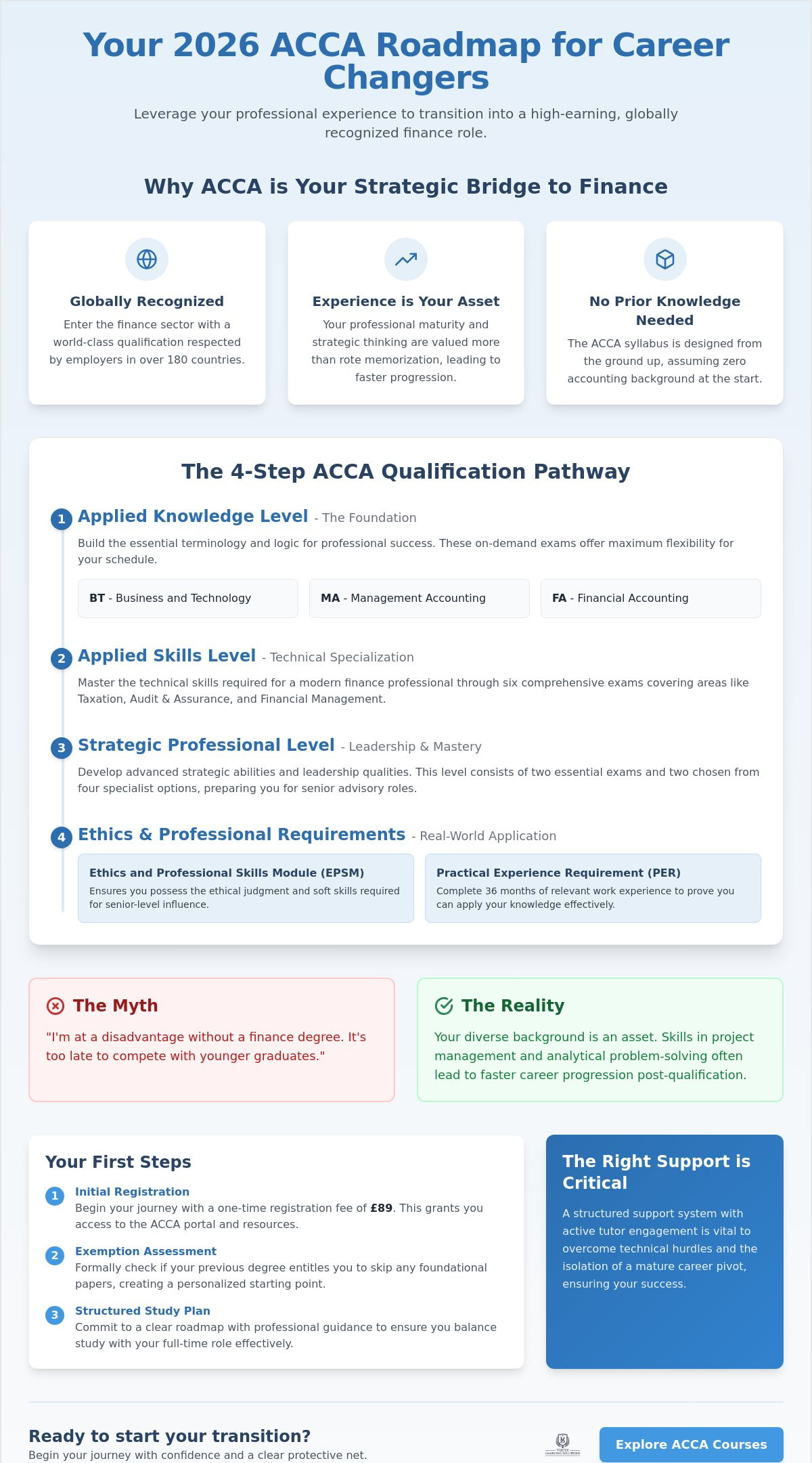
We understand that you need more than just a textbook; you require a structured roadmap that respects your time and validates your existing skills. This guide provides a definitive path for your 2026 transition, from understanding the initial £89 registration fee to mastering the 13-paper syllabus. You'll discover how to leverage the Ethics and Professional Skills Module and the Practical Experience Requirement to secure a high-earning role. We will preview the September 2026 syllabus updates and provide a clear, step-by-step strategy to ensure your exam success and professional stability.
Key Takeaways
- Understand how the ACCA qualification serves as a globally recognized bridge, allowing you to enter the finance sector by leveraging your professional maturity rather than starting from zero.
- Learn to navigate the initial Applied Knowledge level, specifically focusing on the foundational principles of Business and Technology (BT), Management Accounting (MA), and Financial Accounting (FA).
- Discover the strategic benefits of ACCA for non-accounting graduates, including how your existing skills in project management and analytical problem-solving often lead to faster career progression.
- Identify the critical role of a structured support system and active tutor engagement in overcoming the technical hurdles and isolation often associated with a mature career pivot.
Table of Contents
ACCA for Career Changers in 2026: Is It Too Late to Start?
Transitions are often met with hesitation, yet the 2026 financial landscape actively seeks the perspective of seasoned professionals. The Association of Chartered Certified Accountants (ACCA) provides a globally recognized bridge for those entering the sector without a traditional commerce degree. One of the primary benefits of ACCA for non-accounting graduates is that professional maturity is treated as a strategic asset. Senior finance roles require more than just technical calculation; they demand the judgment and leadership that only years of diverse experience can provide. It's never too late to pivot when the path is this clearly structured.
The year 2026 marks a pivotal era where digital-first accounting and remote global opportunities have lowered traditional barriers to entry. If you don't possess a prior degree, the Foundations in Accountancy (FIA) route offers a structured entry point that maintains the same rigorous standards. This ensures that your transition is based on a stable, logical progression rather than a frantic attempt to catch up. Your previous career isn't a distraction; it's the foundation of your future seniority.
The Myth of the Accounting Degree Requirement
Many prospective students believe they're at a disadvantage without a background in finance. It's a common misconception. The ACCA syllabus is specifically designed to assume zero prior knowledge at the Applied Knowledge level. Firms today highly value professionals from sectors like technology or healthcare because they bring unique analytical frameworks. Your background helps you understand the operational realities behind the numbers, making your insights more impactful than those of a fresh graduate. You aren't behind; you're just approaching the field from a different, often more valuable, angle.
Stability and Earning Potential in the 2026 Economy
Chartered accountancy remains a remarkably recession-proof profession. While other industries face volatility, the demand for structured financial oversight and strategic risk management continues to grow. The salary trajectory for a career changer is often accelerated. Starting as a trainee allows you to learn the technical foundations, but your previous experience often propels you into management roles far quicker once you become ACCA-qualified. You can explore our structured ACCA courses to begin this transition with professional confidence and a clear protective net.
Navigating the ACCA Roadmap from a Non-Finance Background
Entering a new profession requires a roadmap that eliminates guesswork and provides a clear sense of security. The first step involves a formal exemption assessment to determine if your previous degree entitles you to skip any foundational papers. While those with finance degrees might bypass certain modules, one of the primary benefits of ACCA for non-accounting graduates is the opportunity to build a flawless technical foundation from the ground up. You can start your accountancy career with total clarity by verifying your entry point through the official ACCA portal before committing to your first exam.
The journey is structured around three gateway exams: ACCA Business and Technology (BT), Management Accounting (MA), and Financial Accounting (FA). These papers are specifically engineered for those with zero finance background; they translate complex corporate concepts into logical, manageable frameworks. Once these are mastered, you'll progress through the six Applied Skills exams to develop technical specialization in areas like Taxation and Audit and Assurance. The final pillar of this roadmap is the Ethics and Professional Skills Module (EPSM). This module ensures you possess the leadership qualities and ethical judgment required for senior-level advisory roles.
Starting with Applied Knowledge: Your Finance Foundation
The ACCA Applied Knowledge modules provide the essential terminology and logic needed for professional success. These exams are on-demand, meaning you can sit them at any time of the year at a licensed center or via remote proctoring. This flexibility is vital for career changers who need to balance their learning with existing work commitments. It removes the pressure of rigid academic calendars and allows you to progress at a pace that matches your professional capacity.
Managing the Transition: Study Hours and Commitment
Success in these professional exams requires a disciplined approach rather than brute-force memorization. You should realistically allocate approximately 10 to 15 hours of study per week for each module. This commitment allows you to maintain a full-time role while making consistent, measurable progress. One of the key benefits of ACCA for non-accounting graduates is the ability to stagger these commitments over several years, ensuring you don't burn out. Utilizing strategic accounting exam study tips designed for mature learners can significantly reduce your stress. If you're looking for a structured environment to manage this workload, our dedicated ACCA support provides the professional protective net you need.
Leveraging Transferable Skills: Your Competitive Edge
Your previous career isn't a detour; it's a strategic advantage that fresh graduates simply don't possess. While younger candidates may have theoretical knowledge, they often lack the "soft" skills that drive corporate value. One of the most significant benefits of ACCA for non-accounting graduates is the ability to merge industry-specific expertise with elite financial training. Professional maturity allows you to navigate complex stakeholder relationships and manage high-pressure deadlines with a level of composure that employers prioritize in the 2026 market.
Career changers frequently find that they promote faster than their peers once they enter the finance sector. This acceleration happens because you've already mastered critical competencies such as project management, client communication, and analytical problem-solving in other contexts. To bridge the initial experience gap, we recommend passing the first three to four exams before applying for your first role. Demonstrating progress through the Applied Knowledge level proves your technical commitment, making you an attractive candidate for positions such as:
Junior Financial Analyst: Ideal for those with strong data or research backgrounds.
Accounts Assistant: A foundational role that provides exposure to ledger management.
Bookkeeper: Excellent for understanding the transactional flow of a business.
The Professional Hybrid Advantage
A former engineer who becomes an auditor, or a marketer who transitions into management accounting, possesses a "hybrid" perspective that is incredibly rare. You understand the operational friction points that a traditional accountant might miss. Refining this expertise through ACCA Applied Skills modules allows you to apply technical frameworks to real-world scenarios you've already lived through. This makes you a superior consultant or advisor because you speak the language of both the boardroom and the finance office.
Updating Your CV for the Finance Sector
Pivoting your CV requires a shift in focus toward numeracy and commercial awareness. Instead of listing past duties, highlight achievements where you managed budgets, analyzed data trends, or improved operational efficiency. Explicitly stating your progress in the ACCA syllabus serves as a powerful signal of your dedication. Employers aren't just looking for an accountant; they're looking for a strategic partner who understands how a business actually functions. If you're ready to start building this technical foundation, you can enroll in our comprehensive ACCA courses to secure your professional future.
Why the Right Support System is Critical for Career Changers
Navigating a career pivot requires more than just access to information; it demands a structured environment that mitigates the isolation of independent study. For many, the greatest benefits of ACCA for non-accounting graduates are realized only when technical hurdles are met with immediate, expert clarification. Passive learning through pre-recorded videos often leaves mature students struggling with complex concepts that aren't intuitive to those outside the finance sector. Direct tutor support via WhatsApp transforms this experience, providing a professional safety net where questions are answered in real-time, ensuring you never feel lost in the syllabus.
Efficiency is the priority for busy professionals. Swapping massive, generic textbooks for concise, exam-focused notes allows you to master the syllabus without drowning in irrelevant detail. This targeted approach respects your limited time, focusing strictly on what's required to pass. Weekly live sessions further enhance this by simulating a classroom environment, ensuring you remain engaged and accountable throughout the 2026 exam cycles. This structured proximity to experts provides an intellectual security that self-study simply cannot match.
Vertex Learning Solutions: Tailored for Professionals
Our ACCA online courses are specifically designed for career changers who require high-touch, elite expert proximity. We don't just provide content; we offer a strategic partnership through every stage of your qualification. For those committed to the full journey, our Full Access packages deliver a structured, cost-effective route that covers all levels from Applied Knowledge to Strategic Professional. This comprehensive approach ensures your professional transition is backed by a consistent, high-quality protective net.
Success in 2026: Balancing Life, Work, and ACCA
Our weekly live sessions provide a seamless classroom-at-home experience that integrates directly into your professional schedule. With four exam sessions available in 2026, including the September session with a standard entry deadline of July 27, you have the flexibility to plan your progress meticulously. One of the key benefits of ACCA for non-accounting graduates is this inherent flexibility, allowing you to maintain your current income while building your future. Take the first definitive step toward your new career by enrolling in the ACCA Business and Technology (BT) module today.
Securing Your Professional Future in Finance
The transition into a high-earning finance career is no longer restricted to those with specialized undergraduate degrees. By merging your industry experience with the technical rigour of this qualification, you position yourself as a strategic asset in the 2026 economy. The benefits of ACCA for non-accounting graduates extend beyond simple certification; they offer a logical path to professional stability and enhanced earning potential. Success requires a disciplined adherence to the roadmap, from foundational exams to strategic leadership modules.
You don't have to manage this intense commitment alone. A structured support system is essential for maintaining your career momentum while you study. We provide a professional protective net that includes tutor support via WhatsApp for every student and weekly live sessions for real-time engagement. Our exam-focused study notes are specifically designed for busy professionals, ensuring your preparation is efficient and targeted. Start your career pivot today with VLS ACCA Courses and transform your professional background into a global finance career. It's time to build the future you deserve.
Frequently Asked Questions
Do I need a degree to start ACCA as a career changer?
No, you don't strictly require a degree to begin your qualification journey. The Foundations in Accountancy (FIA) route serves as a structured entry point for those without prior higher education, allowing for a seamless transition into the main syllabus. This accessibility is one of the primary benefits of ACCA for non-accounting graduates who may have entered the workforce through diverse or non-traditional paths.
How long does it typically take to complete ACCA while working full-time?
Most professionals who are balancing full-time employment complete the 13 required papers within three to four years. By utilizing the four exam sessions available annually in March, June, September, and December, you can pace your studies to maintain professional stability. A disciplined strategy of attempting one paper per session is often the most sustainable approach for mature learners.
Is ACCA harder for people coming from a non-mathematical background?
The syllabus prioritizes logical reasoning, commercial awareness, and data interpretation over advanced mathematical theory. One of the significant benefits of ACCA for non-accounting graduates is that the Applied Knowledge level is specifically designed to build technical understanding from the ground up. You don't need to be a mathematician to succeed; you simply need a disciplined, analytical approach to problem-solving.
Can I get an accounting job before I finish all my ACCA exams?
Yes, you can certainly secure a relevant role well before completing the full qualification. Many employers actively seek trainees who have passed their initial modules, such as Business and Technology (BT), as it signals a verified commitment to the profession. Your previous career experience often qualifies you for Junior Analyst or Accounts Assistant roles while you continue your studies.
What is the cost of starting ACCA for a career changer in 2026?
The initial financial commitment in 2026 includes a one-time registration fee of £89 and an annual student subscription of £140. As you progress, you'll encounter standard entry fees such as £173 for Applied Skills exams. This pay-as-you-go structure provides a manageable financial roadmap, allowing you to invest in your professional future without the burden of upfront tuition costs for the entire qualification.