Vertex Learning Solutions


The traditional shortcut between ACCA and CPA Canada is officially a thing of the past, but this doesn't mean your international credentials have lost their value in the North American market. It's understandable to feel a sense of unease regarding the expired Mutual Recognition Agreement or the 2026 transition making national CPA Canada membership optional. You're likely seeking a career path that provides both global mobility and local professional standing without the fear of your hard-earned qualifications being ignored. When evaluating the long-term ROI of an ACCA vs accounting degree, the choice depends on whether your goals are rooted in local public practice or high-level international management.
This comparison provides the clarity you need to navigate the "Member of an accounting body outside Canada" pathway with confidence. You'll discover the critical differences in curriculum, provincial recognition, and the specific bridging requirements for 2026. We examine how to strategically position your skills to ensure your professional transition is both secure and efficient, allowing you to build a career that is respected both in Canada and across the globe.
Key Takeaways
- Understand the current regulatory shift following the expiration of the Mutual Recognition Agreement and how it affects your professional standing in 2026.
- Evaluate the strategic value of the ACCA vs accounting degree when deciding between a versatile global career or a specialized role within the Canadian regulatory framework.
- Identify the core curriculum distinctions between ACCA’s international IFRS focus and the Canadian-specific standards required for local public practice and taxation.
- Learn the exact procedural steps for transitioning international credentials through provincial assessments to ensure your professional path is secure and recognized.
- Gain a clear decision matrix to align your choice of designation with your specific long-term goals, whether in multinational corporations or local Canadian firms.
Table of Contents
ACCA vs CPA Canada: Understanding the 2026 Landscape
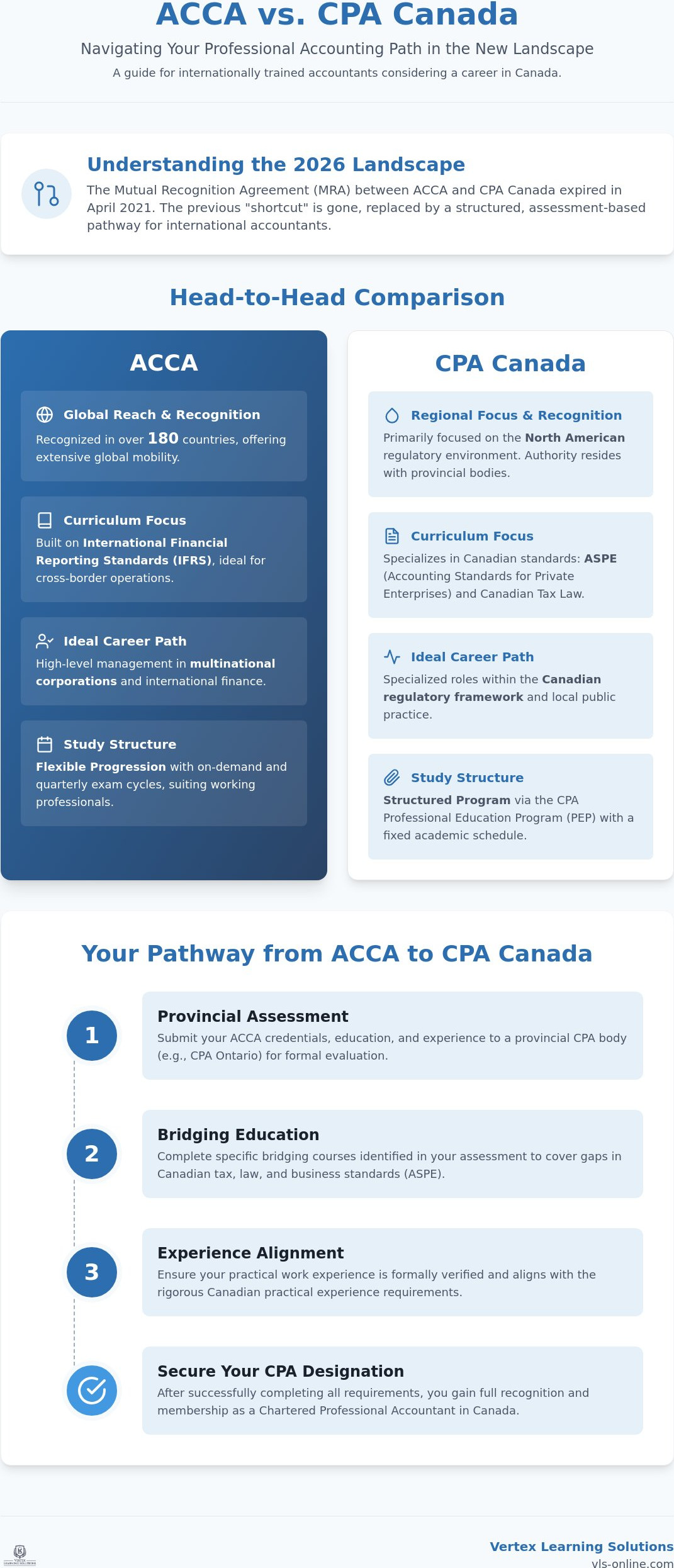
The Association of Chartered Certified Accountants (ACCA) operates as a centralized global entity, providing a standardized qualification recognized in over 180 countries. In contrast, CPA Canada functions as a federated national organization where the actual regulatory authority resides within individual provincial bodies. This structural distinction is the primary reason why the Mutual Recognition Agreement (MRA) between the two entities, which expired in April 2021, remains unrenewed as of July 2026. The shift has replaced a direct "shortcut" with a more structured, assessment-based transition.
Deciding between an ACCA vs accounting degree often represents the first strategic crossroads for aspiring professionals. While a university degree provides the theoretical foundation, the ACCA qualification offers a professional protective net for those targeting multinational corporations or financial services. These paths aren't mutually exclusive. In fact, many high-level professionals view them as complementary, using the global reach of the ACCA to support the local specialization required by Canadian regulators.
The Reality of Recognition in Canada
Professional recognition in Canada is no longer a monolithic process. Each province maintains its own criteria for internationally trained accountants. For instance, CPA Ontario and CPA British Columbia have distinct assessment protocols that evaluate an applicant’s specific education and experience. The current CPA structure itself is the result of the 2014 merger of three legacy designations: Chartered Accountants (CA), Certified Management Accountants (CMA), and Certified General Accountants (CGA). This history of consolidation means that Canadian standards are deeply integrated into the local provincial fabric.
As of 2026, the entry pathway for international accountants requires a formal assessment by a provincial CPA body to determine specific bridging education requirements and practical experience alignment. This "Member of an accounting body outside Canada" pathway ensures that your global expertise is verified against the rigorous local standards of the Canadian market. Professionals who navigate this process successfully often find that their international background provides a significant advantage in understanding complex, cross-border financial reporting and IFRS compliance.
Curriculum and Global Mobility: A Strategic Comparison
The choice between ACCA vs accounting degree involves more than just selecting a credential; it's a decision about the technical language you wish to speak throughout your career. ACCA’s curriculum is built on International Financial Reporting Standards (IFRS), providing a universal framework for cross-border operations. CPA Canada focuses heavily on Accounting Standards for Private Enterprises (ASPE) and specific Canadian tax laws. While the CPA Professional Education Program (PEP) is designed specifically for the domestic market, the ACCA's 13-paper journey equips students with a broader, more diverse toolkit. This global reach is evident in ACCA's presence in over 180 countries, whereas CPA Canada remains primarily focused on the North American regulatory environment.
Technical Standards: IFRS vs. Canadian GAAP
For those targeting senior roles in Canadian multinationals, possessing deep Diploma in IFRS knowledge is a major asset that bridges the gap between local reporting and global consolidation. Practitioners in Canada must master local tax and law to serve domestic clients effectively. IFRS expertise is a competitive advantage in the 2026 Canadian job market because it allows professionals to manage the complex financial reporting requirements of organizations with international footprints. You can find detailed guidance on how the national body views these qualifications on the CPA Canada International Credential Recognition page.
Flexibility and Study Pace
ACCA provides significant advantages in terms of progression speed. Its on-demand and quarterly exam cycles allow students to move at their own pace, unlike the fixed academic schedule of the CPA PEP. This flexibility is vital for professionals balancing full-time employment with their studies. To reach the highest levels of management, the ACCA Strategic Professional modules prepare you for senior global roles by emphasizing leadership and strategic reporting. If you're looking for a structured way to start this journey, exploring exam-focused ACCA courses can provide the necessary stability and support during your preparation.
The Pathway to Canada: Transitioning from ACCA to CPA
Transitioning from a global designation to a Canadian CPA is a strategic process that requires meticulous planning. Since the direct mutual recognition expired, your path is defined by a provincial assessment that respects your international expertise while ensuring local compliance. When weighing the benefits of an ACCA vs accounting degree, the professional qualification serves as a robust platform for this transition, often providing a more streamlined entry into the Canadian professional environment than a standard academic degree alone.
- Step 1: Complete the full ACCA qualification and gain 36 months of verified practical experience.
- Step 2: Apply for a formal assessment with your chosen provincial body, such as CPA Ontario, to determine your specific entry point.
- Step 3: Enroll in required bridging modules, which almost always include Canadian Taxation and Canadian Business Law.
- Step 4: Successfully challenge the Common Final Exam (CFE) if the provincial assessment deems it necessary for your certification.
For many professionals, the debate between pursuing an ACCA vs accounting degree ends when they realize that professional certifications offer a more globally portable skillset. This portability is vital when navigating the "Member of an accounting body outside Canada" pathway, as it demonstrates a proven level of technical mastery to provincial regulators.
Work Experience Requirements (PER)
The ACCA Practical Experience Requirement (PER) and the Canadian mentored experience model share a commitment to competency, but their documentation styles differ. To ensure your international experience counts, you'll need to map your past roles to the specific technical and enabling competencies required by Canadian provinces. This alignment is critical; it proves you've handled the level of responsibility expected of a professional in the Canadian market. You don't want to leave this to chance, so meticulous record-keeping is your best defense against potential non-recognition.
Employment Opportunities for ACCA Members
The Canadian job market remains highly receptive to international talent, especially within the Big 4 firms and the burgeoning technology sector. These organizations value the IFRS depth that ACCA members bring to the table. Navigating the bridging exams while working can be demanding, but you can streamline the process by leveraging strategic accounting exam study tips to maximize your efficiency. If you're currently preparing for your next sitting, accessing our exam-focused ACCA courses can provide the expert support needed to secure your professional future.
Decision Matrix: Which Route Should You Choose in 2026?
Choosing between the ACCA vs accounting degree or the CPA Canada designation requires a precise alignment with your long-term residency goals and career specialization. The decision isn't merely about education; it's about the regulatory environment in which you intend to practice. Your choice should reflect a strategic assessment of where you want to be in five years and the level of professional protection you require.
- Choose ACCA if: You prioritize global mobility, aim for leadership roles in multinational corporations, or are currently based outside Canada and wish to build a recognized foundation before migrating.
- Choose CPA Canada if: Your primary objective is a permanent career within Canada focusing on domestic public audit, statutory reporting, or taxation for small-to-medium local firms.
For many professionals, the most resilient approach is a hybrid strategy. Starting with ACCA Applied Skills allows you to build a rigorous technical foundation while still in your home country. This proactive approach mitigates the risks associated with migration, ensuring you arrive in Canada with a credential that is already respected by global recruiters. Vertex Learning Solutions facilitates this through expert tutor support and flexible ACCA courses, providing a professional safety net throughout your journey.
Cost and Time Efficiency
The financial investment for each path varies based on provincial requirements and your previous educational background. In 2026, mandatory membership fees for provincial bodies like CPABC are $955 plus tax, which does not include the costs for the Professional Education Program (PEP). ACCA’s structure includes registration, annual subscriptions, and individual exam fees. To optimize your investment, utilizing 'Full Access' bundles can significantly reduce overall expenditure, providing a structured and predictable path toward certification without the hidden costs of fragmented study materials.
Final Verdict for the 2026 Finance Professional
In an economy increasingly shaped by automation and artificial intelligence, the "Global Accountant" mindset is the most secure professional strategy. Technical proficiency is now the baseline; strategic insight and cross-border adaptability are the true differentiators. Whether you are weighing the merits of an ACCA vs accounting degree, the key is to begin with a clear understanding of your career trajectory. Your next step involves a candid assessment of your current level and the selection of your first module to begin building your professional protective net.
Securing Your Professional Future in a Global Economy
Navigating the transition between international standards and Canadian requirements demands a strategic, long-term perspective. The expiration of the Mutual Recognition Agreement has fundamentally changed the landscape, making provincial assessments the definitive gateway to practicing in Canada. While the debate over ACCA vs accounting degree often focuses on immediate entry, the true value lies in how a professional designation provides a structured protective net for your career. By choosing a path that balances global mobility with localized bridging, you ensure your expertise remains relevant in both the North American and international markets.
Vertex Learning Solutions stands as your strategic partner in this journey, providing the stability and expert guidance needed to master complex regulations. You'll benefit from expert tutor support via WhatsApp and weekly live interactive sessions, ensuring no question remains unanswered. With exam-focused study materials for 2026 sittings, you can progress with the confidence that your preparation meets the highest professional standards. Start your global accounting journey with Vertex's ACCA preparation courses today. Your commitment to excellence is the most reliable asset you possess; we are here to ensure it yields the professional results you deserve.
Frequently Asked Questions
Is ACCA equivalent to CPA in Canada for 2026?
ACCA is not automatically equivalent to a Canadian CPA designation as of 2026. Following the expiration of the Mutual Recognition Agreement, provincial bodies require a case by case assessment of your credentials. While your global expertise is respected, you must fulfill specific bridging requirements to use the CPA title locally. This ensures all practitioners meet the precise regulatory standards of the Canadian market.
Can I get a PR in Canada with an ACCA qualification?
While an ACCA qualification itself isn't a visa, it serves as a powerful asset for your Express Entry application. World Education Services (WES) often evaluates the full ACCA qualification as equivalent to a three year Canadian degree or a master's degree. This recognition boosts your CRS points, directly improving your chances of receiving an Invitation to Apply (ITA) for Permanent Residency.
How many exams do ACCA members have to take for CPA Canada?
The exam requirements are determined by your specific provincial CPA assessment. Typically, ACCA members must complete bridging modules in Canadian Taxation and Canadian Business Law before challenging the Common Final Exam (CFE). Some provinces may grant further exemptions based on your years of post qualification experience, making the transition more efficient for seasoned professionals.
What is the average salary for an ACCA member in Canada vs. a CPA?
Compensation levels depend heavily on your sector and the regulatory requirements of your role. Canadian CPAs often earn higher salaries in public practice and statutory audit due to licensing requirements. However, in the corporate sector, the strategic depth of an ACCA vs accounting degree is highly valued. Senior finance roles in multinational firms frequently offer salaries exceeding six figures for those with global reporting expertise.
Can I study ACCA while living in Canada?
Studying for the ACCA while residing in Canada is entirely feasible through online learning platforms. Exams are conducted at designated centers across major cities or through secure remote invigilation for many modules. This allows you to maintain your global professional standing and complete your qualification while simultaneously building your local work experience within the Canadian economy.