
ACCA vs CIMA Difficulty: Which Accounting Qualification is Harder in 2026?
Struggling with ACCA vs CIMA difficulty? Our 2026 guide analyzes pass rates & exam structures to help you choose the right path for your career goals & stren...
In this article
Ready to qualify online?
Get full access to expert-led ACCA & CIMA exam preparation with live tutor support.
Explore Full AccessWhat if the perceived difficulty of your professional path has less to do with the volume of content and more to do with how your brain processes logic versus strategic ambiguity? It's natural to feel a sense of apprehension when evaluating the ACCA vs CIMA difficulty, especially when the fear of committing years to the wrong syllabus weighs heavily on your career trajectory. You want to ensure your investment leads to a designation that complements your cognitive strengths rather than fighting against them.
This guide offers an objective assessment of these qualifications by examining verified pass rates and exam structures for 2026. You'll gain a clear understanding of which framework aligns with your professional goals and "brain type." We'll examine the technical depth of ACCA against the management focus of CIMA, providing the clarity you need to choose your path with absolute certainty and implement strategies to mitigate the risk of failure.
Key takeaways
- Evaluate the fundamental ACCA vs CIMA difficulty through the lens of your professional strengths, whether they lie in technical audit precision or strategic management reporting.
- Compare the 13-exam ACCA journey with CIMA’s 12-exam framework to understand how session-based cycles and objective tests influence your long-term completion timeline.
- Identify why mastering specific exam techniques and seeking structured feedback are more critical for success than theoretical knowledge alone in high-pressure modules.
- Establish a robust study strategy that leverages expert tutor support and real-time guidance to maintain professional momentum and effectively mitigate the risk of failure.
Technical Depth vs. Strategic Breadth: Understanding the Core Differences
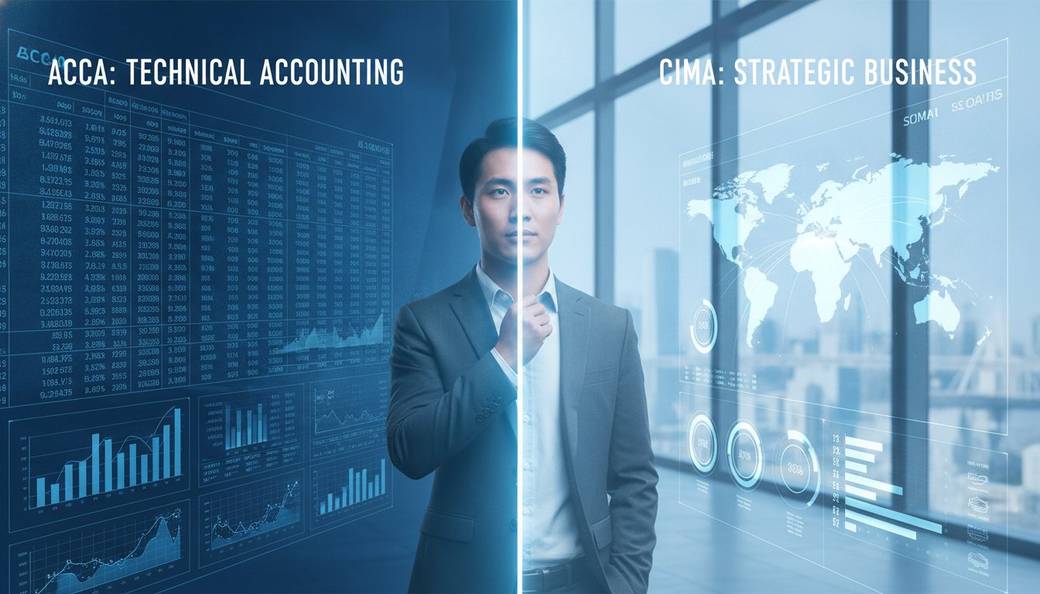
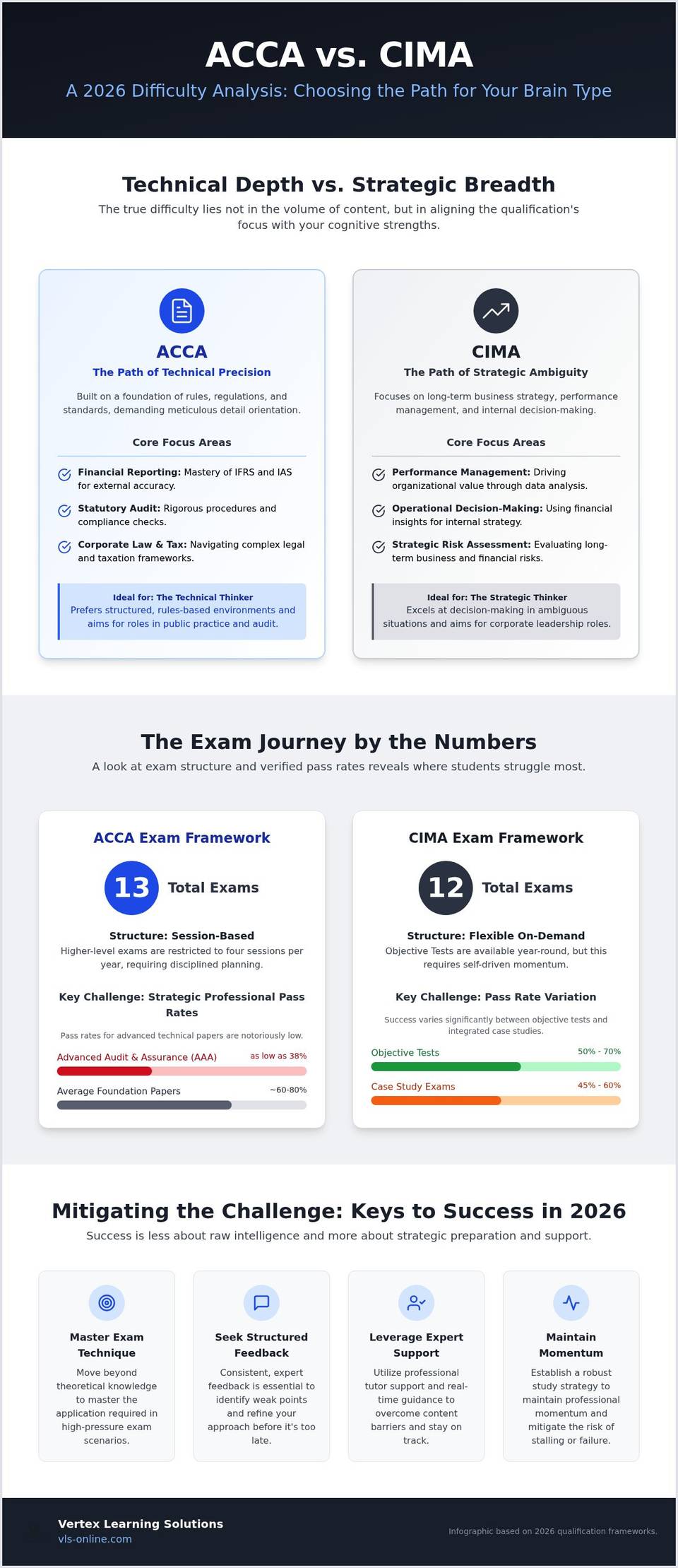
The debate surrounding ACCA vs CIMA difficulty often overlooks the fundamental distinction in cognitive application. ACCA is built upon a foundation of technical precision, requiring candidates to master complex tax laws, rigorous audit procedures, and international financial reporting standards. It demands a high level of detail orientation. Conversely, CIMA challenges students through strategic ambiguity; it focuses on cost management, organizational performance, and long-term business strategy.
Choosing the right path depends on your natural intellectual inclination. Technical thinkers often find the structured, rules-based environment of the Association of Chartered Certified Accountants (ACCA) more intuitive. Business-oriented individuals, however, may prefer the decision-making focus of CIMA. It's a common misconception that ACCA's 13 exams make it objectively harder than CIMA's 12-exam structure. Tallying papers is a poor metric. Difficulty is defined by the depth of the syllabus and the application of logic, not merely the number of exams on your dashboard.
The Syllabus Split: Financial vs. Management Accounting
The ACCA courses prioritize external reporting and regulatory compliance, ensuring that every financial statement meets strict IFRS or IAS requirements. This contrasts sharply with CIMA, where the curriculum centers on internal decision-making and driving organizational value through data analysis.
ACCA core focus: Financial reporting accuracy, statutory audit, and corporate law.
CIMA core focus: Operational decision-making, performance management, and strategic risk assessment.
While ACCA prepares you for public practice and audit, CIMA grooms you for leadership roles within a corporate structure. Syllabus density represents the primary hurdle for first-year students who must adapt to a high volume of foundational concepts. Success requires a transition from simple memorization to professional application within complex, simulated business environments.
Exam Structure and Pass Rates: Where Students Struggle Most
The architectural differences between these two paths significantly impact how students experience pressure. ACCA requires the completion of 13 exams, moving from Applied Knowledge to the rigorous Strategic Professional level. In contrast, the CIMA Professional Qualification involves 12 exams. While ACCA higher-level papers are restricted to four sessions per year, CIMA offers greater flexibility through year-round Objective Tests. This flexibility can be a double-edged sword; without a fixed deadline, some students struggle with consistent momentum.
Pass rates provide an objective look at the ACCA vs CIMA difficulty. While foundational papers show high success, Strategic levels in both qualifications see a significant drop. Consider these verified benchmarks:
ACCA Advanced Audit and Assurance (AAA): Pass rates often dip as low as 38%.
CIMA Objective Tests: Success rates usually hover between 50% and 70%.
CIMA Case Study Exams: Typically range from 45% to 60%.
The challenge in CIMA lies in synthesizing three distinct pillars into one high-stakes business simulation, whereas ACCA tests your ability to handle deep technical complexity within a modular format.
The 'Case Study' Hurdle vs. The 'Technical Paper' Grind
For many, the peak of difficulty in ACCA is the technical grind of papers like Strategic Business Reporting (SBR). Success here demands absolute mastery of accounting standards and regulatory frameworks. If you prefer this structured, technical modularity, exploring ACCA online courses can help you build the necessary precision. CIMA's Strategic Case Study (SCS) presents a different challenge. It places you in the role of a CFO where you must navigate strategic ambiguity and provide high-level business advice. Vertex Learning Solutions provides the expert tuition required to bridge these gaps, ensuring you don't just study, but perform.
Mitigating the Challenge: How to Navigate Professional Exams in 2026
Success in professional accounting isn't merely a byproduct of high intelligence. Most students who falter do so because they lack consistent feedback and refined exam technique. When analyzing ACCA vs CIMA difficulty, it's clear that the sheer volume of content often leads to a frustration barrier where progress stalls. This is where strategic support becomes essential. According to Kaplan's analysis of ACCA vs CIMA, the choice often hinges on whether your career path favors technical audit or corporate management. Regardless of the route, the right study materials act as a difficulty-reducer rather than just a passive source of information.
Vertex Learning Solutions addresses these hurdles through active tutor support via WhatsApp. This immediate access allows you to clarify complex accounting standards or strategic models in real-time, preventing small misunderstandings from becoming major obstacles. Weekly live sessions further enhance this by simulating the time-sensitive pressure of the actual exam environment. These sessions provide a professional protective net, ensuring you're not navigating the intricacies of the syllabus alone. Having a mentor who sees the connections in the regulations provides the intellectual security needed to proceed with confidence.
Building a 2026 Study Strategy for Success
Your first priority is assessing your long-term career goals. If your objective is public practice or audit, ACCA remains the gold standard. For those aiming for strategy and operations, CIMA offers the necessary framework. Once decided, you should invest in comprehensive exam preparation that integrates personalized tutor feedback. For more detailed guidance on optimizing your routine, consult our Accounting Exam Study Tips. This structured approach transforms ACCA vs CIMA difficulty from an intimidating hurdle into a manageable professional milestone.
Securing Your Professional Future in 2026
Navigating the ACCA vs CIMA difficulty requires a clear-eyed assessment of your cognitive strengths and career aspirations. Whether you prioritize the technical precision of ACCA or the strategic ambiguity of CIMA, success is rarely a matter of raw intelligence alone. It's about the quality of your professional protective net. By integrating expert guidance and structured feedback into your study routine, you transform these high-stakes exams into manageable milestones. Vertex Learning Solutions provides the infrastructure you need to succeed, offering WhatsApp tutor support, weekly live interactive sessions, and exam-focused study notes tailored for the 2026 candidate. Don't leave your certification to chance; choose a strategic partner that understands the complexity of the modern accounting environment. Start your journey with Vertex: Explore our ACCA and CIMA Online Courses and move forward with absolute confidence in your professional trajectory.