
ACCA PM Exam Techniques: The 2026 Strategic Guide to Passing Performance Management
Master the essential ACCA PM exam techniques for 2026. This guide shifts focus from calculation to strategic interpretation to help you pass with confidence.
In this article
Ready to qualify online?
Get full access to expert-led ACCA & CIMA exam preparation with live tutor support.
Explore Full AccessThe ACCA Performance Management exam isn't actually a math test. While calculations provide the foundation, the majority of marks reside in your ability to interpret data and offer strategic insight. Many candidates reach the final hour with perfect formulas but no time left to explain what those figures mean for the business. It’s a common struggle that leads to unnecessary pressure on results day. This guide equips you with the specific ACCA PM exam techniques and strategic mindset needed to navigate the 2026 syllabus with absolute precision.
You'll discover how to master CBE spreadsheet functionality for maximum efficiency and learn a structured framework for written answers that satisfies markers. We'll also break down the logic behind "tricky" Section A distractors so you can approach every question with the calm confidence of a seasoned professional. By simplifying the complexity of the exam environment, we ensure your technical knowledge translates into a secure, passing score.
Key takeaways
- Shift your focus from rote calculation to strategic interpretation by adopting the examiner's perspective on core business objectives.
- Refine your Section C performance using the "Point, Explain, Apply" framework to ensure every sentence contributes toward a passing score.
- Master the specific 2026 ACCA PM exam techniques required to link spreadsheet data seamlessly into your word processor discussions.
- Validate your readiness by completing full mock exams on the official CBE platform and analyzing common pitfalls identified in recent examiner reports.
Decoding the PM Mindset and Section A & B Tactics
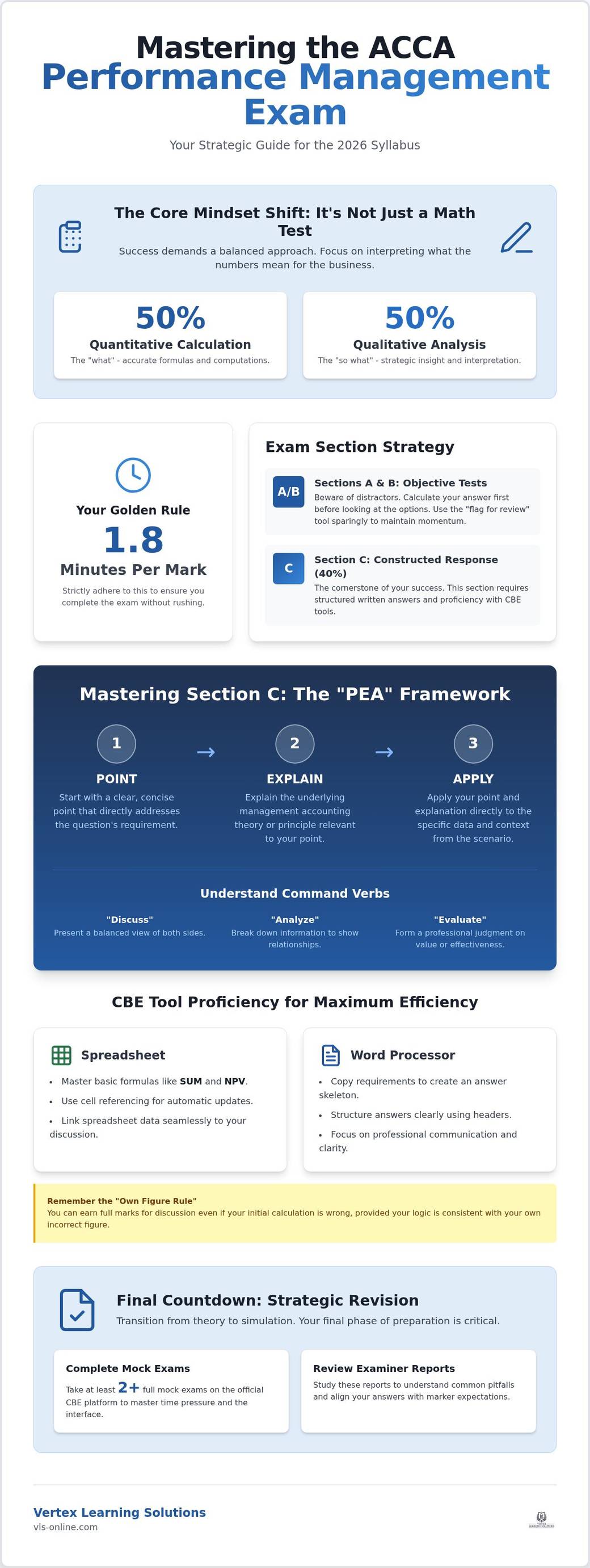
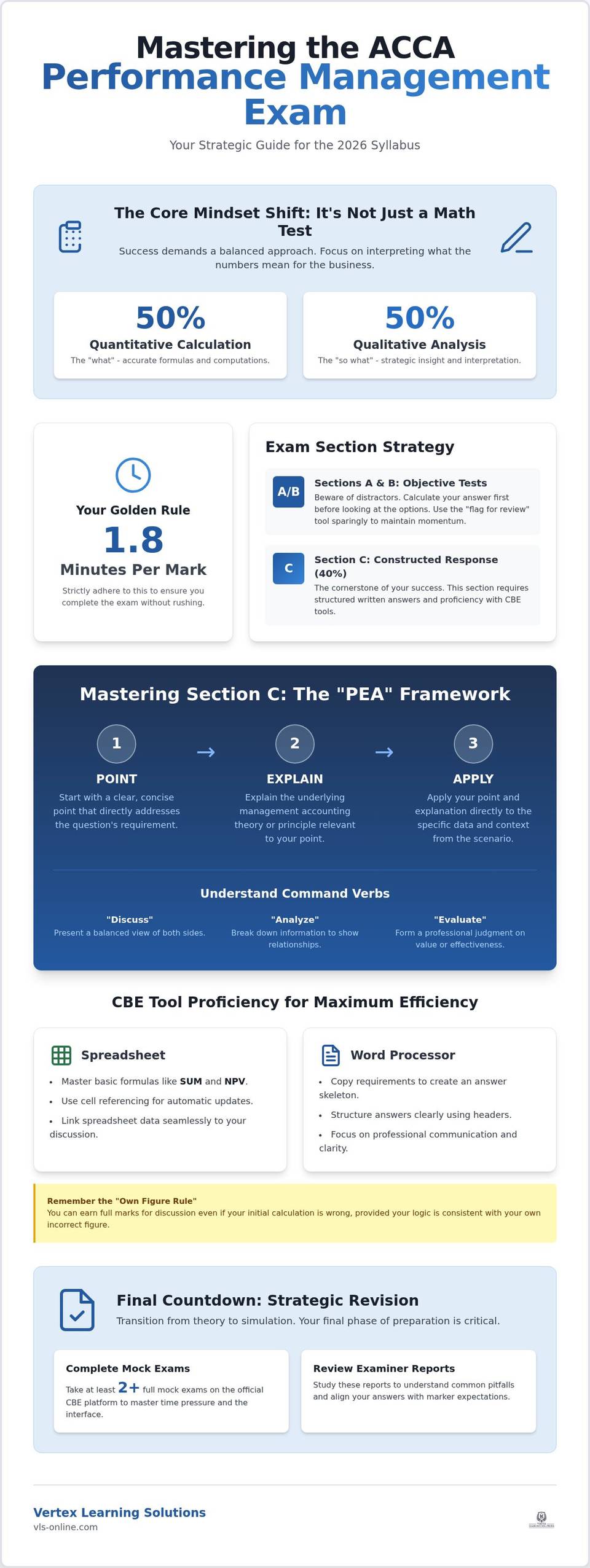
Success in Performance Management begins with a fundamental shift in perspective. You must recognize that the syllabus demands a balanced 50/50 split between quantitative calculation and qualitative discursive analysis. Many candidates fail because they over-invest in complex formulas while neglecting the strategic "why" behind the numbers. To excel, adopt the examiner’s view by identifying the core business objective within every scenario. Ask yourself whether the goal is to optimize a scarce resource or to evaluate divisional performance. This mindset ensures your answers remain relevant to the specific corporate context.
Precision in time allocation is your primary safeguard against exam-room fatigue. You should strictly adhere to a limit of 1.8 minutes per mark. This discipline prevents you from over-explaining a two-mark question at the expense of a high-value Section C requirement. Maintaining this pace requires a calm, methodical approach to every page.
Navigating Objective Test Case Challenges
Section A and B rely on Objective Test questions, where examiners frequently use sophisticated distractors. These are plausible but incorrect options designed to catch common errors, such as forgetting a fixed cost or misapplying a variance formula. One of the most effective ACCA PM exam techniques is to perform your calculation independently before viewing the options. If your result isn't there, re-evaluate your assumptions immediately.
Efficiency is key. Use the "flag for review" tool sparingly to maintain your momentum; don't let a single difficult item disrupt your rhythm. Remember that PM builds directly upon ACCA Applied Skills foundational knowledge. Success requires a stable grasp of these basics combined with the analytical depth needed for 2026 standards. These ACCA PM exam techniques turn a daunting syllabus into a manageable, structured path toward professional certification.
Mastering Section C: Structure and CBE Tool Proficiency
Section C is the cornerstone of your success, providing 40% of the total marks available. High-scoring candidates don't just calculate; they communicate. One of the most effective ACCA PM exam techniques is the "Point, Explain, Apply" (PEA) framework. You start with a clear point, explain the underlying management accounting theory, and then apply it directly to the scenario's specific data. This structured approach ensures your answer remains focused, professional, and easy for the marker to follow.
You must also identify the specific depth required by command verbs. While "Discuss" invites a balanced view of both sides, "Analyze" requires you to break the information down to show how various components relate. "Evaluate" demands a professional judgment on the value or effectiveness of a specific business strategy. Mastering these ACCA PM exam techniques is essential for securing the higher-level marks that separate a pass from a fail.
The Spreadsheet and Word Processor Advantage
Efficiency in the CBE environment depends on your proficiency with the built-in software. Master basic formulas like SUM and NPV, and use cell referencing to ensure that any updates to your data flow through your entire calculation automatically. This saves vital minutes and reduces clerical errors. You can also copy and paste key requirements or headers from the scenario directly into your word processor to create an instant answer skeleton. If you're looking to refine these technical skills, exploring the ACCA PM courses at VLS provides the hands-on practice needed for the 2026 syllabus. Finally, remember the "own figure rule," which guarantees that even if a calculation is incorrect, you can still earn full marks for the subsequent discussion if your logic remains consistent with your initial result.
Final Countdown: Mock Exams and Strategic Revision
The transition to the final revision phase requires a disciplined shift from theory to simulation. Completing at least two full mock exams within the official CBE practice platform is a non-negotiable requirement for success. This process familiarizes you with the interface and tests your ability to apply ACCA PM exam techniques under genuine time pressure. It's during these sessions that you'll discover if your time management holds up when faced with complex data sets and multi-layered requirements.
Reviewing official examiner reports is equally critical. These documents highlight where global candidates typically lose marks, often by failing to read the specific requirements of a question or by providing generic answers that lack application. By studying these patterns, you avoid common pitfalls and align your technical knowledge with the marker’s expectations. You should also balance your technical deep-dives with broader accounting exam study tips to maintain the mental endurance needed for a three-hour professional assessment.
Leveraging Expert Support for PM Success
Online study doesn't have to be an isolated experience. At Vertex Learning Solutions, our WhatsApp tutor support provides a professional safety net, allowing you to clarify complex variances or decision-making models in real-time. Weekly live sessions further simulate a classroom environment, where you can troubleshoot difficult topics with peers and experts alike. For those seeking a structured, mentor-led path to the 2026 exams, our comprehensive ACCA courses provide the resources and community necessary to turn your preparation into a definitive pass. These ACCA PM exam techniques, combined with dedicated support, ensure you enter the exam hall with absolute confidence.
Securing Your Professional Future in Performance Management
Success in the 2026 syllabus requires more than just a grasp of variances and budgeting models. It demands a sophisticated integration of CBE tool proficiency and a structured approach to discursive requirements. By mastering the PEA framework and committing to rigorous mock exam simulations, you transform theoretical knowledge into the professional insight markers expect. Refining your ACCA PM exam techniques is a continuous process of alignment between technical accuracy and strategic execution.
You don't have to navigate this complex landscape alone. With expert tutor support via WhatsApp, comprehensive 2026 study notes, and weekly interactive live sessions, Vertex Learning Solutions serves as your professional safety net. Enroll in the VLS ACCA Performance Management Course today to ensure your preparation is both structured and effective. We're here to provide the stability and expertise you need to approach your exam with absolute confidence.