
ACCA FR Practice Questions and Answers: The Strategic 2026 Success Guide
Ace the 2026 exam with our guide to ACCA FR practice questions and answers. Master IFRS, improve speed, and learn expert techniques to pass Financial Reporting.

In this article
Ready to qualify online?
Get full access to expert-led ACCA & CIMA exam preparation with live tutor support.
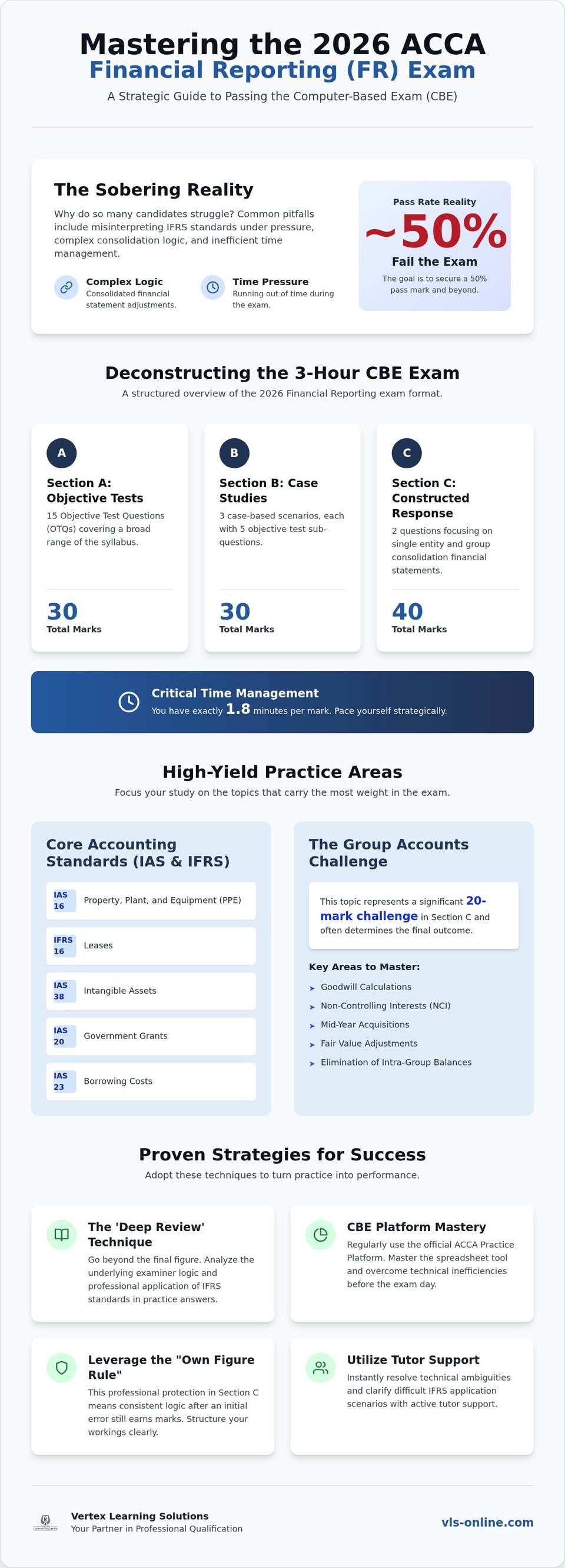
Explore Full AccessWhy do nearly half of all candidates fail the Financial Reporting exam when the syllabus remains stable for the 2026-2027 cycle? It's a sobering reality that many students struggle with the intricate logic of consolidated financial statement adjustments or find themselves misinterpreting IFRS standards under the pressure of a ticking clock. You've likely felt the frustration of running out of time during mock exams, realizing that simply reading the textbook isn't enough to secure a pass. To achieve the 50% pass mark and beyond, you need a disciplined approach centered on high-quality ACCA FR practice questions and answers that simulate the rigorous computer-based environment.
This strategic guide is designed to provide the professional protective net you need for the 2026 exam cycle. We'll show you how to master Section C constructed response questions with expert-led answering techniques and improve your calculation speed for vital accounting ratios. By focusing on the structural application of IAS/IFRS standards rather than rote memorization, you'll develop the calm confidence required to navigate Section B case studies. We'll explore the specific logic behind marking schemes, ensuring your preparation is both methodical and results-oriented.
Key takeaways
- Understand the 2026 CBE format, specifically how mastering Section A and B objective test questions provides a critical safety net for your overall score.
- Prioritize high-yield accounting standards like IAS 16 and IFRS 16 to build a robust foundation for Section B case studies and Section C constructed responses.
- Leverage targeted ACCA FR practice questions and answers to refine your calculation speed and precision when handling complex consolidated financial statement adjustments.
- Adopt the 'Deep Review' technique to analyze the underlying examiner logic, ensuring you understand the professional application of standards rather than just the final figure.
- Utilize active WhatsApp tutor support to instantly resolve technical ambiguities and clarify difficult application scenarios within the IFRS framework.
Analyzing the 2026 ACCA FR Exam Format and Question Styles
The 2026 Financial Reporting (FR) exam remains a rigorous assessment of both technical proficiency and practical application. Administered by the Association of Chartered Certified Accountants (ACCA), the three-hour computer-based exam (CBE) is structured into three distinct sections. Section A contains 15 objective test questions (30 marks), while Section B features three case-based scenarios with five sub-questions each (30 marks). These first two sections serve as your professional safety net. Scoring highly in these objective areas reduces the immense pressure of the 40-mark Section C. To achieve this, your study regimen must prioritize high-quality ACCA FR practice questions and answers that mirror the actual exam interface.
Technical proficiency extends beyond accounting theory; it requires mastery of the digital environment. Many candidates lose marks not through lack of knowledge, but through technical inefficiency in the CBE spreadsheet tool. Common pitfalls include failing to use cell references for calculations or struggling with the lack of "drag-and-fill" functionality found in commercial software. Utilizing the official ACCA Practice Platform is non-negotiable for familiarization. It ensures that when you sit for the actual exam, the software feels like a helpful tool rather than an obstacle to your success.
Section C: Mastering the Constructed Response Questions
Section C demands a deeper level of synthesis, focusing heavily on single entity financial statement preparation and group consolidations. Success here isn't just about the final tally. It's about the transparency of your process. The "own figure rule" is a critical professional protection; it ensures that if you make an early calculation error, you aren't penalized repeatedly throughout the question, provided your subsequent logic remains consistent. Clear labeling of workings and structured spreadsheet layouts are the best ways to secure these vital marks.
Time Management Strategies for the 3-Hour Exam
Discipline is the hallmark of a professional. You have exactly 1.8 minutes per mark. When working through ACCA FR practice questions and answers as part of a structured ACCA course, you should simulate this pace to build mental stamina. Many high-performing students choose to tackle Section A and B first to build momentum. This approach secures the objective marks early, leaving a dedicated block of time for the complex requirements of Section C without the distraction of unfinished questions elsewhere.
High-Yield ACCA FR Practice Areas: Standards, Groups, and Ratios
Strategic efficiency in the 2026 cycle depends on your ability to prioritize high-yield topics. While the syllabus is broad, certain areas consistently carry more weight in the marking scheme. You should focus your ACCA FR practice questions and answers on the core standards that form the backbone of Section B case studies. Standards such as IAS 16 (Property, Plant, and Equipment), IFRS 16 (Leases), and IAS 38 (Intangible Assets) aren't just isolated topics; they're the building blocks for complex financial reporting. Understanding their interplay is essential for anyone following the path outlined in our ACCA Applied Skills: The Ultimate Educational Guide for 2026.
Accounting Standards (IAS & IFRS) Practice Focus
Mastery of recognition and measurement is non-negotiable for professional success. Your practice scenarios should challenge your ability to distinguish between research and development costs under IAS 38. Similarly, the nuances of government grants (IAS 20) and the capitalization of borrowing costs (IAS 23) often separate passing candidates from those who fall just short. Precision in these areas ensures you don't lose marks on technicalities during the objective test portions of the exam.
Group Accounts: The 20-Mark Challenge
Group accounts represent a significant 20-mark challenge that often determines the final outcome in Section C. You must develop a methodical, step-by-step approach to calculating Goodwill and Non-Controlling Interests (NCI), especially when dealing with mid-year acquisitions. Fair value adjustments and the elimination of intra-group balances remain common areas where marks are lost due to calculation speed or minor oversights. Regular engagement with structured ACCA FR practice questions and answers helps internalize these steps, turning a complex requirement into a predictable, manageable routine.
Finally, move beyond simple formula memorization for ratio analysis. The examiner expects you to explain the "why" behind the numbers. If a gross profit margin has declined, you must be able to link this to rising costs or specific pricing strategies. This analytical depth defines a professional accountant. If you find these interpretations challenging, our comprehensive FR support provides the expert guidance needed to bridge the gap between calculation and professional analysis.
The Vertex Method: How to Review Practice Answers for Maximum Retention
Strategic preparation for the 2026 cycle requires a shift from volume to analytical depth. Many candidates mistakenly believe that completing a high quantity of questions is the primary driver of success. However, the Vertex Method prioritizes the "Deep Review" technique. This approach mandates that you spend as much time analyzing the solution as you did attempting the question. By dissecting ACCA FR practice questions and answers, you begin to perceive the underlying logic that dictates how marks are awarded. To facilitate this level of scrutiny, our students utilize dedicated WhatsApp tutor support to clarify technical ambiguities instantly, ensuring that professional misconceptions don't take root.
Maintaining a "Mistake Log" is a critical component of this methodical approach. This structured record allows you to identify recurring weaknesses in your application of IFRS standards, turning errors into strategic insights. Instead of repeating the same calculation mistakes, you'll develop a proactive defense against them. If you're seeking personalized guidance to refine your technique, you can explore our full access ACCA courses for expert feedback on your performance.
Leveraging Expert Support for Difficult FR Concepts
Vertex live sessions bridge the gap between theoretical practice and exam-day execution. These interactive environments allow you to observe how a professional strategist deconstructs a complex financial scenario in real time. We focus on the cognitive process behind the answer, helping you understand the examiner's expectations for Section C presentation. By engaging with structured feedback and live demonstrations, students often experience a measurable improvement in their ability to handle high-pressure requirements with composure.
Final Mock Exam Strategy
Your first full mock exam should be scheduled at least three weeks before the sitting to allow for meaningful remediation. It's essential to simulate true exam pressure by completing the mock in a single, uninterrupted three-hour block. This discipline builds the mental stamina required for the official computer-based exam. To access exclusive 2026 practice sets and begin your final review, sign up for the ACCA Financial Reporting (FR) module. This final phase of preparation ensures that your success is built on a foundation of professional stability and technical precision.
Securing Your Professional Future in Financial Reporting
Mastering the 2026 Financial Reporting syllabus requires more than just exposure to ACCA FR practice questions and answers; it demands a tactical understanding of marking logic and the discipline to analyze your own performance. By prioritizing high-yield accounting standards and adopting a methodical review process, you transform your study hours into a strategic advantage. This structured approach provides the professional safety net necessary to navigate the complexities of Section C with precision and calm confidence. It's about building a system that minimizes risk and maximizes your technical accuracy under pressure.
Success is rarely a solitary pursuit. It's built on a foundation of expert guidance and proactive support. At Vertex, we provide the tools you need to excel, including exam-focused video lectures and weekly live interactive sessions that simulate the rigors of the actual exam environment. Our unique on-demand WhatsApp tutor support ensures that no technical ambiguity remains unresolved. You don't have to navigate these complex regulations alone. Start your ACCA FR journey with Vertex expert tutor support today and build the technical proficiency required for a distinguished career in finance. Your path to professional certification is within reach.