
ACCA FR Chapters: A Strategic Roadmap for 2026 Exam Success
Navigate the 2026 ACCA FR chapters with our strategic roadmap. We break down high-yield topics and syllabus weighting to help you maximize your exam score.

In this article
Ready to qualify online?
Get full access to expert-led ACCA & CIMA exam preparation with live tutor support.
Explore Full AccessSuccess in your 2026 Financial Reporting exam isn't determined by how many IFRS standards you can recite, but by how well you understand the structural hierarchy that binds them together. It's natural to feel overwhelmed when facing the extensive list of acca fr chapters, especially when trying to bridge the gap between abstract theory and the complex calculations required in Section C. This guide provides the strategic clarity you need to navigate the 2026 syllabus with confidence. We'll break down the high-yield topics and the exact weighting of each area so you can focus your energy where it yields the highest marks. From the Conceptual Framework to group accounting and ratio analysis, you'll discover a structured roadmap designed to transform your study routine into a professional preparation strategy.
The 2026 ACCA FR Syllabus Structure: Mapping the Chapters
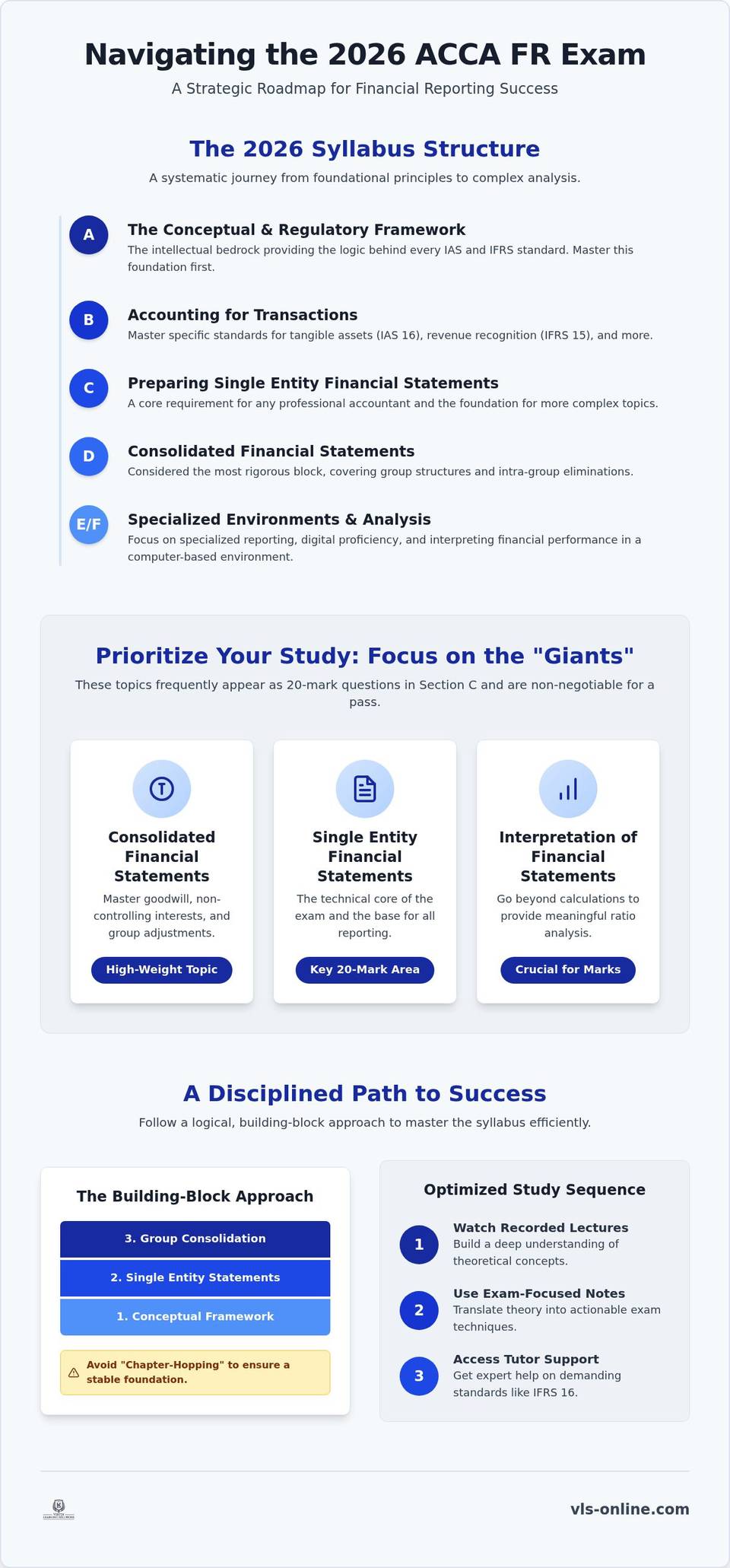
Approaching the 2026 Financial Reporting syllabus requires more than a checklist; it demands a systematic understanding of how individual standards interact. The Association of Chartered Certified Accountants (ACCA) organizes this knowledge into six distinct areas, labeled A through F. Area A, the Conceptual and Regulatory Framework, serves as the intellectual bedrock. It provides the logic behind every IAS and IFRS standard you'll encounter. Without mastering this foundation, the subsequent acca fr chapters can feel like a collection of isolated rules rather than a unified reporting system. You can explore our structured ACCA courses to see how we bridge these theoretical gaps.
Key takeaways
- Understand the hierarchical structure of the six core syllabus areas to build a stable professional foundation for advanced reporting standards.
- Master the foundational acca fr chapters starting with the Conceptual and Regulatory Framework to ensure clarity before approaching complex calculations.
- Prioritize high-yield topics such as Consolidated Financial Statements and the Interpretation of Financial Statements to maximize scoring potential in Section C.
- Follow a logical building-block sequence in your preparation to avoid the risks of chapter-hopping and ensure a systematic understanding of the 2026 syllabus.
Syllabus Areas A to F: From Framework to Analysis
The journey through the curriculum moves from theoretical principles to practical application. Area B focuses on accounting for transactions, where you'll master specific standards like IAS 16 for tangible assets and IFRS 15 for revenue recognition. Area C transitions into the preparation of single entity financial statements, a core requirement for any professional accountant. Many students find Area D, Consolidated Financial Statements, to be the most rigorous block. It requires a sophisticated understanding of group structures and intra-group eliminations, often forming the centerpiece of Section C questions.
Areas E and F complete the roadmap by addressing specialized reporting environments and the critical role of technology. While the 2026 syllabus maintains consistency in its core standards, there's an increased emphasis on digital proficiency. You'll need to demonstrate your ability to analyze data and interpret financial performance within a computer-based environment. This structural clarity ensures that your preparation isn't just about passing a test, but about building long-term professional competence.
Prioritising Your Study: High-Yield Chapters for the FR Exam
Strategic time allocation is the hallmark of a successful candidate. While every standard deserves attention, your performance in Section C hinges on a few specific acca fr chapters. The preparation of Consolidated Financial Statements and Single Entity Financial Statements represents the technical core of the exam. These topics frequently appear as 20-mark questions. Mastering them is non-negotiable for anyone seeking a pass mark above the 50% threshold. You must treat these as the "Giants" of your study plan to ensure exam day stability.
The official 2026 ACCA FR syllabus confirms that interpretation remains a vital pillar of professional competence. Many students mistakenly prioritize numerical mechanics over conceptual understanding. They believe that getting the numbers right is enough to secure a pass. However, the Interpretation of Financial Statements chapter requires you to bridge the gap between calculating ratios and providing meaningful analysis. Without the theoretical framework established in the earlier acca fr chapters, your analysis will lack the professional depth required by examiners.
Mastering the 'Big Three': Consolidation, Single Entity, and Interpretation
Group accounting requires a disciplined approach to complex adjustments like goodwill and non-controlling interests. We recommend mastering these through repetitive, structured templates that minimize errors under exam pressure. Similarly, ratio analysis becomes a reliable mark-earner when you follow a logical reporting sequence. For a broader perspective on your journey, consult our guide on ACCA Applied Skills: The Ultimate Educational Guide for 2026. If you find these standards challenging, our expert-led courses offer the structured protection you need to navigate high-yield areas with complete confidence.
Strategic Preparation: How to Master FR Chapters Efficiently
Arbitrarily jumping between different standards often leads to cognitive overload and fragmented understanding. Success requires a disciplined, building-block approach to the acca fr chapters. You cannot master complex group consolidation without first internalizing the single entity framework. This linear progression ensures that each standard reinforces the previous one, creating the stable intellectual foundation necessary for the 2026 exam. Precision is key. By following the syllabus in its intended order, you avoid the common pitfalls of "chapter-hopping" that leave many candidates feeling unprepared.
The VLS method optimizes your study time by moving systematically from detailed recorded lecture videos to concise, exam-focused study notes. This transition ensures that theoretical concepts are immediately translated into actionable exam techniques. When you encounter roadblocks in technically demanding standards like IFRS 16 (Leases) or IAS 37 (Provisions), our direct WhatsApp tutor support provides a professional safety net. This proactive assistance allows you to resolve complex queries before they become systemic misunderstandings. It's about turning confusion into professional clarity.
Theoretical mastery must eventually manifest as high-speed execution in Section A and B objective test questions (OTQs). These sections demand absolute accuracy. By applying the principles from each chapter to a high volume of practice questions, you develop the mental agility required for the computer-based environment. It's the bridge between understanding a rule and executing it under pressure. Systematic practice is the only way to ensure your knowledge translates into marks.
Vertex Learning Solutions’ Exam-Focused Approach to Financial Reporting
Our weekly live sessions simulate a rigorous classroom environment, providing the opportunity to tackle challenging past paper questions under expert guidance. This interaction is essential for refining your calculation logic and professional interpretation. You can explore our full range of ACCA courses to find the strategic partner for your qualification journey. Every student should follow a disciplined four-step checklist for each chapter: read the notes, watch the lectures, practice the questions, and review the examiner's feedback. This systematic approach ensures that no technical detail is overlooked.
Strategic Mastery of Your Professional Future
Achieving success in the 2026 exam sessions requires a transition from passive reading to active, strategic application. By systematically navigating the acca fr chapters, you move from the foundational principles of the conceptual framework to the complex technicalities of group accounting and financial interpretation. This structured approach ensures you aren't just memorizing standards; you're building the analytical skills required of a professional accountant. We provide the safety net you need to master these challenging topics with confidence. Master ACCA Financial Reporting with our expert-led online course, which features exam-focused study notes, interactive live sessions, and direct tutor support via WhatsApp to resolve your queries in real-time. Your preparation is the foundation of your professional integrity. We're here to ensure that foundation is unbreakable. Step into your next exam session with the calm confidence that comes from expert guidance.