
ACCA Financial Reporting (FR): The Ultimate 2026 Study & Exam Guide
Master the 2026 ACCA Financial Reporting (FR) exam with our ultimate study guide. Get expert tips on IFRS 18, ESG, and Section C to ensure your success.

In this article
Ready to qualify online?
Get full access to expert-led ACCA & CIMA exam preparation with live tutor support.
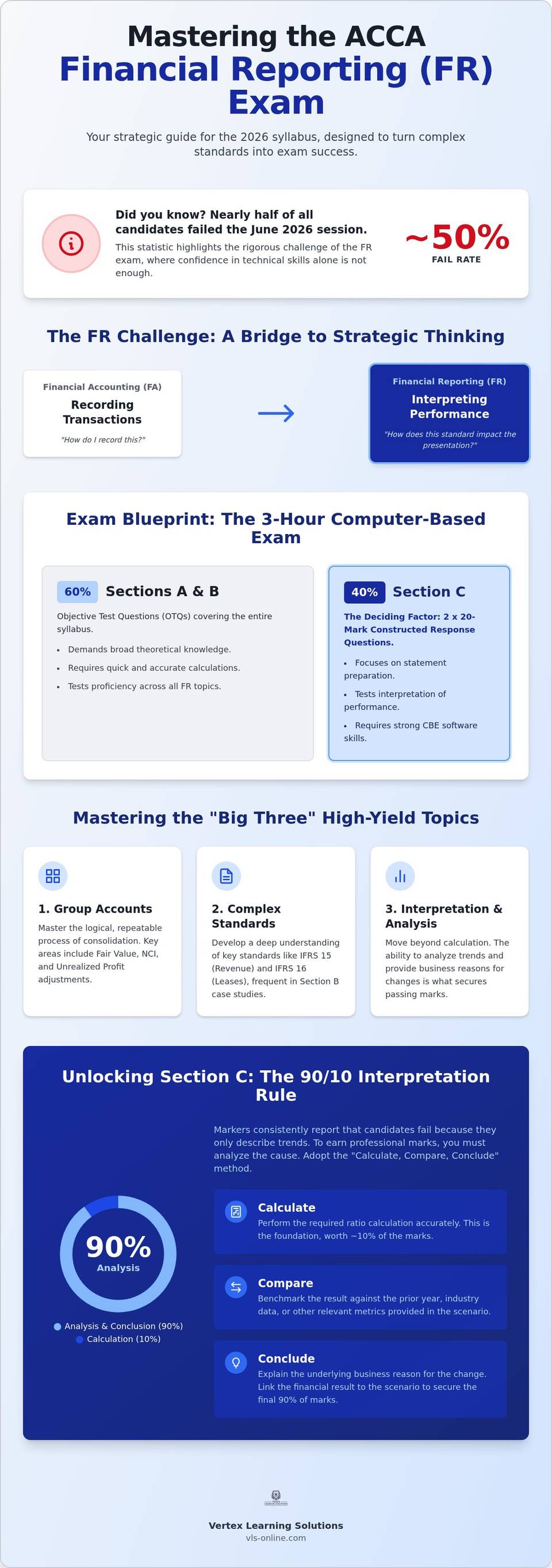
Explore Full AccessDid you know that nearly half of all candidates failed the June 2026 session, despite many being confident in their technical calculation skills? This statistic highlights the rigorous challenge of the ACCA Financial Reporting (FR) exam, where the margin for error remains thin. It's understandable if you feel the weight of transitioning from basic bookkeeping to the sophisticated application of international standards like IFRS 18. You're no longer just recording transactions; you're expected to interpret corporate performance with analytical precision while managing the strict time constraints of a computer-based environment.
We've designed this expert-led guide to serve as your professional safety net through this complex regulatory landscape. You'll gain a clear, strategic roadmap for your 2026 studies that moves beyond rote memorization toward true conceptual mastery. We'll preview the essential syllabus updates, including the latest ESG reporting requirements, and provide proven techniques to elevate your confidence in Section C constructed response questions. By the end of this article, you'll have a disciplined plan to ensure your exam success is a matter of structured preparation rather than chance.
Key takeaways
- Understand how the 2026 syllabus bridges the gap between basic accounting and strategic reporting while mastering the new IFRS 18 presentation requirements.
- Develop a systematic approach to the ACCA Financial Reporting (FR) "Big Three" topics, including group accounts and single entity statements, to secure high marks in Section C.
- Shift your focus from simple ratio calculation to professional interpretation, as analysis represents the majority of marks in complex constructed response questions.
- Implement a structured study roadmap that utilizes expert mentorship and live sessions to simplify the most intricate international financial reporting standards.
- Master computer-based exam techniques and time management strategies to maintain precision and confidence during the three-hour assessment.
Navigating the ACCA Financial Reporting (FR) Syllabus & Exam Structure
The Association of Chartered Certified Accountants (ACCA) positions the FR paper as a critical gateway within the Applied Skills level. It serves as the professional bridge between the foundational recording skills of Applied Knowledge and the complex, judgment-based requirements of Strategic Professional modules. Success in 2026 requires more than technical accuracy; it demands a systematic understanding of how financial information is synthesized to represent corporate health in a transparent manner.
Bridging the Gap: From Financial Accounting (FA) to FR
Many candidates mistakenly view this module as a simple extension of Financial Accounting (FA). While FA focuses on the mechanics of double-entry, ACCA Financial Reporting (FR) demands the application of rigorous IFRS and IAS standards to complex business scenarios. You're no longer just balancing a ledger. You're now interpreting the economic substance of transactions. This transition requires a mindset shift from "how do I record this?" to "how does this standard impact the presentation of the entity's performance?" For instance, understanding the new IFRS 18 categories in the statement of profit or loss is essential for accurate reporting in the current 2026 environment.
Understanding the 2026 Exam Format: Sections A, B, and C
The three-hour computer-based exam (CBE) is structured to test both breadth and depth through three distinct sections. Sections A and B represent 60% of the total marks, consisting of objective test questions that cover the entire syllabus. These sections demand a disciplined approach to theoretical knowledge and quick calculations. Section C contains two 20-mark constructed response questions that focus on the preparation of financial statements and the interpretation of performance. These 40 marks often decide the final outcome.
In 2026, proficiency in the CBE environment is non-negotiable. You must be comfortable navigating spreadsheet functions and word-processing tools under pressure. These digital skills are just as vital as your knowledge of consolidated financial statements or the conceptual framework. Mastery of the software ensures that your technical knowledge isn't hindered by the interface, allowing you to focus entirely on the professional application of standards.
Strategic Preparation: Mastering Core Topics and Exam Techniques
A successful approach to the ACCA Financial Reporting (FR) exam involves prioritizing the "Big Three" areas: Group Accounts, Single Entity Statements, and Interpretation. While candidates often feel comfortable with numerical workings, the 2026 exam environment rewards those who can articulate the "why" behind the figures. Precision in your calculations provides the necessary foundation, but your ability to provide a structured analysis is what ultimately secures a passing grade.
High-Yield Technical Areas: Group Accounts and Standards
Consolidation often intimidates students, yet it follows a logical, repeatable process. You should master a standardized step-by-step approach for the Consolidated Statement of Financial Position, ensuring that adjustments for fair value, unrealized profit, and non-controlling interests become second nature. Beyond groups, you must develop a deep understanding of complex standards such as IFRS 15 (Revenue from Contracts with Customers) and IFRS 16 (Leases). These topics frequently appear in Section B case studies, where one small misunderstanding of a standard's criteria can lead to multiple incorrect answers.
Winning Section C: The Interpretation and Analysis Framework
In Section C, calculating a ratio is merely the entry point. It represents roughly 10% of the available marks. To capture the remaining 90%, you should adopt the "Calculate, Compare, Conclude" method. First, perform the calculation. Second, compare it against the prior year or industry benchmark. Third, conclude by explaining the underlying business reason for the change. Marker feedback consistently shows that candidates fail because they describe a trend without analyzing its cause. Writing clear, logical sentences that link financial results to the provided scenario will help you earn essential professional marks.
Efficiency is paramount. Managing your time effectively is the final pillar of success. Don't let a difficult Section B scenario consume your focus; move on and return to it if time permits. By combining the ACCA Study Hub with structured online courses, you gain the expert perspective needed to simplify these intricate requirements. This dual approach ensures your technical knowledge is robust enough to handle the pressures of the three-hour CBE.
Achieving Exam Success with Vertex Learning Solutions
The transition from calculation to interpretation is where most students stumble. While self-study is a common choice, the June 2026 pass rate of 52% proves that many candidates lack the professional depth required for success. Vertex Learning Solutions (VLS) offers more than just recorded content; we provide a structured safety net that clarifies the most complex international standards. By integrating the Official ACCA Financial Reporting Resources into a methodical study plan, we ensure your preparation remains disciplined and focused on high-yield topics.
Expert-Led Tuition: The VLS Support Ecosystem
VLS distinguishes itself through active, real-time mentorship. Our students benefit from direct tutor support via WhatsApp, which allows for the immediate resolution of technical queries before they evolve into significant roadblocks. You'll also participate in weekly live sessions that simulate a classroom environment, offering you the chance to engage with complex scenarios under expert guidance. These sessions are supplemented by exam-focused study notes designed to simplify the most challenging aspects of ACCA Financial Reporting (FR). You can explore our full range of ACCA courses online to find the right level of support for your professional needs.
Your Pathway to Strategic Professional
Mastering the FR syllabus isn't merely about passing one exam. It's about building the intellectual framework necessary for the final stages of your qualification. The analytical skills you develop here translate directly to success in Strategic Business Reporting (SBR) and Advanced Audit and Assurance (AAA). Understanding the nuances of consolidated statements and standard application now will prevent future struggles at the Strategic Professional level. For a broader view of how these modules fit together, read about the ACCA Applied Skills level in our comprehensive guide. We stand by you as a strategic partner, ensuring your journey is stable, predictable, and successful.
Mastering Your Path to Financial Reporting Excellence
Securing success in the ACCA Financial Reporting (FR) exam in 2026 requires a disciplined transition from technical bookkeeping to high-level professional analysis. You've seen that your ability to interpret corporate performance is just as vital as your calculation accuracy. By mastering the "Big Three" topics and navigating the new presentation requirements of IFRS 18 with precision, you position yourself for a passing grade. While the 52% pass rate reflects the exam's rigorous nature, a structured study roadmap significantly mitigates the risks of unguided preparation.
Vertex Learning Solutions provides the professional safety net you need to navigate this complex regulatory landscape. We combine comprehensive 2026 exam-focused materials with active tutor support via WhatsApp and weekly live interactive sessions. These resources ensure that no technical standard remains a roadblock to your progress. Our approach simplifies the most intricate requirements, allowing you to build the intellectual framework necessary for your future success at the Strategic Professional level.
Take the definitive step toward your qualification. Enrol in the ACCA Financial Reporting (FR) course today and approach your next exam session with absolute confidence. Your commitment to professional excellence deserves a partner that values precision and integrity as much as you do.