Vertex Learning Solutions


Skipping foundational exams might seem like the ultimate competitive advantage, but the shortest path to your professional letters is often the one where most candidates lose their footing. While the prospect of bypassing up to nine exams is enticing, an uncalculated leap into higher-level papers can lead to costly resets and a fragile knowledge base. You've worked hard for your prior qualifications, so it's only logical to leverage that effort. However, true career acceleration requires a more sophisticated approach than simply ticking boxes.
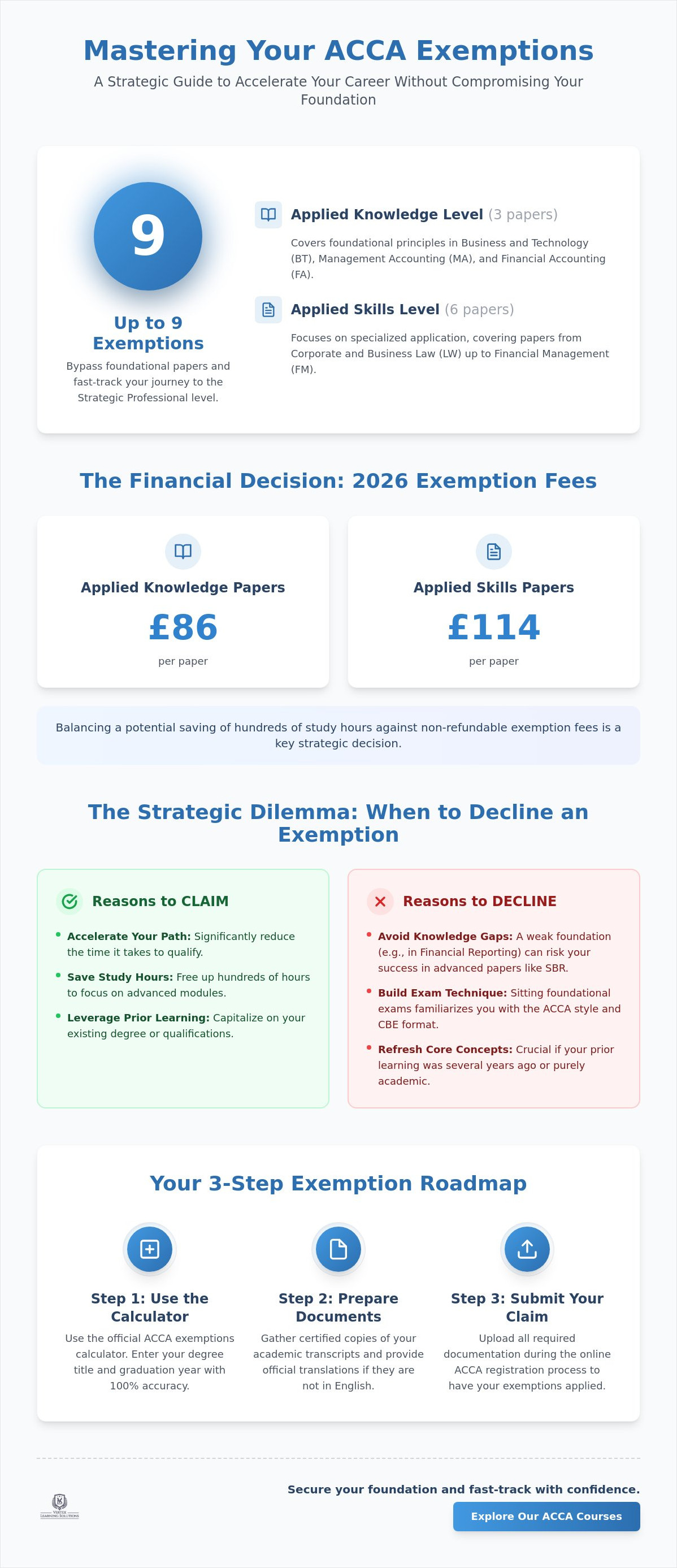
We understand that you're looking for clarity amidst the complexity of eligibility criteria and the 2026 fee structure. This guide will teach you how to master the ACCA exemptions calculator to build a customized roadmap that protects your professional integrity. You'll gain a clear count of your eligible exemptions and a rigorous cost-benefit analysis of the current fees, which range from £86 for Knowledge papers to £114 for Skills papers. We'll also provide a strategic bridge plan to ensure you're fully prepared for advanced modules. This approach gives you the security of a solid foundation while you fast-track your journey to the top of the profession.
Key Takeaways
- Understand how to employ the ACCA exemptions calculator as a precise diagnostic instrument to map your prior qualifications against the current 2026 regulatory framework.
- Evaluate the strategic implications of the nine-paper exemption threshold, which encompasses the Applied Knowledge and Applied Skills levels up to Financial Management (FM).
- Navigate the administrative complexities of the claim process by adhering to strict documentation standards, including certified transcripts and official translations.
- Implement a structured bridge plan to secure foundational knowledge, ensuring that accelerated progress through exemptions does not create vulnerabilities in higher-level Strategic Professional papers.
Navigating the ACCA Exemptions Calculator: Your Strategic Starting Point
The journey toward becoming a member of the Association of Chartered Certified Accountants (ACCA) begins with a rigorous audit of your existing academic assets. The ACCA exemptions calculator serves as the definitive diagnostic tool for this purpose. It's designed to recognize the professional expertise you've already cultivated through prior studies. Within the 2026 qualification framework, these exemptions aren't merely shortcuts; they're strategic placements that ensure your study time is invested where it provides the highest return on effort. By identifying which foundational modules you've already mastered, you can enter the program at a level that matches your current professional standing.
Accuracy is paramount when you're interfacing with this system. A minor discrepancy in your graduation year or a vague interpretation of your degree title can lead to invalid results. The database is highly granular, accounting for specific syllabus versions that were active during your years of study. Entering "Accounting" when your official transcript reads "BSc (Hons) International Accounting and Finance" might result in a different exemption count. You should treat this data entry process with the same professional rigor you'll apply to your future financial reporting. It's the foundation upon which your entire 2026 study plan will rest.
How the Calculator Evaluates Your Academic Background
The system evaluates the precise alignment between your university's curriculum and the ACCA's standards. For example, a degree from an accredited institution may grant exemptions for the Applied Knowledge papers, while professional certifications from bodies like CIMA often extend eligibility into the Applied Skills level. Prior learning is the benchmark for determining the degree of syllabus overlap between your previous qualifications and the ACCA modules. This evaluation ensures that you aren't required to re-examine concepts you've already proven you understand.
It's vital to distinguish between the two primary tiers of exemptions. Applied Knowledge exemptions cover foundational principles like Business and Technology (BT) or Management Accounting (MA). Applied Skills exemptions move into specialized application, such as Taxation (TX) or Audit and Assurance (AA). Understanding this distinction helps you anticipate the shift in complexity as you progress through our ACCA courses. A clear result from the calculator allows you to map out your path with total confidence.
Knowledge vs. Skills: Developing a Strategic Fast-Track Plan
The maximum exemption threshold allows you to bypass up to nine papers, effectively clearing the path through both the Applied Knowledge and Applied Skills levels. This trajectory covers everything from Business and Technology (BT) to Financial Management (FM). While the ACCA exemptions calculator provides a definitive numerical output, your decision must be qualitative. You're balancing a potential saving of hundreds of study hours against the non-refundable fees, which currently stand at £86 for Knowledge and £114 for Skills papers. Efficiency is valuable, but it should never come at the cost of technical proficiency.
A frequent concern among candidates is whether skipping Financial Reporting (FR) will compromise their performance in the complex Strategic Business Reporting (SBR) module. The transition from "Knowledge" to "Skills" represents a shift from understanding principles to applying them in professional scenarios. If your prior learning was purely academic or occurred several years ago, the technical gap can be significant. Success in 2026 requires a proactive strategy that bridges these potential vulnerabilities before they impact your exam results.
The Strategic Choice: When to Decline an Exemption
Skipping isn't always winning. Some candidates choose to sit ACCA Applied Knowledge papers even when eligible for exemptions. This approach builds essential exam technique and familiarizes you with the computer-based testing environment. If you identify a weak foundational area, attempting the exam provides a safety net for your future studies. Refreshing these core concepts ensures you don't face a knowledge cliff when you reach the professional papers.
Exemptions for Qualified Accountants (CA, CIMA, MBA)
Professional transitions require specialized roadmaps. CIMA certificate holders often find a streamlined entry into the Applied Skills level, benefiting from the overlap in management accounting and financial principles. Similarly, an MBA can offer a strategic advantage when navigating the ACCA Strategic Professional level, particularly in leadership-focused modules. These advanced entry points respect your existing credentials while positioning you for elite roles in the global market. To ensure your transition is seamless, you might consider a comprehensive study package that provides review materials for skipped modules.
The Operational Roadmap: How to Claim Your Exemptions in 2026
Transitioning from a theoretical count to a formal award requires a disciplined administrative approach. Once you've utilized the ACCA exemptions calculator to identify your eligibility, the next phase involves the formal submission of your credentials during the registration process. This isn't a mere formality; it's a verification of your professional history. You'll need to provide high-resolution scans of your official transcripts and graduation certificates. If these documents aren't in English, the ACCA requires a translation from a certified official translator to ensure every module title is correctly interpreted.
Financial planning is equally critical in this roadmap. For the 2026 cycle, the fees are set at £86 for each Applied Knowledge paper and £114 for each Applied Skills paper. It's vital to remember that these fees are non-refundable once the exemption is granted. For final-year university students, the system allows for "conditional exemptions." This status permits you to plan your future exam sittings based on predicted grades, though you must provide final proof of completion before the exemptions are fully ratified on your record.
Critical Timelines and Administrative Deadlines
Timing your application is essential for a smooth entry into the 2026 exam sessions. The verification process typically spans 10 to 20 working days, though high-volume periods can extend this window. To sit for the September 2026 session, you must have your exemptions confirmed well before the standard entry deadline of July 27, 2026. Similarly, for the December session, aim to finalize your status before October 27, 2026. Proactive management ensures you don't miss exam windows due to pending documentation reviews.
Navigating the myACCA Portal for Exemption Management
Your student record within the myACCA portal is the single source of truth for your progress. After your application is processed, you should verify that each module is correctly listed under the "Exemptions" tab. If the ACCA exemptions calculator didn't originally list your specific institution or degree, you can still apply for a manual assessment. This requires a more detailed submission, often including a full syllabus breakdown of your prior course. Secure your professional future by starting with our structured ACCA study programs today.
Bridging the Knowledge Gap: Vertex Learning Solutions’ Support
The numerical output provided by the ACCA exemptions calculator represents a formal recognition of your past achievements, yet it doesn't account for the potential decay of technical knowledge over time. Skipping a paper is a strategic administrative move, but skipping the underlying knowledge is a risk that often manifests as failure at higher levels. Our mission is to ensure that your fast-track journey is built on a stable foundation rather than a precarious shortcut. If you're entering at the Applied Skills level, you must possess the same depth of understanding as those who sat the foundational exams.
Vertex Learning Solutions addresses this "exemption gap" by providing a professional safety net. We don't believe in leaving students to struggle with advanced concepts without the necessary tools. Our framework allows you to revisit core principles whenever a technical query arises, ensuring that your progression remains steady and predictable. This proactive preparation is especially vital when transitioning to complex modules like Strategic Business Reporting (SBR), where foundational accounting standards are taken as a given. You've earned your exemptions, and we're here to ensure they remain an asset rather than a liability.
Leveraging VLS Resources for Fast-Track Success
Students who bypass the Knowledge level can access our library of recorded lectures to refresh specific concepts before tackling the more rigorous Skills papers. This self-paced review is complemented by our dedicated WhatsApp tutor support. If a foundational topic feels unclear while you're studying a more advanced module, you can reach out to an expert for immediate, discrete clarification. This direct access removes the friction often associated with entering the qualification at an advanced stage, giving you the confidence to move forward.
Preparing for the Strategic Professional Level
Long-term success depends on structural stability, particularly for quantitative modules like Advanced Financial Management (AFM). The VLS "full access" philosophy serves as a safeguard for exempted students by granting them the resources to bridge any historical knowledge gaps before they become critical exam vulnerabilities. We provide a comprehensive environment where prior learning is reinforced by current expert guidance. By treating your education as a continuous system rather than a series of isolated hurdles, we help you secure the professional standing you've worked so hard to achieve. Using the ACCA exemptions calculator is only the first step; our support ensures you reach the finish line.
Securing Your Professional Legacy through Strategic Planning
Success in the 2026 ACCA landscape requires more than just identifying which exams you can skip. It demands a rigorous evaluation of your technical readiness and a disciplined approach to administrative deadlines. By mastering the ACCA exemptions calculator, you've established a baseline for your career acceleration. You now understand the vital balance between the efficiency of exemptions and the necessity of a robust knowledge base for the Strategic Professional level. The most successful candidates are those who view their exemptions as a strategic advantage rather than a simple shortcut.
To maintain your competitive edge, you must ensure that your progression is supported by elite expertise. Fast-track your ACCA journey with VLS professional tutor support and benefit from a comprehensive protective network. We provide WhatsApp tutor support for immediate query resolution and exam-focused study notes tailored for all levels of the qualification. Our weekly live sessions simulate a classroom environment, offering the structural stability required to master even the most complex modules. You've built the roadmap; now let us provide the professional protection you need to reach your destination with absolute confidence.
Frequently Asked Questions
How much do ACCA exemptions cost in 2026?
For the 2026 calendar year, the fees for Applied Knowledge level papers are £86 per module, while Applied Skills level papers are £114 each. These costs are mandatory and non-refundable once the exemption is officially granted. You should treat these fees as a strategic investment in your timeline, as they allow you to bypass months of study for concepts you've already mastered elsewhere.
Can I claim exemptions after I've already registered as an ACCA student?
Yes, you can initiate an exemption claim at any point during your journey by uploading new qualifications to the myACCA portal. While most candidates use the ACCA exemptions calculator during their initial registration, the system allows for updates if you complete a degree or professional certification later. The administrative team will review your new documents and update your student record accordingly, provided the evidence meets their rigorous standards.
What happens if I take an exemption but then realize I don’t know the material?
If you discover a knowledge gap after skipping a paper, you can't undo the exemption or reclaim the fee, but you can proactively study the foundational content. It's quite common for students to feel a bit rusty on technical details from prior degrees. In these cases, utilizing bridge resources or recorded lectures from earlier modules is a vital safety net to ensure you don't struggle when those concepts reappear in advanced papers.
Are there exemptions for the Strategic Professional level exams?
No exemptions are available for any of the exams at the Strategic Professional level. This final tier is designed to test your ability to lead at an executive level and apply complex technical knowledge in real-world scenarios. Every student, regardless of their prior academic background or professional status, must sit these four papers to prove they meet the global standards required for full membership.
Do ACCA exemptions expire if I take a break from my studies?
Once an exemption is granted and the associated fee is paid, it remains on your student record indefinitely and does not expire. You won't be required to sit those papers even if you pause your studies for several years. However, you should be aware that the syllabus is updated annually. If you return after a long break, a brief review of the current foundational material is a prudent step to ensure your knowledge remains relevant.