
ACCA Exam Time Management: The 2026 Strategic Guide to Finishing on Time
Master ACCA exam time management for 2026. Our guide covers the 1.8-minute rule, CBE shortcuts, and strategic tips to finish on time and secure your pass.

In this article
Ready to qualify online?
Get full access to expert-led ACCA & CIMA exam preparation with live tutor support.
Explore Full AccessThe difference between a 48% fail and a 52% pass in 2026 rarely comes down to technical accounting knowledge; it's decided by the discipline of the clock. It's an exhausting, familiar scenario to find yourself staring at a blank 20-mark requirement with only ten minutes remaining. You've likely felt the frustration of perfecting a complex calculation while knowing you're sacrificing the accessible marks that actually secure a qualification. This guide provides a professional framework for ACCA exam time management that transforms the ticking clock from a source of panic into a strategic asset.
By mastering the mathematical 1.8-minute rule and specific CBE platform efficiencies, you'll gain the confidence to move past stuck questions. We'll detail how to navigate the spreadsheet and word processor tools with precision, ensuring you leave nothing on the table as you approach the final sittings of the current qualification structure.
Key takeaways
- Implement a disciplined mathematical approach by allocating 1.5 minutes per mark to create a vital 30-minute buffer for complex final reviews.
- Leverage specific CBE platform shortcuts, such as requirement cloning and automated spreadsheet formulas, to eliminate redundant data entry and maximize technical efficiency.
- Adopt the VLS approach to prioritize "easy marks" in definitions and basic calculations, ensuring you secure the foundational 50% before tackling high-complexity requirements.
- Refine your ACCA exam time management through the strategic abandonment technique, preventing a single difficult calculation from jeopardizing your ability to finish the entire paper.
The Mathematics of Success: Mastering the 1.8-Minute Rule
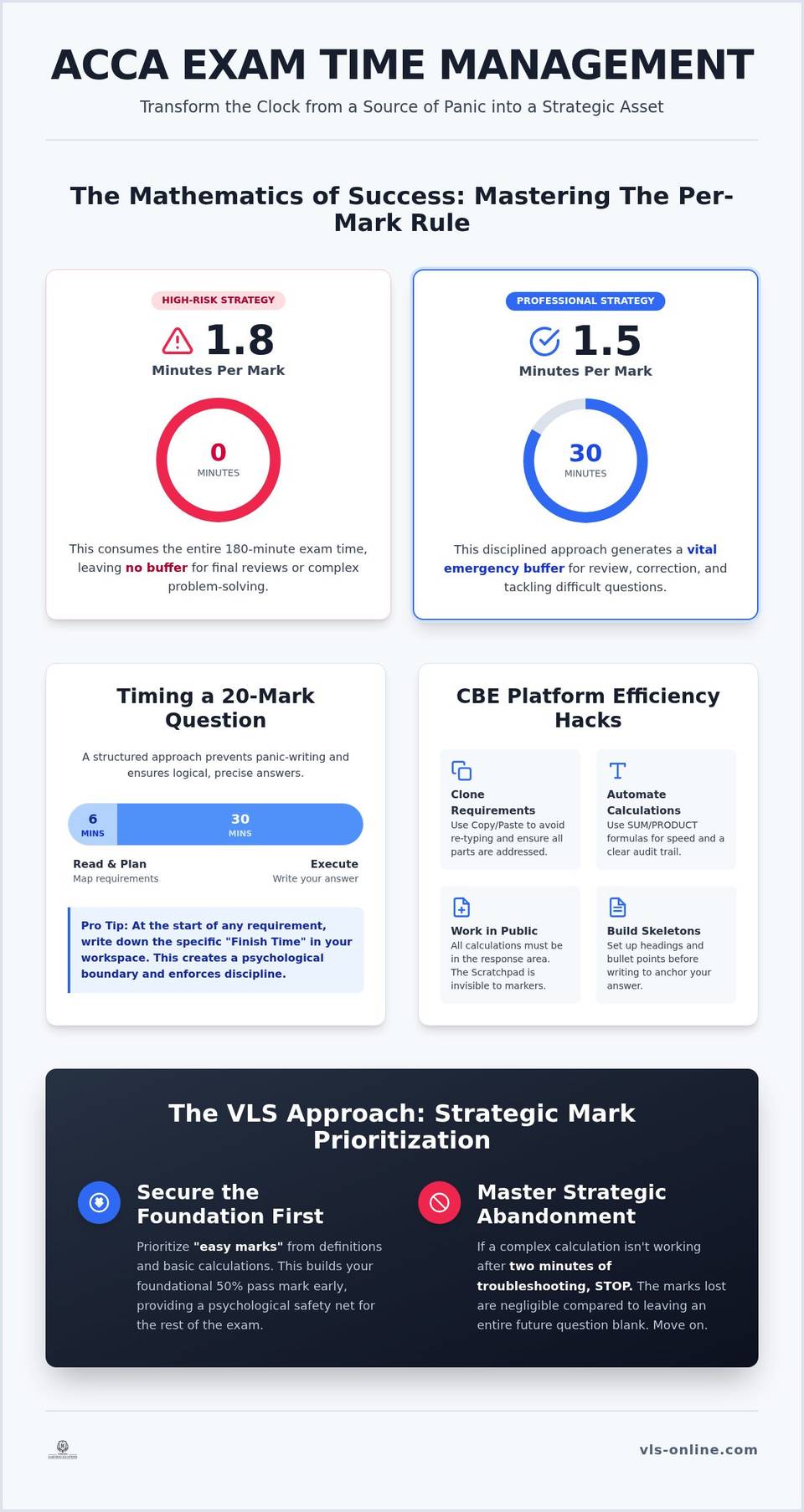
The Association of Chartered Certified Accountants (ACCA) structures its exams to test both technical depth and operational discipline. The fundamental calculation is simple: a 180-minute window for a 100-mark paper allows exactly 1.8 minutes per mark. However, relying on this maximum limit is a high-risk strategy. Professional candidates treat time as a finite capital to be invested, not merely spent. To ensure security, you'll want to aim for a 1.5-minute allocation per mark. This disciplined approach generates a 30-minute "emergency buffer" that proves vital for final reviews or resolving complex errors.
Effective ACCA exam time management requires real-time monitoring rather than retrospective regret. At the start of every requirement, write the specific "finish time" at the top of your workspace. If you begin a 10-mark requirement at 14:00, your target exit is 14:15. This creates a psychological boundary. When the clock hits that mark, you must possess the professional maturity to move on. Leaving a difficult requirement partially finished is often more strategic than sacrificing the "easy marks" available in the next section.
Allocating Time for Reading and Planning
The concept of a standalone "15-minute planning period" is often a myth in modern CBE environments. Planning must be an integrated, iterative process. For a standard 20-mark question, you should allocate approximately 6 minutes to reading the scenario and mapping requirements. The remaining 30 minutes are reserved for execution. Vertex Learning Solutions emphasizes this structured split during mock sessions to refine your ACCA exam time management for the 2026 sessions. This ensures your response remains logically closed and precise, preventing the common pitfall of panic-writing in the final minutes.
CBE Technical Efficiency: Speed Hacks for the 2026 Exam Platform
The Computer-Based Exam (CBE) environment is a professional workspace, not an obstacle to be feared. Mastery of this platform is a core component of effective ACCA exam time management. Start by using the "Copy and Paste" function to clone requirements directly into your response area. This practice eliminates re-typing errors and ensures every requirement is addressed. You must treat the "Scratchpad" with caution. Markers cannot see it; therefore, you should perform all calculations within the response area to secure valuable "own figure" marks. Markers can only award credit for what is visible in your final submission.
Efficiency in the spreadsheet tool relies on automation rather than manual labor. Basic formulas such as SUM and PRODUCT are essential for speed. These tools create a transparent audit trail for markers while saving seconds on every calculation. If you're looking to bridge the gap between theory and platform mastery, professional ACCA courses offer the simulated practice required for 2026. Consult the official ACCA exam resources regularly to ensure your technical skills remain sharp. These small technical gains aggregate into a significant time advantage during the final hour of the exam.
Optimizing the Word Processing Tool
Speed is often found in structure rather than prose. Create "skeletons" by setting up your answer headings before you even read the full scenario details. This proactive approach anchors your ACCA exam time management strategy. When writing, prioritize technical keywords and logical clarity over perfect grammar. Markers seek professional insight, not literary perfection. Using bold headings and concise bullet points allows you to satisfy mark schemes without the time-intensive burden of flowery paragraphs. A well-structured, bulleted response is often easier to mark and faster to produce.
Strategic Mark Prioritization: The VLS Approach to Exam Stamina
Success in professional-level papers requires a transition from a completionist mindset to one of strategic utility. Effective ACCA exam time management hinges on your ability to identify "easy marks" before exhausting your mental energy on high-complexity requirements. Foundational definitions and basic calculations often carry the same weight as intricate discursive analysis but require significantly less time to execute. Prioritizing these elements ensures you secure the passing 50% early in the session, providing a psychological safety net for the remaining time.
A vital component of this strategy is the "Strategic Abandonment" technique. Professionals recognize when a specific calculation is no longer yielding a return on time invested. If a consolidation doesn't balance after two minutes of troubleshooting, you must stop. The marks lost for a minor imbalance are negligible compared to the marks forfeited by leaving a later question blank. Through Vertex Learning Solutions, students refine this judgment during weekly live sessions that simulate the 3-hour grind of the 2026 exam cycle. Tutor support via WhatsApp provides the immediate clarification needed to turn these technique errors into strategic strengths.
Mock Exams as Time Management Drills
Completing a single full-length mock under strict, timed conditions provides more value than 10 hours of casual, untimed study. This simulation is the only way to build the physical and mental stamina required for the CBE platform. During these drills, you must perform a time leakage analysis to identify which topics consistently cause your schedule to slip. Identifying these bottlenecks allows you to adjust your approach before the actual exam day. It's better to discover a time management flaw in a practice environment than in the final 15 minutes of a live session.
Securing Your Professional Future Through Strategic Discipline
Mastering ACCA exam time management is the final hurdle in your journey toward certification. By integrating the 1.5-minute rule with technical CBE platform efficiencies, you'll ensure that no requirement is left unaddressed due to poor planning. Success in 2026 requires more than technical knowledge; it demands the professional maturity to prioritize high-yield marks over complex, low-reward calculations. You've worked hard to acquire the theory; now you must protect that investment with a disciplined execution strategy.
Vertex Learning Solutions provides the professional safety net you need to refine these skills. With our London-based global expertise and a curriculum focused on simulated mock exams, we transform your approach from reactive to strategic. Our tutors offer immediate technique clarification via WhatsApp, ensuring your preparation remains precise and effective. Enroll in VLS ACCA Courses for Expert Exam Technique Support and approach your next session with absolute professional confidence. Your path to qualification is within reach.