
ACCA Audit and Assurance (AA) 2026 Exam Success Guide
Ace the 2026 exam with our ACCA Audit and Assurance (AA) study guide. Go beyond memorization to master risk, controls, and time management. Pass with confide...

In this article
Ready to qualify online?
Get full access to expert-led ACCA & CIMA exam preparation with live tutor support.
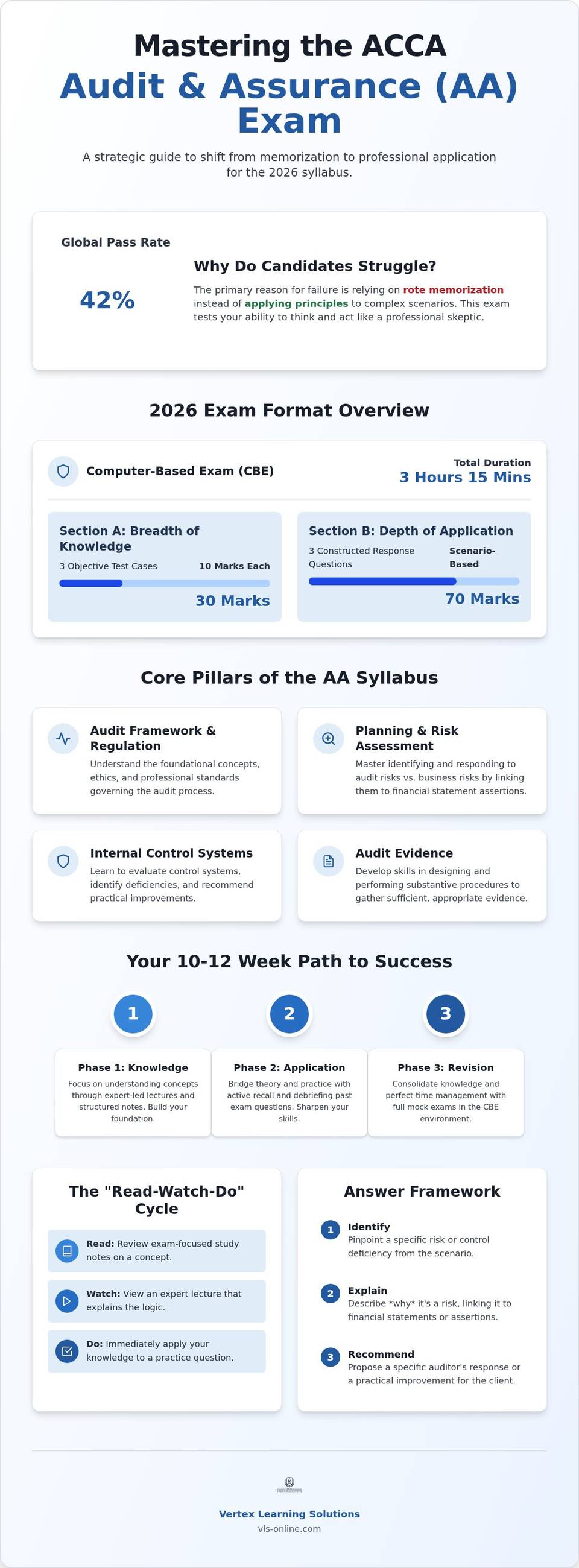
Explore Full AccessRote memorization of International Standards on Auditing is frequently the primary reason candidates fail to secure a passing mark in the Audit and Assurance exam. While many students can recite definitions, the 42% global pass rate highlights a systemic struggle to apply these principles to the complex scenarios presented in the 2026 syllabus. If you've found yourself confused by the distinction between audit risk and business risk, or if Section B's time constraints feel insurmountable, you aren't alone. This ACCA Audit and Assurance (AA) study guide serves as your professional protective net, offering the structured clarity and strategic insight required to navigate these complexities with composure.
We understand that success in this module requires more than just academic knowledge; it demands the mindset of a professional skeptic. In this guide, we'll provide a definitive roadmap for your 2026 exam preparation, covering everything from the revised ISA 570 Going Concern requirements to the introduction of the ISA for LCE. You'll gain access to proven techniques for identifying risks and managing your 3-hour and 15-minute CBE session with precision. By the end of this article, you'll have a clear, logical path toward exam day confidence and professional excellence.
Key takeaways
- Understand the critical transition from financial reporting to professional oversight by mastering the 2026 syllabus structure across audit framework, planning, and evidence.
- Establish a disciplined 10-12 week timeline that prioritizes knowledge acquisition through expert-led recorded lectures and structured study notes.
- Implement this comprehensive ACCA Audit and Assurance (AA) study guide to master the "Identify, Explain, Recommend" framework, ensuring precise responses to internal control scenarios.
- Refine your ability to distinguish between audit and business risks using a logical formula that links financial statement impact to specific assertions.
- Gain the professional confidence needed for the 3-hour CBE by adopting a strategic approach to time management and application-based exam techniques.
Understanding the ACCA Audit and Assurance (AA) Syllabus in 2026
The transition from Financial Reporting (FR) to Audit and Assurance (AA) represents a significant shift in your professional development. While earlier papers focus on the preparation of financial statements, AA requires you to step into the role of an independent evaluator. Before diving into the technicalities, it's vital to understand the fundamental objective: What is an Audit? Essentially, you're moving from the creation of data to its verification. The 2026 syllabus is meticulously structured around four central themes: the audit framework, planning and risk assessment, internal control systems, and audit evidence. As one expert tutor puts it, "The AA exam tests your ability to act as a professional sceptic, not just a calculator."
Mastering this syllabus requires a shift from rote learning to high-level application. The global pass rate reflects the difficulty students face when trying to apply theoretical International Standards on Auditing (ISAs) to real-world scenarios. A comprehensive ACCA Audit and Assurance (AA) study guide must therefore prioritize the "Application" requirement over simple "Knowledge." You're expected to evaluate business processes and identify where they might fail, rather than just listing the rules. This analytical approach is what separates a successful candidate from one who merely memorizes the text.
The Core Pillars of the AA Exam
Audit Risk and Response is often the "make or break" section of the paper; it requires you to identify specific risks in a scenario and propose valid auditor responses. You must also become adept at assessing internal control systems to identify deficiencies and recommend logical improvements. Finally, gathering sufficient appropriate evidence through substantive procedures remains a cornerstone of the exam. For those seeking a structured bridge between these complex concepts, specialized ACCA AA courses provide the professional depth and tutor support needed to navigate these technical requirements with confidence.
The 2026 Exam Format: Section A vs. Section B
The 3-hour and 15-minute CBE is divided into two distinct parts. Section A consists of three objective test cases, each worth 10 marks, totaling 30 marks. These test your breadth of knowledge across the entire syllabus. Section B contains three constructed response questions, totaling 70 marks. This is where your ability to draft professional, structured answers is tested. Success here depends on your capacity to link your technical knowledge to the specific facts of the case study provided. It's not enough to know the theory; you must demonstrate its relevance to the client's specific circumstances.
A Step-by-Step Study Plan for ACCA AA Success
Establishing a disciplined timeline is the first step toward securing your professional future. We recommend a 10-12 week study period to ensure a deep understanding of the syllabus without the risks of burnout. This structured ACCA Audit and Assurance (AA) study guide divides your journey into three distinct phases. Phase 1 focuses on knowledge acquisition through Vertex recorded lectures, where the focus is on understanding the logic behind the standards. Phase 2 shifts to active recall and question debriefing. This is where you begin to bridge the gap between theory and application. Finally, Phase 3 is the revision sprint, where you consolidate your knowledge through full mock exams.
Mastering Theory Through the Vertex Methodology
Traditional textbooks can be overwhelming. Our methodology simplifies the 500-page curriculum into exam-focused study notes that highlight what's truly examinable. We utilize a "Read-Watch-Do" cycle: read the concept, watch the expert lecture, and immediately do a related practice question. If you encounter a complex ISA that doesn't click, our WhatsApp tutor support provides a direct line to expert guidance. You're never stuck for long. This proactive approach turns passive reading into active learning, ensuring you build a robust professional foundation.
The Importance of Mock Exams in the Digital Environment
You shouldn't let your first experience with the 3-hour exam pressure happen on the actual day. It's essential to visit the Official ACCA Website to access the Practice Platform. Simulating the CBE environment is vital for mastering Section B's constructed response questions. Self-marking your attempts against the official answers is perhaps the most valuable tool in your study arsenal. It forces you to think like an examiner and identify exactly where your logic might be falling short. Refining your approach through a structured ACCA AA course can provide the professional safety net needed to master these phases with poise.
Advanced Exam Techniques for Audit and Assurance
To translate your preparation into marks, you must adopt a structured approach to answer construction. The "Identify, Explain, Recommend" framework is your most reliable tool for tackling internal control questions. You identify the deficiency from the scenario, explain the potential business implication, and recommend a practical control to mitigate the risk. This three-step process ensures your answer is logically closed and leaves no room for ambiguity. Similarly, when addressing audit risk, use the formula: Risk = Financial Statement Impact + Assertion. Stating that an account is "wrong" is insufficient; you must specify if it's potentially overstated or understated and which assertion is at risk. This level of precision is a core component of any effective ACCA Audit and Assurance (AA) study guide.
Time management is the silent hurdle in this paper. You have exactly 1.8 minutes per mark. If a question is worth 10 marks, you must move on after 18 minutes to protect your performance in Section B. This discipline prevents the common pitfall of over-explaining simple points while neglecting high-value questions. For a deeper dive into these strategies, consult the Official ACCA AA Study Resources, which provide examiner reports that highlight where students frequently lose marks due to poor time allocation or generic responses.
Writing Like an Auditor: Professional Phrasing
Your choice of verbs dictates the quality of your substantive procedures. Avoid vague terms like "check" or "look at." Professional auditors use active verbs such as Inspect, Observe, and Recalculate. Every procedure you draft should pass the "So What?" test. If the procedure doesn't directly impact the audit opinion or address a specific assertion, it's likely a generic filler that scores zero marks. Precision isn't just about technical knowledge; it's about demonstrating your professional skepticism through clear, impactful writing.
The Vertex Advantage: Live Sessions and Personal Support
While self-study provides the foundation, Vertex live sessions bridge the final gap by simulating the exam environment and offering real-time feedback. These sessions allow you to refine your technique under expert supervision, ensuring you're ready for the 2026 sittings. Mastering the analytical mindset required for AA also prepares you for the ACCA SBR exam later in your journey. Once you've secured your AA pass, your next strategic step will be moving toward advanced modules like ACCA AFM or Advanced Audit and Assurance with a proven methodology for success.
Securing Your Professional Future in Audit
Success in the 2026 sittings requires a definitive transition from passive knowledge to active, professional application. By mastering the "Identify, Explain, Recommend" framework and adhering to a disciplined study timeline, you position yourself to exceed the global pass rate with confidence. This ACCA Audit and Assurance (AA) study guide has outlined the logical steps needed to navigate complex ISAs and internal control deficiencies with the poise of a seasoned practitioner. Precision in your phrasing and a rigorous approach to time management are the final components of an elite exam strategy.
True confidence comes from having a strategic partner by your side. We provide a professional protective net through weekly live classroom simulations and exam-focused study notes that simplify the most dense technical standards. Our unique approach ensures you're never navigating these complexities alone, as our expert tutors remain just a message away via direct WhatsApp support. This level of accessibility transforms a difficult syllabus into a manageable, structured path toward your qualification.
Take the definitive step toward professional excellence today. Enroll in the Vertex ACCA AA Course for Full Tutor Support and begin your journey with a partner committed to your stability and success. You possess the capability to master this syllabus; we provide the expertise to ensure you achieve it.