
Senior finance manager skills for finance leadership and analysis
Explore the skills needed for a senior finance manager, including leadership, financial analysis, forecasting, and practical decision-making at every level.

In this article
Ready to qualify online?
Get full access to expert-led ACCA & CIMA exam preparation with live tutor support.
Explore Full AccessSenior finance leadership involves more than producing accurate reports. The skills needed for a senior finance manager combine financial analysis and technical accounting knowledge with strategic judgment, clear communication, problem-solving, and the ability to lead people. The role also requires turning financial information into practical advice that helps a business make informed decisions.
Strong accounting expertise is a foundation of the job, but senior responsibilities also require connecting that expertise to business priorities. This article explains what finance managers do and how leadership, critical thinking, and technical finance skills support their work. It focuses in particular on the capabilities behind forecasting, reporting, compliance, and sound financial decisions.
Key takeaways
- Translate financial reports into clear recommendations that help non-finance colleagues and senior leaders make informed decisions.
- Use critical thinking to identify the causes of financial problems, assess risk, and shape practical responses.
- Build technical expertise in forecasting, budgeting, reporting, compliance, and financial systems to support reliable oversight.
- As responsibilities grow, shift from handling every technical task to guiding teams and aligning financial work with business priorities.
1. Leadership, communication, and emotional intelligence
Senior finance managers lead accountants and coordinate decisions across departments. They need to make financial evidence useful to non-finance colleagues. For example, explain a forecast variance by linking it to hiring, inventory, or project timing. Use clear language rather than accounting jargon, so operations leaders have a practical basis for action.
Written reports should state the decision, evidence, risk, and next step. In a board pack, distinguish an actual cash shortfall from a timing difference, then explain the effect on planned spending. In meetings with executives, auditors, or lenders, answer directly and accurately. Emotional intelligence, including managing your own emotions and understanding others’, can help you hear concerns and resolve disagreements.
Strategic planning connects financial forecasts to short- and long-term business objectives. A senior manager works with marketing, operations, and legal teams to test assumptions before recommending investment or cost controls. For example, compare a campaign’s expected return with its cash requirements and risks, then explain the trade-offs to decision-makers. Effective business partnering brings finance into decisions early, rather than limiting its role to reporting results.
In the United States, a bachelor’s degree is a common foundation; CPA or CFA credentials may complement relevant experience. According to the U.S. Bureau of Labor Statistics, financial managers typically need a bachelor’s degree and 5 years or more of experience in another business or financial occupation. CPA candidates must complete 150 hours of college credit and hold a bachelor's degree. CFA candidates must pass three exams and gain at least three years of qualifying work experience.
2. Critical thinking and problem-solving
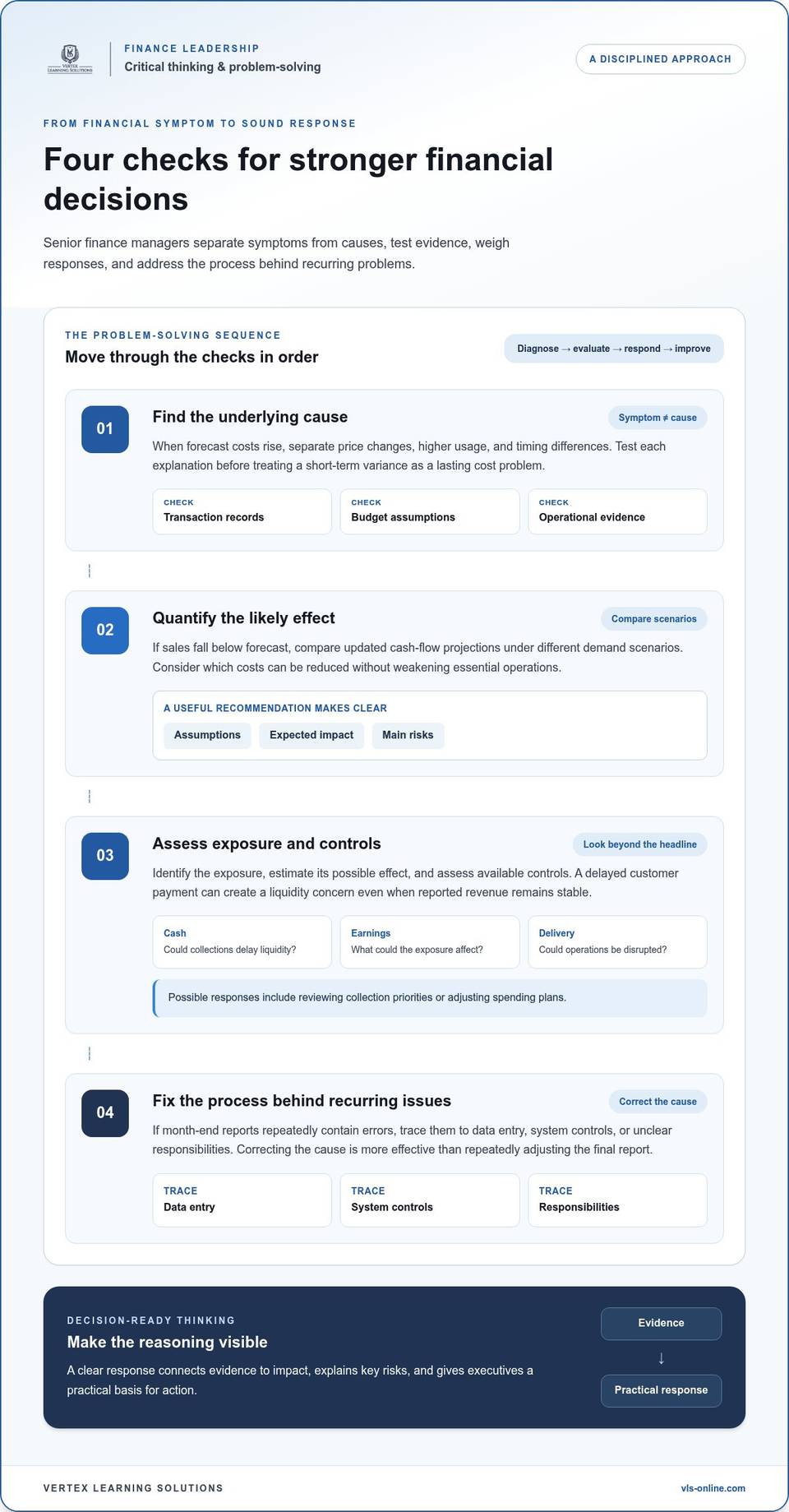
Senior finance managers use critical thinking to distinguish a financial symptom from its underlying cause. If forecast costs rise, separate price changes, higher usage, and timing differences. Then test each explanation against transaction records, budget assumptions, and operational evidence. This helps prevent a short-term variance from being mistaken for a lasting cost problem.
Next, quantify the likely effect of each response. If sales fall below forecast, for example, compare updated cash-flow projections under different demand scenarios. Assess which costs can be reduced without weakening essential operations. A recommendation should explain its assumptions, expected impact, and main risks, giving executives a clear basis for action.
Risk analysis requires the same disciplined approach. Identify the exposure, estimate how it could affect cash, earnings, or delivery, then assess available controls. A delayed customer payment, for instance, may create a liquidity concern even when reported revenue remains stable. Senior managers connect that finding to practical steps, such as reviewing collection priorities or adjusting spending plans.
Problem-solving also means improving the process behind recurring issues. If month-end reports repeatedly contain errors, trace them to data entry, system controls, or unclear responsibilities. Correcting the cause is more effective than repeatedly adjusting the final report. ACCA Audit and Assurance study can help build structured skills in evidence evaluation and control assessment, both useful when investigating financial risks and recommending sound responses.
3. Finance and accounting technical skills
The skills needed for a senior finance manager include interpreting financial statements, building forecasts, and using accounting systems effectively. These capabilities connect reported results with operational decisions. For example, revenue may rise while cash collections slow, putting pressure on working capital. A senior manager must assess both measures and determine what they mean for liquidity and upcoming commitments.
Strong technical judgment also means testing assumptions in budgets and financial models. Compare projected sales, supplier costs, and staffing plans with actual results, then explain which changes materially affect performance. Digital tools can speed up reporting, but managers still need to validate source data, investigate unusual movements, and ensure the results support a sound decision.
Risk management involves identifying financial exposures, assessing their potential impact, and applying appropriate controls. Senior finance managers maintain policies and procedures that protect financial integrity and understand the regulations and reporting standards relevant to their industry. Financial statements must comply with applicable standards, such as GAAP or IFRS, and other relevant reporting requirements.
Responsibilities also broaden with seniority. Finance managers commonly oversee operational budgets and reporting; senior finance managers provide broader analysis, oversee controls, and advise decision-makers. Finance directors typically set the wider financial direction and lead the overall function. The skills needed for a senior finance manager therefore combine technical depth with the ability to delegate routine work, challenge assumptions, and communicate material risks to leadership.
Vertex Learning Solutions: ACCA Business and Technology (BT)
Vertex Learning Solutions offers ACCA Business and Technology (BT) to help learners build a structured foundation in business and finance. If you want to strengthen your understanding before taking on more advanced responsibilities, ACCA Management Accounting (MA) and ACCA Financial Accounting (FA) develop knowledge relevant to budgets, financial records, and business decisions. ACCA Corporate and Business Law (LW) covers the legal framework that informs responsible business practice.
Learning materials include recorded lectures, exam-focused study notes, and interactive practice questions, alongside tutor support via WhatsApp and weekly live sessions. These resources can support a disciplined study routine while you develop your accounting knowledge. Visit vls-online.com to explore the available courses or contact Vertex Learning Solutions.
Build your next stage of finance leadership
Career development is most effective when each learning step addresses a capability you want to use in practice. Identify an area to strengthen, such as interpreting financial information or understanding how business decisions affect performance, then choose study that supports that goal. The skills needed for a senior finance manager develop through continued learning alongside professional experience.
Vertex Learning Solutions offers ACCA Business and Technology (BT), ACCA Management Accounting (MA), and ACCA Financial Accounting (FA) for learners building their knowledge of business and finance. Consider which foundation best matches your current responsibilities and future direction, then explore the available learning options.
Contact Vertex Learning Solutions to discuss your next step. A considered learning plan can help you move forward with greater clarity and confidence.